Huang Jinlan, Zhou Yue, Xu Hui, Wang Mingfu
Institute for Advanced Study, Shenzhen University, Shenzhen 518060, China.
College of Chemistry and Environmental Engineering, Shenzhen University, Shenzhen 518060, China.
Pharmaceuticals (Basel). 2025 Apr 8;18(4):544. doi: 10.3390/ph18040544.
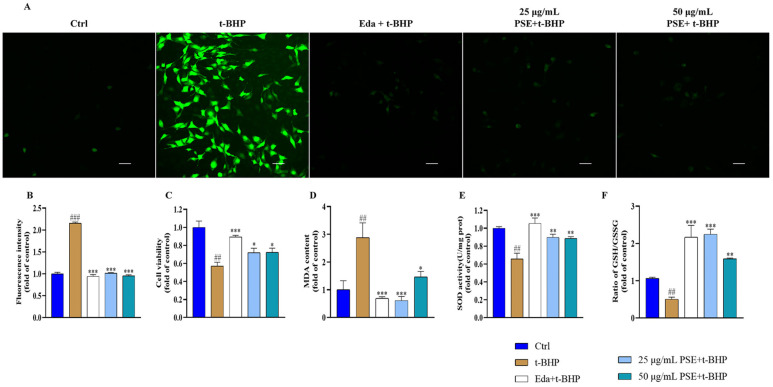
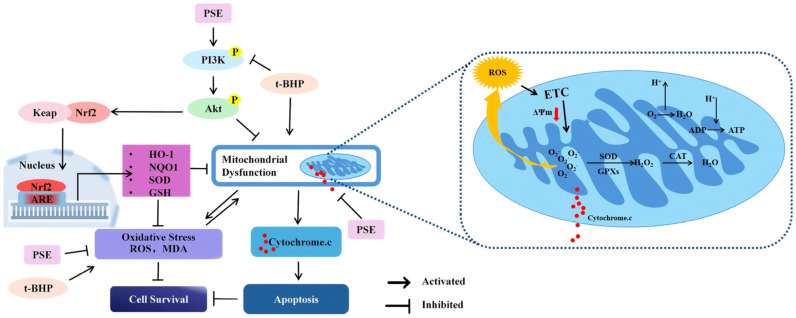
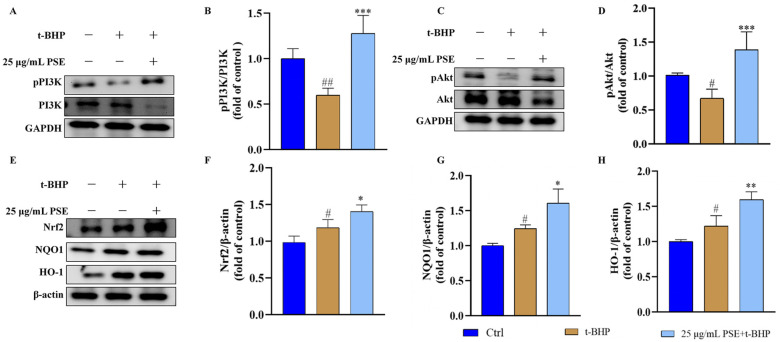
Oxidative stress is a key therapeutic target in neurological disorders. As processing wastes from the peanut industry, peanut skins are great sources of antioxidants and possess potential in neuroprotection. We prepared a peanut skin extract (PSE) and investigated its protective effects against tert-butyl hydroperoxide (t-BHP)-induced oxidative injury in HT-22 neuronal cells. PSE was rich in phenolic compounds (123.90 ± 0.46 mg GAE/g), comprising flavonoids (75.97 ± 0.23 mg RE/g) and proanthocyanidins (53.34 ± 1.58 mg PE/g), and displayed potent radical scavenging activities in chemical-based assays. In HT-22 cells, PSE pretreatment restored oxidative balance and endogenous antioxidant defense disrupted by t-BHP, as evidenced by significant reductions in ROS generation and lipid peroxidation levels, along with enhanced endogenous antioxidants. Specifically, 25 μg/mL PSE pretreatment reduced ROS levels by 53.03%, decreased MDA content by 78.82%, enhanced superoxide dismutase (SOD) activity by 12.42%, and improved the ratio of glutathione (GSH) to oxidized glutathione (GSSG) by 80.34% compared to the t-BHP group. Furthermore, PSE rescued mitochondrial membrane potential collapse, inhibited cytochrome c (Cyt.c) release, and prevented subsequent apoptotic death. Notably, the neuroprotective efficacy of PSE was comparable to that of edaravone, an approved neuroprotective drug. Mechanistic investigations combining network pharmacology and experimental validation revealed that the PI3K/Akt/Nrf2 signaling pathway played a pivotal role in mediating the neuroprotective effects of PSE. Compared to t-BHP-treated cells, 25 µg/mL PSE pretreatment significantly upregulated PI3K/Akt phosphorylation, the expression of Nrf2, and its downstream antioxidant proteins heme oxygenase-1 (HO-1) and NAD(P)H dehydrogenase quinone 1 (NQO1). Collectively, these findings demonstrate the potential of PSE as a natural protective agent against oxidative-related neurological disorders.
氧化应激是神经疾病的关键治疗靶点。作为花生行业的加工废料,花生皮是抗氧化剂的重要来源,具有神经保护潜力。我们制备了花生皮提取物(PSE),并研究了其对叔丁基过氧化氢(t-BHP)诱导的HT-22神经元细胞氧化损伤的保护作用。PSE富含酚类化合物(123.90±0.46毫克没食子酸当量/克),包括黄酮类化合物(75.97±0.23毫克芦丁当量/克)和原花青素(53.34±1.58毫克儿茶素当量/克),并在基于化学的检测中表现出强大的自由基清除活性。在HT-22细胞中,PSE预处理恢复了被t-BHP破坏的氧化平衡和内源性抗氧化防御,这表现为活性氧生成和脂质过氧化水平显著降低,同时内源性抗氧化剂增强。具体而言,与t-BHP组相比,25微克/毫升PSE预处理使活性氧水平降低了53.03%,丙二醛含量降低了78.82%,超氧化物歧化酶(SOD)活性提高了12.42%,谷胱甘肽(GSH)与氧化型谷胱甘肽(GSSG)的比值提高了80.34%。此外,PSE挽救了线粒体膜电位崩溃,抑制了细胞色素c(Cyt.c)释放,并防止了随后的凋亡死亡。值得注意的是,PSE的神经保护功效与已获批的神经保护药物依达拉奉相当。结合网络药理学和实验验证的机制研究表明,PI3K/Akt/Nrf2信号通路在介导PSE的神经保护作用中起关键作用。与t-BHP处理的细胞相比,25微克/毫升PSE预处理显著上调了PI3K/Akt磷酸化、Nrf2及其下游抗氧化蛋白血红素加氧酶-1(HO-1)和NAD(P)H脱氢酶醌1(NQO1)的表达。总的来说,这些发现证明了PSE作为一种天然保护剂对抗氧化相关神经疾病的潜力。