Choręziak Anna, Rzymski Piotr
Department of Environmental Medicine, Poznan University of Medical Sciences, 60-806 Poznań, Poland.
Nutrients. 2025 Apr 19;17(8):1377. doi: 10.3390/nu17081377.
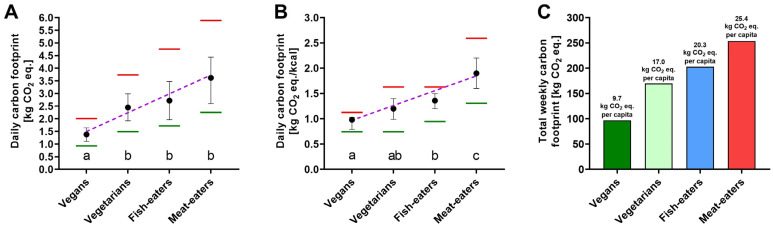
Analyzing the carbon footprint of diets in various populations is important as it can help identify more sustainable food choices that reduce the overall impact of human activities on ongoing warming of the global climate. This pilot exploratory study analyzed the carbon footprint (measured in kg of CO equivalent, eq.) using food diaries collected from Polish individuals with varying levels of animal-derived product exclusion in their diets. The study employed a food diary method, where participants from four dietary groups (vegan, vegetarian, fish-eater, and meat-eater) recorded all meals and beverages consumed over a 7-day period, including portion sizes and packaging details. These diaries were then analyzed to assess dietary adherence and calculate carbon footprints, utilizing standardized CO equivalent emission data from publicly available databases. The analysis revealed a decreasing trend in the carbon footprint corresponding to the degree of elimination of animal-derived products from the diet (R = 0.96, = 0.0217). The mean daily footprint in the vegan group was 1.38 kg CO eq., which was significantly lower than in the vegetarian (2.45), fish-eater (2.72), and meat-eater groups (3.62). For each 1000 kcal, the meat-eater diet generated 39.7, 58.3, and 93.9% more CO eq. than in the case of fish-eaters, vegetarians, and vegans, respectively. Over a week, a group of 10 vegans had a total carbon footprint lower than vegetarians, fish-eaters, and meat-eaters by 42.9, 52.2, and 61.8%, respectively. Hard and mozzarella cheese had the highest contribution to the carbon footprint in vegetarians, fish, and seafood in fish-eaters, and poultry, pork, and beef had the highest contribution in meat-eaters. Dietary carbon footprints vary considerably by dietary pattern, with lower consumption of animal-derived products associated with lower emissions. Additionally, identifying specific high-impact food items within each diet may inform strategies for reducing environmental impact across various eating patterns.
分析不同人群饮食的碳足迹很重要,因为这有助于确定更具可持续性的食物选择,从而减少人类活动对全球气候持续变暖的总体影响。这项试点探索性研究使用从波兰收集的食物日记分析了碳足迹(以千克二氧化碳当量,eq.为单位),这些日记来自饮食中动物源性产品排除程度不同的个体。该研究采用了食物日记法,来自四个饮食组(纯素食者、素食者、食鱼者和肉食者)的参与者记录了他们在7天内食用的所有餐食和饮料,包括份量大小和包装细节。然后利用公开数据库中的标准化二氧化碳当量排放数据对这些日记进行分析,以评估饮食依从性并计算碳足迹。分析显示,碳足迹随着饮食中动物源性产品的排除程度呈下降趋势(R = 0.96, = 0.0217)。纯素食组的平均每日碳足迹为1.38千克二氧化碳当量,明显低于素食组(2.45)、食鱼组(2.72)和肉食组(3.62)。每1000千卡热量,肉食者饮食产生的二氧化碳当量分别比食鱼者、素食者和纯素食者多39.7%、58.3%和93.9%。在一周时间里,一组10名纯素食者的总碳足迹分别比素食者、食鱼者和肉食者低42.9%、52.2%和61.8%。硬质奶酪和马苏里拉奶酪对素食者的碳足迹贡献最大,鱼类和海鲜对食鱼者的碳足迹贡献最大,而家禽、猪肉和牛肉对肉食者的碳足迹贡献最大。饮食碳足迹因饮食模式而异,动物源性产品消费量较低与排放量较低相关。此外,确定每种饮食中特定的高影响食物项目可能为减少各种饮食模式对环境影响的策略提供参考。