
使用基于生理药代动力学模型评估卡博特韦与OAT1/OAT3底物及UGT1A1/UGT1A9抑制剂的药物相互作用的矩阵法
Matrix Approach Assessment of Cabotegravir Drug-Drug Interactions with OAT1/OAT3 Substrates and UGT1A1/UGT1A9 Inhibitors Using Physiologically-Based Pharmacokinetic Modeling.
作者信息
Tracey Helen, Bate Simon T, Ford Susan, Patel Parul, Bloomer Jackie, Patel Aarti, Taskar Kunal S
机构信息
GSK, Stevenage SG1 2NY, UK.
GSK, Durham, NC 27701, USA.
出版信息
Pharmaceutics. 2025 Apr 18;17(4):531. doi: 10.3390/pharmaceutics17040531.
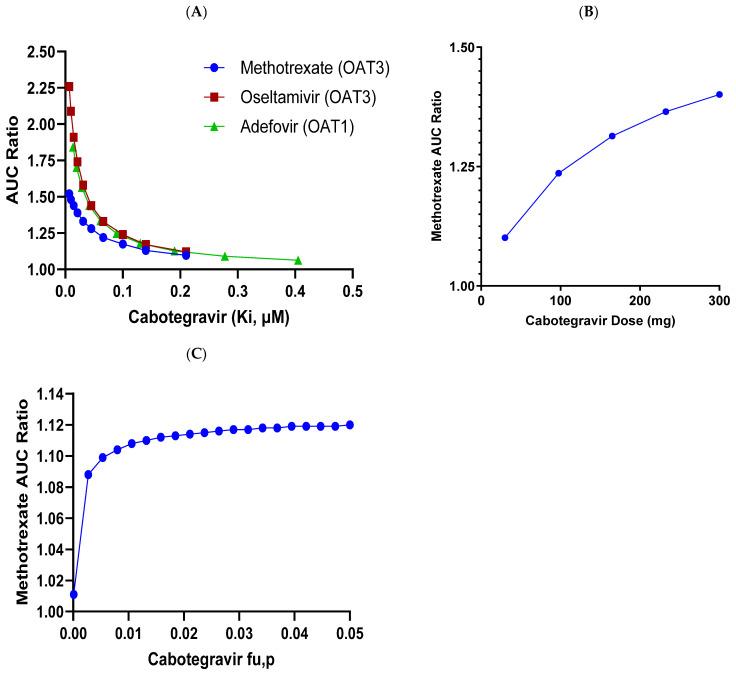
Cabotegravir (CAB), available as an oral tablet and as a long-acting (LA) nanosuspension for intramuscular injection, is approved as a combination therapy for the treatment, and as a monotherapy for the prevention, of HIV-1 infection. People living with HIV may receive multiple concomitant medications, with the associated risk of drug-drug interactions (DDIs). CAB is an inhibitor of OAT1/OAT3 renal transporters and a substrate of the UDP-glucuronosyltransferase enzymes UGT1A1 and 1A9, in vitro. While the effect of induction of UGT1A1/UGT1A9 on CAB exposure had been investigated in the clinic, the effect of the risk of DDIs with CAB via inhibition of these enzymes, or as an inhibitor of OAT1/OAT3 transporters, had not been evaluated. A physiologically-based pharmacokinetic (PBPK) model was developed and verified for orally dosed CAB to investigate the DDI risks associated with CAB, using a matrix approach to extensively qualify the PBPK platform and the substrates and/or inhibitors of either OAT1/OAT3 or UGT1A1/UGT1A9. The effect of uncertainties in in vitro inhibition values for OAT1/OAT3 was assessed via sensitivity analysis. A mean increase of less than 25% in systemic exposure for OAT1/OAT3 substrates was predicted, with the potential for an increase of up to 80% based on the sensitivity analysis. On co-dosing with UGT1A1/UGT1A9 inhibitors, the predicted mean increase in CAB exposure was within 11%. PBPK modelling indicated that clinically relevant DDIs are not anticipated with OAT1/3 substrates or UGT1A1/1A9 inhibitors and CAB. With maximal exposure of the LA formulation of CAB being lower than the oral, the results of these simulations can be extrapolated to LA injectable dosing.
卡博特韦(CAB)有口服片剂和用于肌肉注射的长效纳米混悬液两种剂型,被批准用于HIV-1感染的联合治疗及预防的单药治疗。HIV感染者可能会同时服用多种药物,存在药物相互作用(DDIs)的风险。体外实验表明,CAB是有机阴离子转运体1/3(OAT1/OAT3)的抑制剂,也是尿苷二磷酸葡萄糖醛酸基转移酶UGT1A1和1A9的底物。虽然临床上已经研究了UGT1A1/UGT1A9诱导对CAB暴露的影响,但尚未评估通过抑制这些酶或作为OAT1/OAT3转运体抑制剂与CAB发生DDIs的风险。建立并验证了口服给药CAB的基于生理的药代动力学(PBPK)模型,以研究与CAB相关的DDIs风险,采用矩阵方法全面验证PBPK平台以及OAT1/OAT3或UGT1A1/UGT1A9的底物和/或抑制剂。通过敏感性分析评估了OAT1/OAT3体外抑制值不确定性的影响。预计OAT1/OAT3底物的全身暴露平均增加不到25%,根据敏感性分析,最高可能增加80%。与UGT1A1/UGT1A9抑制剂合用时,预计CAB暴露的平均增加在11%以内。PBPK模型表明,OAT1/3底物或UGT1A1/1A9抑制剂与CAB之间预计不会出现具有临床意义的DDIs。由于CAB长效制剂的最大暴露量低于口服制剂,这些模拟结果可外推至长效注射给药。


 Zotero 插件