McCarter Maggie, Self Stella C W, Li Huixuan, Ewing Joseph A, Gual-Gonzalez Lídia, Kanyangarara Mufaro, Nolan Melissa S
Department of Epidemiology and Biostatistics, Arnold School of Public Health, University of South Carolina, 915 Greene Street, Columbia, SC 29208, USA.
Data Support Core, Prisma Health, 701 Grove Rd, Greenville, SC 29605, USA.
Microorganisms. 2025 Apr 3;13(4):812. doi: 10.3390/microorganisms13040812.
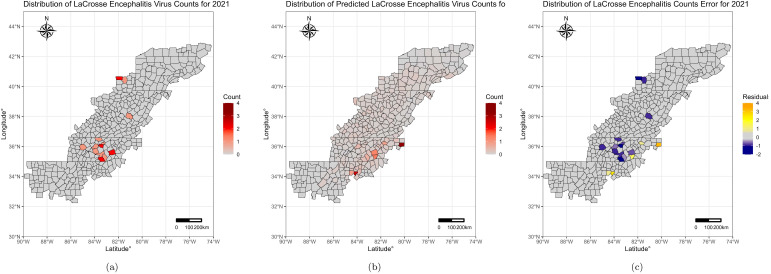
La Crosse virus (LACV) is a rare cause of pediatric encephalitis, yet identifying and mitigating transmission foci is critical to detecting additional cases. Neurologic disease disproportionately occurs among children, and survivors often experience substantial, life-altering chronic disability. Despite its severe clinical impact, public health resources to detect and mitigate transmission are lacking. This study aimed to design a Bayesian modelling approach to effectively identify and predict LACV incidence for geospatially informed public health interventions. A Bayesian negative binomial spatio-temporal regression model best fit the data and demonstrated high accuracy. Nine variables were statistically significant in predicting LACV incidence for the Appalachian Mountain Region. Proportion of children, proportion of developed open space, and proportion of barren land were positively associated with LACV incidence, while vapor pressure deficit index, year, and proportions of developed high intensity land, evergreen forest, hay pasture, and woody wetland were negatively associated with LACV incidence. Model prediction error was low, less than 2%, indicating high accuracy in predicting annual LACV human incidence at the county level. In summary, this study demonstrates the utility of Bayesian negative binomial spatio-temporal regression models for predicting rare but medically important LACV human cases. Future studies could examine more granular models for predicting LACV cases from localized variables such as mosquito control efforts, local reservoir host density and local weather fluctuations.
拉克罗斯病毒(LACV)是小儿脑炎的罕见病因,但识别并减轻传播源对于发现更多病例至关重要。神经系统疾病在儿童中更为常见,幸存者往往会经历严重的、改变生活的慢性残疾。尽管其临床影响严重,但缺乏用于检测和减轻传播的公共卫生资源。本研究旨在设计一种贝叶斯建模方法,以有效地识别和预测拉克罗斯病毒的发病率,为地理空间信息的公共卫生干预措施提供依据。贝叶斯负二项式时空回归模型与数据拟合度最佳,且显示出高准确性。九个变量在预测阿巴拉契亚山区拉克罗斯病毒发病率方面具有统计学意义。儿童比例、已开发开放空间比例和荒地比例与拉克罗斯病毒发病率呈正相关,而水汽压亏缺指数、年份以及高强度开发土地、常绿森林、干草牧场和木质湿地的比例与拉克罗斯病毒发病率呈负相关。模型预测误差较低,小于2%,表明在县级预测拉克罗斯病毒的年度人类发病率具有较高的准确性。总之,本研究证明了贝叶斯负二项式时空回归模型在预测罕见但具有医学重要性的拉克罗斯病毒人类病例方面的实用性。未来的研究可以研究更精细的模型,以便根据蚊虫控制措施、当地宿主密度和当地天气波动等局部变量来预测拉克罗斯病毒病例。