Sun Kaiqiang, Zhao Ningbin, Shi Peizheng, Sun Zhuang, Ye Chen, Fu Li, Dai Dan, Chu Wubo, Cai Tao, Tsai Hsu-Sheng, Lin Cheng-Te
School of Materials Science and Chemical Engineering, Ningbo University, Ningbo 315211, China.
Qianwan Institute, Ningbo Institute of Materials Technology and Engineering (NlMTE), Chinese Academy of Sciences, Ningbo 315201, China.
Sensors (Basel). 2025 Apr 17;25(8):2547. doi: 10.3390/s25082547.
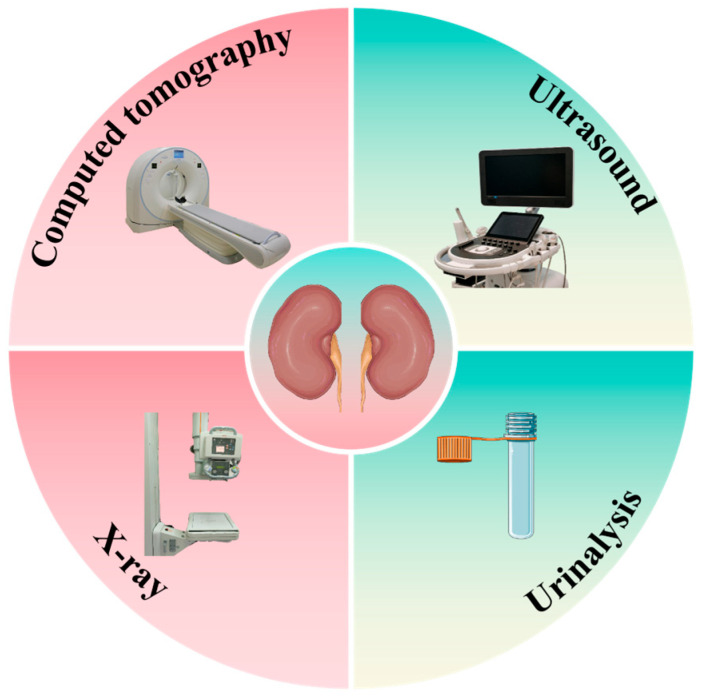
Nephrolithiasis (kidney stone disease) continues to pose a significant global health challenge, affecting millions of individuals and placing substantial economic pressures on healthcare systems. Traditional diagnostic methods-such as computed tomography (CT), ultrasound, and basic urinalysis-are often limited by issues including radiation exposure, lower sensitivity in detecting small stones, operator dependency, and the inability to provide real-time analysis. In response, electrochemical sensors have emerged as innovative and powerful tools capable of the rapid, sensitive, and specific detection of key biomarkers associated with nephrolithiasis. This review highlights the advances in electrochemical approaches for monitoring oxalate and uric acid, the two primary metabolites implicated in kidney stone formation. We discuss the principles of electrode design and fabrication, including nanomaterial integration, 3D printing, and molecular imprinting, which have markedly improved detection limits and selectivity. Furthermore, we critically evaluate the practical challenges-such as sensor fouling, reproducibility, and stability in complex biological matrices-that currently impede widespread clinical implementation. The potentials for miniaturization and point-of-care integration are emphasized, with an eye toward continuous or home-based monitoring systems that can offer personalized insights into risk of stone formation and progression. By consolidating recent findings and exploring future trends in multi-analyte detection and wearable diagnostics, this review provides a roadmap for translating electrochemical sensors from research laboratories to routine clinical practice, ultimately aiming to enhance early intervention and improve patient outcomes in nephrolithiasis.
肾结石病(肾结石疾病)仍然是一项重大的全球健康挑战,影响着数百万人,并给医疗系统带来巨大的经济压力。传统的诊断方法,如计算机断层扫描(CT)、超声和基本尿液分析,往往受到包括辐射暴露、检测小结石时灵敏度较低、操作人员依赖性以及无法提供实时分析等问题的限制。作为回应,电化学传感器已成为能够快速、灵敏且特异性地检测与肾结石病相关的关键生物标志物的创新且强大的工具。本综述重点介绍了用于监测草酸和尿酸这两种与肾结石形成有关的主要代谢物的电化学方法的进展。我们讨论了电极设计和制造的原理,包括纳米材料整合、3D打印和分子印迹,这些显著提高了检测限和选择性。此外,我们批判性地评估了目前阻碍广泛临床应用的实际挑战,如传感器污染、重现性以及在复杂生物基质中的稳定性。强调了小型化和即时检测整合的潜力,着眼于能够提供关于结石形成和进展风险的个性化见解的连续或家庭式监测系统。通过整合近期研究结果并探索多分析物检测和可穿戴诊断的未来趋势,本综述为将电化学传感器从研究实验室转化为常规临床实践提供了路线图,最终目标是加强早期干预并改善肾结石病患者的治疗效果。