Rim Austin J, Liu Chang, Jackson Mekensie, Miller James T, Chukwumerije Nkemka, El Chami Rayan, Ibrahim Rand, Kauser Tanveer, Miller Arthur, Simpson Erin, Vaughn W Larsen, Galante Angelo, Clark Craig, Putukian Margot, Grashow Rachel, Baggish Aaron L, Kim Jonathan H
Emory Clinical Cardiovascular Research Institute, Division of Cardiology, Emory University School of Medicine, Atlanta, Georgia, USA.
Emory Clinical Cardiovascular Research Institute, Division of Cardiology, Emory University School of Medicine, Atlanta, Georgia, USA; Department of Epidemiology, Rollins School of Public Health, Emory University, Atlanta, Georgia, USA.
JACC Adv. 2025 Mar 24;4(5):101717. doi: 10.1016/j.jacadv.2025.101717.
Concussions sustained during American-style football (ASF) participation are common. Whether concussions are associated with cardiovascular risk is unknown.
The authors sought to determine whether concussions sustained during collegiate ASF participation lead to increases in systolic blood pressure (SBP) and acquired maladaptive cardiovascular phenotypes.
In a longitudinal and case-controlled analysis, ASF athletes at 2 National Collegiate Athletic Association Division-I programs were followed for up to 2 years with cardiovascular assessments including BP, echocardiography, and vascular applanation tonometry. ASF athletes who sustained clinically diagnosed concussions were compared to weight and player position-matched controls without concussions.
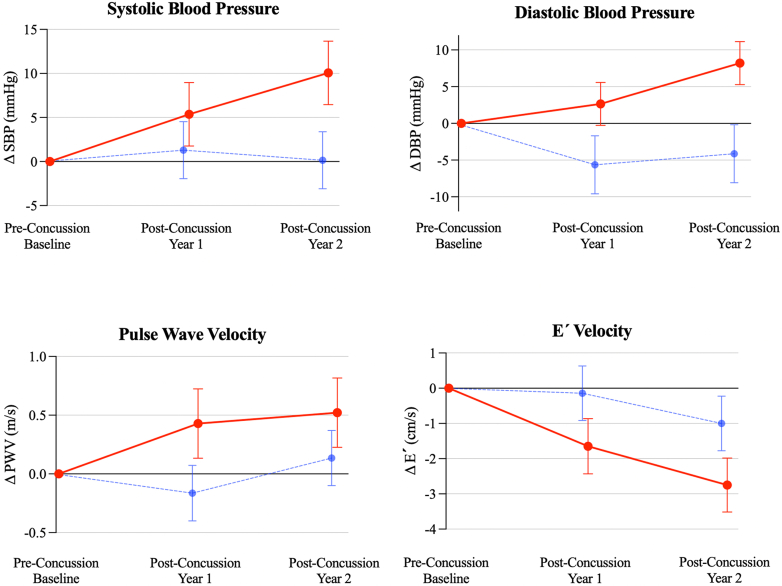
Thirty-nine ASF athletes who sustained concussions (preconcussion baseline: [SBP] 129.6 ± 13.6 mm Hg) and 39 weight and player position-matched controls (preconcussion baseline: [SBP] 131.6 ± 13.1 mm Hg) were followed for 1 season postconcussion; 14 of these pairs were followed through 2 seasons. After 1 season, increased pulse wave velocity (PWV) (case Δ = 0.4 [0.2] m/s, P = 0.036; control Δ = -0.1 [0.1] m/s, P = 0.38) was observed among cases. Among the case and control pairs followed over 2 seasons, increased SBP (case Δ = 10.1 [3.6] mm Hg, P < 0.01; control Δ = 0.1 [3.2] mm Hg, P = 0.97) and diastolic blood pressure (case Δ = 8.2 [2.9] mm Hg, P < 0.01; control Δ = -4.1 [4.0] mm Hg, P = 0.30) and decreased É (case Δ = -2.8 [0.8] cm/s, P = 0.001; control Δ = -1.0 [0.8] cm/s, P = 0.21) were observed among cases. Over 1 season, concussions were associated with higher PWV (β = 0.33 [95% CI: 0.09-0.56], P = 0.007). Among athletes followed over 2 seasons, concussions were associated with higher PWV (β = 0.42 [95% CI: 0.05-0.78], P = 0.03), diastolic blood pressure (β = 5.89 [95% CI: 1.23-10.54], P = 0.01), LV mass index (β = 11.01 [95% CI: 6.13-15.90], P < 0.001), and lower É (β = -2.11 [95% CI: -3.27 to -0.95], P < 0.001).
Concussions sustained during collegiate ASF participation are independently associated with markers of cardiovascular risk and acquired maladaptive cardiovascular phenotypes. Clinical ASF concussion management strategies inclusive of careful BP surveillance may lead to early identification of hypertension.
参加美式橄榄球(ASF)运动时遭受脑震荡很常见。脑震荡是否与心血管风险相关尚不清楚。
作者试图确定在大学ASF运动中遭受的脑震荡是否会导致收缩压(SBP)升高和获得性适应性不良心血管表型。
在一项纵向病例对照分析中,对2个美国国家大学体育协会第一分区项目的ASF运动员进行了长达2年的随访,进行了包括血压、超声心动图和血管压平眼压测量在内的心血管评估。将临床诊断为脑震荡的ASF运动员与体重和球员位置匹配的未患脑震荡的对照组进行比较。
39名遭受脑震荡的ASF运动员(脑震荡前基线:[SBP]129.6±13.6mmHg)和39名体重和球员位置匹配的对照组(脑震荡前基线:[SBP]131.6±13.1mmHg)在脑震荡后随访了1个赛季;其中14对随访了2个赛季。1个赛季后,病例组观察到脉搏波速度(PWV)增加(病例组Δ=0.4[0.2]m/s,P=0.036;对照组Δ=-0.1[0.1]m/s,P=0.38)。在随访2个赛季的病例组和对照组中,病例组观察到收缩压升高(病例组Δ=10.1[3.6]mmHg,P<0.01;对照组Δ=0.1[3.2]mmHg,P=0.97)、舒张压升高(病例组Δ=8.2[2.9]mmHg,P<0.01;对照组Δ=-4.1[4.0]mmHg,P=0.30)和E波降低(病例组Δ=-2.8[0.8]cm/s,P=0.001;对照组Δ=-1.0[0.8]cm/s,P=0.21)。在1个赛季中,脑震荡与较高的PWV相关(β=0.33[95%CI:0.09-0.56],P=0.007)。在随访2个赛季的运动员中,脑震荡与较高的PWV(β=0.42[95%CI:0.05-0.78],P=0.03)、舒张压(β=5.89[95%CI:1.23-10.54],P=0.01)、左心室质量指数(β=11.01[95%CI:6.13-15.90],P<0.001)和较低的E波(β=-2.11[95%CI:-3.27至-0.95],P<0.001)相关。
在大学ASF运动中遭受的脑震荡与心血管风险标志物和获得性适应性不良心血管表型独立相关。包括仔细监测血压在内的临床ASF脑震荡管理策略可能有助于早期识别高血压。