Zhao Qiuchen, Pramanik Jhuma, Lu Yongjin, Homer Natalie Z M, Imianowski Charlotte J, Zhang Baojie, Iqbal Muhammad, Shaji Sanu Korumadathil, Morris Andrew Conway, Roychoudhuri Rahul, Okkenhaug Klaus, Qiu Pengfei, Mahata Bidesh
Department of Pathology, University of Cambridge, Cambridge, CB2 1QP, UK.
Cancer Research UK Cambridge Centre and Department of Oncology, University of Cambridge, Cambridge, CB2 0XZ, UK.
Nat Commun. 2025 Apr 26;16(1):3945. doi: 10.1038/s41467-025-59356-3.
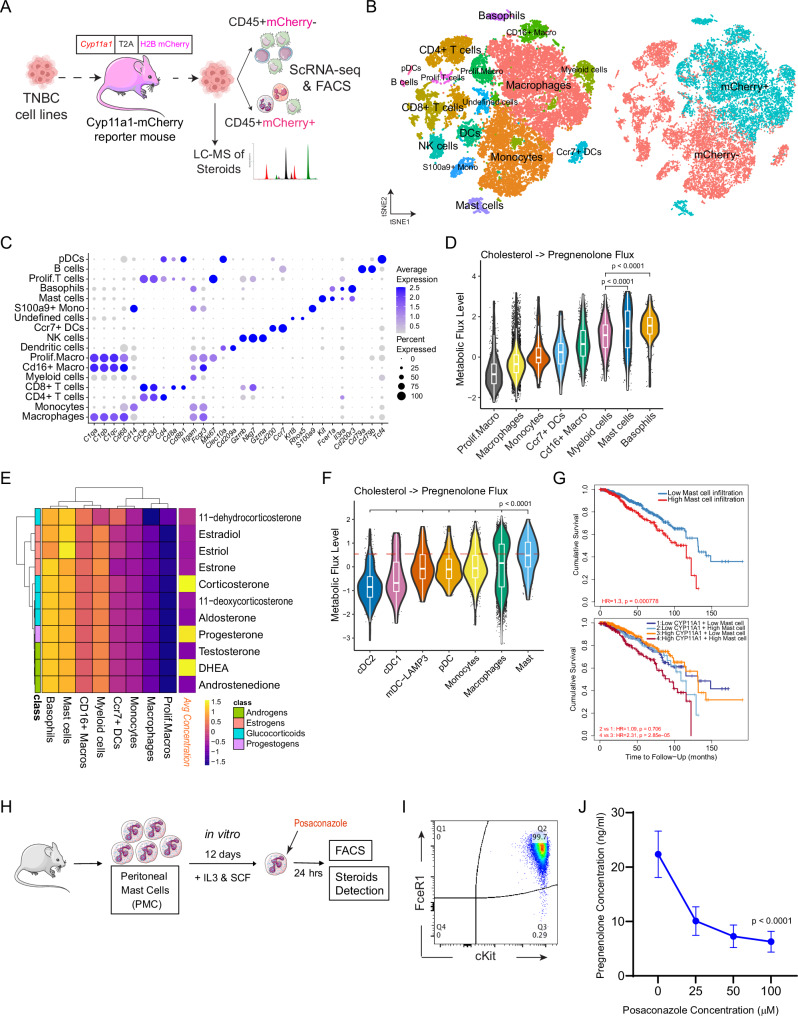
Breast cancer, particularly triple-negative breast cancer (TNBC), evades the body's immune defences, in part by cultivating an immunosuppressive tumour microenvironment. Here, we show that suppressing local steroidogenesis can augment anti-tumour immunity against TNBC. Through targeted metabolomics of steroids coupled with immunohistochemistry, we profiled the existence of immunosuppressive steroids in TNBC patient tumours and discerned the steroidogenic activity in immune-infiltrating regions. In mouse, genetic inhibition of immune cell steroidogenesis restricted TNBC tumour progression with a significant reduction in immunosuppressive components such as tumour associated macrophages. Steroidogenesis inhibition appears to bolster anti-tumour immune responses in dendritic and T cells by impeding glucocorticoid signalling. Undertaking metabolic modelling of the single-cell transcriptomics and targeted tumour-steroidomics, we pinpointed the predominant steroidogenic cells. Inhibiting steroidogenesis pharmacologically using a identified drug, posaconazole, curtailed tumour expansion in a humanised TNBC mouse model. This investigation paves the way for targeting steroidogenesis and its signalling pathways in breast cancer affected by immune-steroid maladaptation.
乳腺癌,尤其是三阴性乳腺癌(TNBC),会通过营造免疫抑制性肿瘤微环境来部分逃避机体的免疫防御。在此,我们表明抑制局部类固醇生成可增强针对TNBC的抗肿瘤免疫力。通过类固醇靶向代谢组学结合免疫组织化学,我们分析了TNBC患者肿瘤中免疫抑制性类固醇的存在情况,并识别了免疫浸润区域中的类固醇生成活性。在小鼠中,免疫细胞类固醇生成的基因抑制限制了TNBC肿瘤进展,肿瘤相关巨噬细胞等免疫抑制成分显著减少。类固醇生成抑制似乎通过阻碍糖皮质激素信号传导来增强树突状细胞和T细胞中的抗肿瘤免疫反应。通过对单细胞转录组学和靶向肿瘤类固醇组学进行代谢建模,我们确定了主要的类固醇生成细胞。使用已鉴定的药物泊沙康唑进行药理学抑制类固醇生成,可减少人源化TNBC小鼠模型中的肿瘤生长。这项研究为针对受免疫-类固醇适应不良影响的乳腺癌中的类固醇生成及其信号通路提供了途径。