Alruwaili Muharib, Alhassan Hassan H, Almutary Hayfa, Tahir Ul Qamar Muhammad
Department of Clinical Laboratory Sciences, College of Applied Medical Sciences, Jouf University, Sakaka, Al-Jouf, 72388, Saudi Arabia.
Medical Surgical Nursing Department, Faculty of Nursing, King Abdulaziz University, Jeddah, Saudi Arabia.
Sci Rep. 2025 Apr 28;15(1):14824. doi: 10.1038/s41598-025-98516-9.
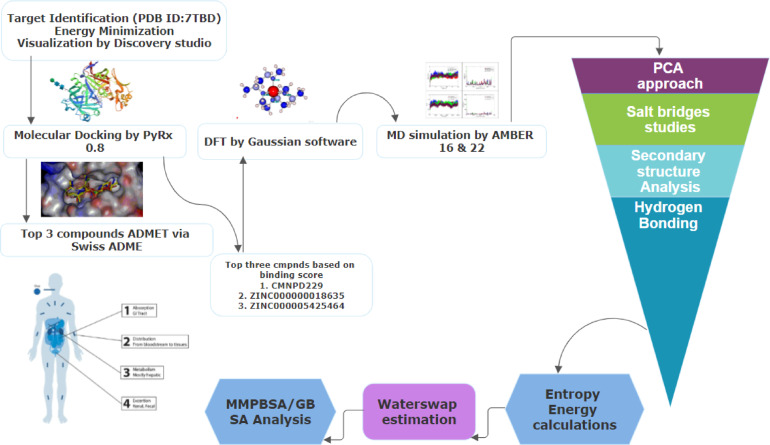
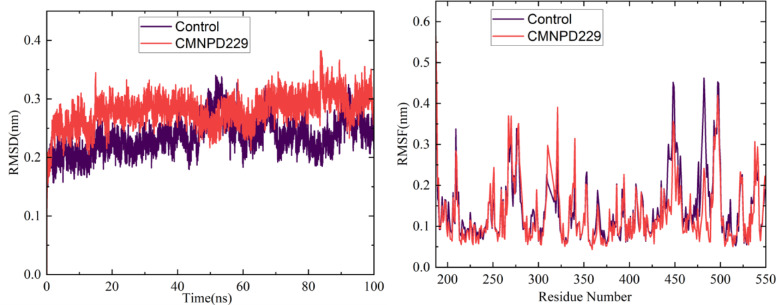
Malaria is a parasitic disease that has caused suffering to humans since ancient times and remains a major public health concern in tropical and subtropical regions.The development of novel antimalarials therefore becomes of utmost importance by targeting aspartic protease. The computational study utilized a molecular docking approach to identify hit compounds. In this stuyda molecular docking approach was employed to identify potential hit compounds. The molecular docking analysis yielded three hit compounds CMNPD229, ZINC000000018635, and ZINC000005425464 along with the reference drug chloroquine, with binding energy scores of -8.1 kcal/mol, -8.0 kcal/mol, -7.8 kcal/mol, and - 6.8 kcal/mol, respectively. These compounds were further to assess their potential as optimal drug candidates. Subsequently density function theory (DFT) was performed. Afterward, the protein-ligand (PL) complexes were subjected to molecular dynamic simulation (MDS) to identify the stability and rigidity of the complexes in a fleeting and dynamic setting. The complex CMNPD229 exhibited good stability followed by ZINC000000018635, ZINC000005425464, and the Control. The compounds showed good MM-PBSA/GBSA, WaterSwap, and entropy energy values. The calculated MM-PBSA/GBSA binding free energy scores were - 120.78 kcal/mol, -107.16 kcal/mol, -91.00 kcal/mol, and - 97.49 kcal/mol for CMNPD229, ZINC000000018635, ZINC000005425464, and the reference drug, respectively.Additionally, salt bridge analysis and secondary structure evaluation revealed that CMNPD229 formed the highest number of interactions (Glu290-Arg23 and Glu305-Lys306), indicating its stability as a potential drug candidate. This study suggests that CMNPD229 holds promise as a potent antimalarial drug by effectively inhibiting Plasmodium falciparum and Plasmodium vivax aspartic proteases.
疟疾是一种寄生虫病,自古以来就给人类带来痛苦,在热带和亚热带地区仍然是一个主要的公共卫生问题。因此,通过靶向天冬氨酸蛋白酶来开发新型抗疟药变得至关重要。该计算研究采用分子对接方法来识别有活性的化合物。在本研究中,采用分子对接方法来识别潜在的有活性化合物。分子对接分析产生了三种有活性化合物CMNPD229、ZINC000000018635和ZINC000005425464以及参考药物氯喹,其结合能分数分别为-8.1千卡/摩尔、-8.0千卡/摩尔、-7.8千卡/摩尔和-6.8千卡/摩尔。这些化合物被进一步评估其作为最佳候选药物的潜力。随后进行了密度泛函理论(DFT)计算。之后,对蛋白质-配体(PL)复合物进行分子动力学模拟(MDS),以确定复合物在短暂和动态环境中的稳定性和刚性。复合物CMNPD229表现出良好的稳定性,其次是ZINC000000018635、ZINC000005425464和对照物。这些化合物显示出良好的MM-PBSA/GBSA、WaterSwap和熵能值。计算得到的CMNPD229、ZINC000000018635、ZINC000005425464和参考药物的MM-PBSA/GBSA结合自由能分数分别为-120.78千卡/摩尔、-107.16千卡/摩尔、-91.00千卡/摩尔和-97.49千卡/摩尔。此外,盐桥分析和二级结构评估表明,CMNPD229形成的相互作用数量最多(Glu290-Arg23和Glu305-Lys306),表明其作为潜在候选药物的稳定性。这项研究表明,CMNPD229有望成为一种有效的抗疟药物,通过有效抑制恶性疟原虫和间日疟原虫的天冬氨酸蛋白酶发挥作用。