Kong Youli, Luo Qian, Zhang Qing, Wei Quan
Rehabilitation Medicine Center and Institute of Rehabilitation Medicine, West China Hospital, Sichuan University, Chengdu, 610041, China.
Key Laboratory of Rehabilitation Medicine in Sichuan Province, West China Hospital, Sichuan University, Chengdu, 610041, China.
Diabetol Metab Syndr. 2025 Apr 28;17(1):142. doi: 10.1186/s13098-025-01705-9.
Among noncommunicable diseases, cardiovascular disease (CVD) is the leading cause of mortality and morbidity. In China, diabetes is renowned for its high incidence rate, and the body roundness index (BRI) is an emerging indicator for assessing obesity, particularly abdominal obesity. High BRI may lead to new-onset CVD events. However, the relationships between the BRI and new-onset CVD in individuals with or without diabetes remain unclear.
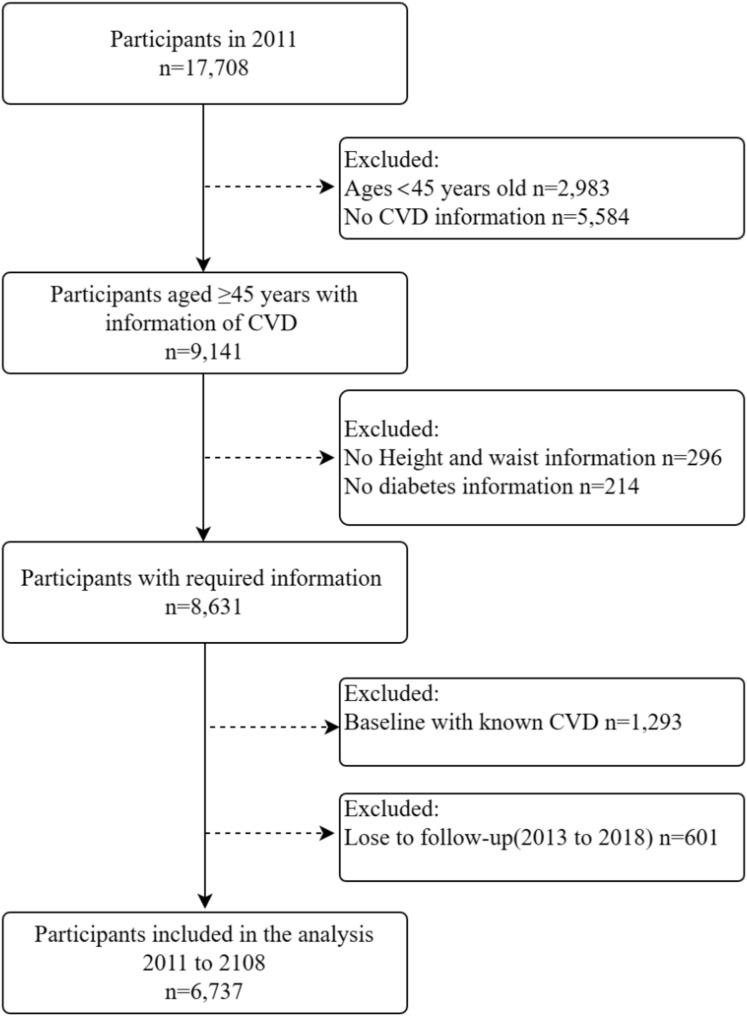
Data for this analysis were extracted from the China Health and Retirement Longitudinal Study (CHARLS). Our research utilized a cohort that was meticulously assessed over a period from 2011 to 2018, encompassing a comprehensive follow-up of 17,708 participants. Ultimately, this study focused on a subset of 6,737 individuals aged 45 years or older. Methodological approaches include Cox regression, Kaplan-Meier survival analysis, restricted cubic splines (RCS) analysis, receiver operating characteristic (ROC) curve analysis, subgroup analysis, and mediation analysis to explore the relationships of interest.
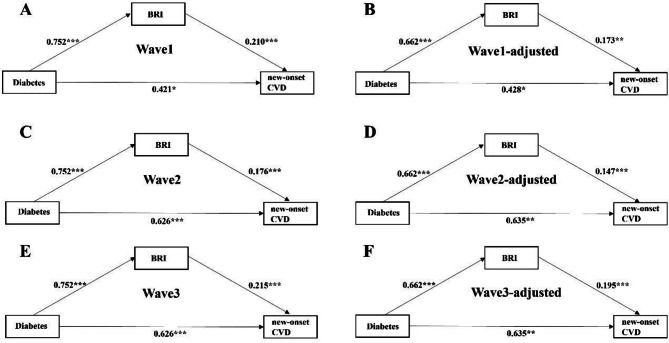
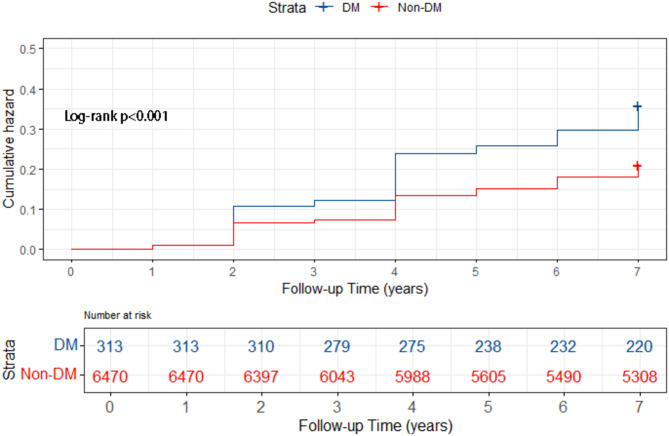
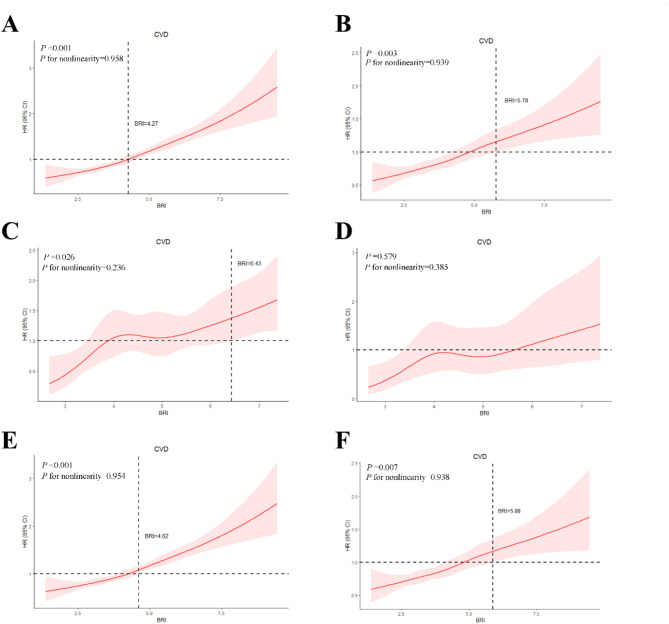
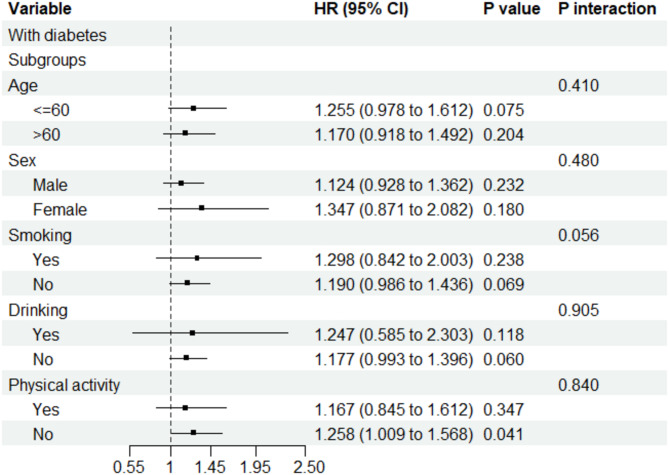
This study included 6,737 participants, all of whom were above the age of 45. Our findings revealed that within this demographic group, 1,481 (22.0%) patients experienced new-onset CVD. The Kaplan-Meier survival analysis further revealed that the group characterized by non-diabetes mellitus (Non-DM) had the lowest cumulative incidence of CVD compared with the diabetes mellitus (DM) group. Multivariate Cox regression revealed that in the fully adjusted model (Model 3) (HR = 1.122, 95% CI = 1.080 to 1.167), BRI was associated with the risk of CVD in the Non-DM group during the three-wave follow-up. RCS analysis revealed a positive, linear-like dose‒dependent relationship between BRI and new-onset CVD in Non-DM patients (P = 0.007, P for nonlinearity = 0.938). Smoking could affect the ability of the BRI to predict the incidence rate of CVD in the total population and in the population without diabetes (P interaction = 0.007). Moreover, the mediating effect of the BRI on new-onset CVD among diabetic patients was particularly pronounced in the long term, exceeding 4 years.
Our findings demonstrate a significant association between the BRI and CVD risk in non-diabetic individuals, with diabetes influencing the incidence and risk of new-onset CVD in middle-aged and elderly Chinese populations through the BRI playing a mediating role. As an obesity indicator, the BRI provides a valuable tool for early detection and intervention of CVD.
Not applicable.
在非传染性疾病中,心血管疾病(CVD)是导致死亡和发病的主要原因。在中国,糖尿病以其高发病率而闻名,身体圆润指数(BRI)是评估肥胖尤其是腹部肥胖的一个新兴指标。高BRI可能导致新发CVD事件。然而,在有或没有糖尿病的个体中,BRI与新发CVD之间的关系仍不清楚。
本分析的数据取自中国健康与养老追踪调查(CHARLS)。我们的研究使用了一个在2011年至2018年期间经过精心评估的队列,对17708名参与者进行了全面随访。最终,本研究聚焦于6737名45岁及以上的个体子集。方法包括Cox回归、Kaplan-Meier生存分析、限制性立方样条(RCS)分析、受试者工作特征(ROC)曲线分析、亚组分析和中介分析,以探索感兴趣的关系。
本研究纳入了6737名参与者,均为45岁以上。我们的研究结果显示,在这一人群中,1481名(22.0%)患者发生了新发CVD。Kaplan-Meier生存分析进一步显示,与糖尿病(DM)组相比,非糖尿病(Non-DM)组的CVD累积发病率最低。多变量Cox回归显示,在完全调整模型(模型3)(HR = 1.122,95%CI = 1.080至1.167)中,在三波随访期间,BRI与Non-DM组的CVD风险相关。RCS分析显示,Non-DM患者中BRI与新发CVD之间存在正的、类似线性的剂量依赖性关系(P = 0.007,非线性P = 0.938)。吸烟会影响BRI预测总人口和无糖尿病人群中CVD发病率的能力(P交互作用 = 0.007)。此外,BRI对糖尿病患者新发CVD的中介作用在长期(超过4年)尤为明显。
我们的研究结果表明,在非糖尿病个体中,BRI与CVD风险之间存在显著关联,糖尿病通过BRI发挥中介作用影响中国中老年人群中新发CVD的发病率和风险。作为一种肥胖指标,BRI为CVD的早期检测和干预提供了一个有价值的工具。
不适用。