Ali Haider, Wadas Jakub, Bendoumou Maryam, Chen Heng-Chang, Maiuri Paolo, Dutilleul Antoine, Selberg Simona, Nestola Lorena, Lalik Kamil, Avettand-Fenoël Veronique, Necsoi Coca, Marcello Alessandro, Kankuri Esko, Karelson Mati, De Wit Stéphane, Pyrc Krzysztof, Pasternak Alexander O, Van Lint Carine, Kula-Pacurar Anna
Laboratory of Molecular Virology, Malopolska Centre of Biotechnology, Jagiellonian University, Kraków, Poland.
Doctoral School of Exact and Natural Sciences, Jagiellonian University, Kraków, Poland.
Virol J. 2025 Apr 28;22(1):124. doi: 10.1186/s12985-025-02744-4.
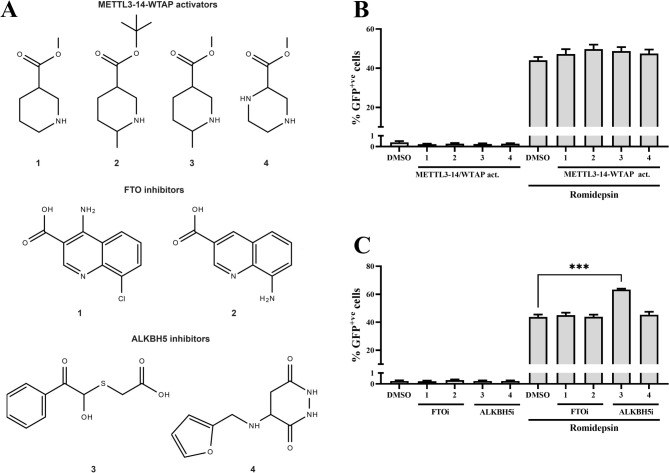
Current latency-reversing agents (LRAs) employed in the "shock-and-kill" strategy primarily focus on relieving epigenetic and transcriptional blocks to reactivate the latent HIV-1. However, their clinical efficacy is limited, partly due to their inability to fully reverse latency and the lack of LRAs specifically targeting post-transcriptional mechanisms. N6-methyladenosine (mA) modification in HIV-1 RNA is emerging as an important post-transcriptional regulator of HIV-1 gene expression, yet its role in latency and reactivation remains largely unrecognized. Here, we explored the potential of small chemical compounds targeting the mA pathway, specifically investigating the inhibition of ALKBH5 and its effect on latent HIV-1 reactivation mediated by the LRA romidepsin.
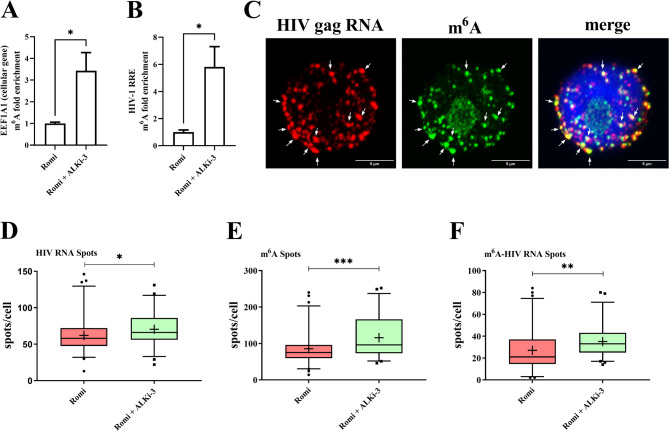
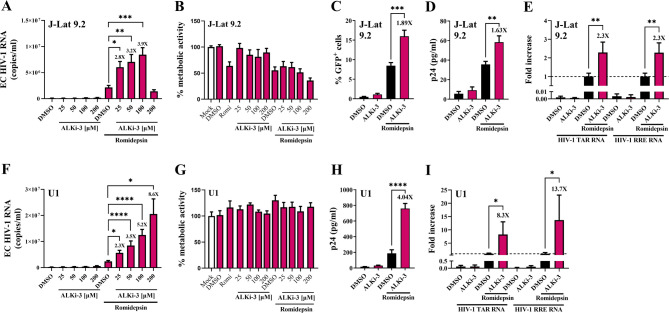
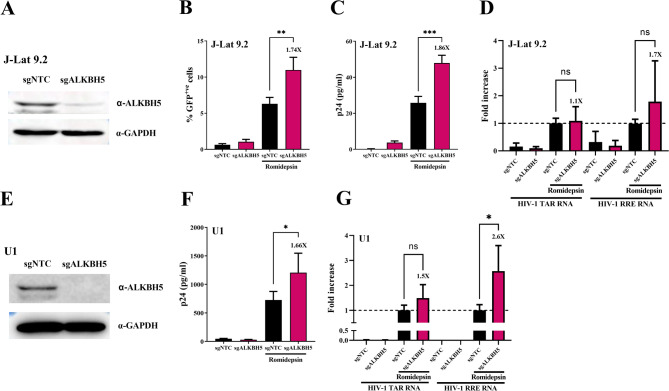
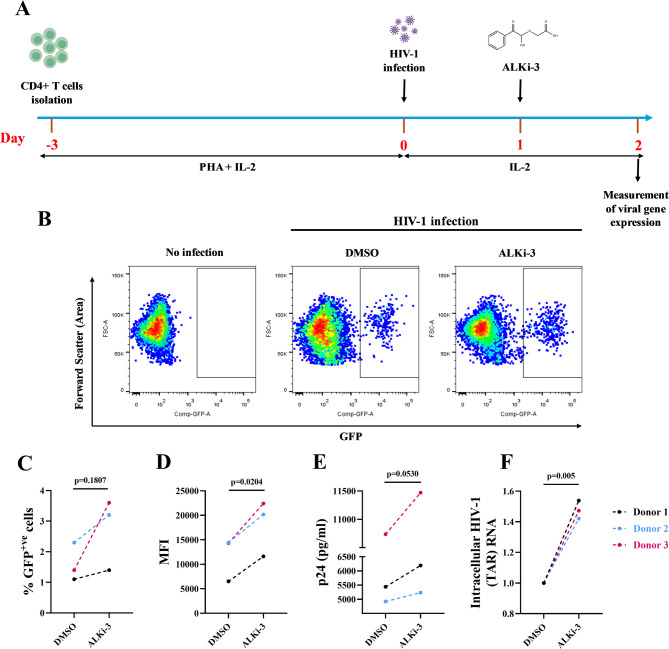
We used four in vitro cellular models of latency, primary model of CD4 T cells HIV-1 infection and ex vivo cultures of CD8-depleted PMBCs from ART-treated HIV patients. We measured latent viral reactivation by evaluating the expression of reporter protein GFP by flow cytometry, viral production by CA-p24 ELISA, and viral transcripts by RT-qPCR. CRISPR/Cas9 method was used to deplete ALKBH5. MeRIP and immuno-RNA FISH were used to address the mA methylation levels on HIV-1 RNA upon ALKBH5 inhibition.
We showed that ALKBH5 inhibitor 3 (ALKi-3) potentiated romidepsin-mediated viral reactivation in in vitro models of latency, primary model of CD4 T cells infected with HIV-1 as well as in ex vivo cultures of CD8-depleted PBMCs from ART-treated HIV patients. CRISPR/Cas9-mediated depletion of ALKBH5 mimicked the effects of ALKi-3. ALKi-3 increased levels of mA-methylated HIV-1 RNA as shown by meRIP and immuno-RNA FISH.
Our study provides a proof-of-concept for the modulation of the mA pathway in enhancing HIV-1 reactivation. This approach represents a promising adjunct to existing reactivation protocols and provides a concept of "dual-kick", aiming to target transcriptional and post-transcriptional steps in HIV-1 reactivation from latency.
目前“休克并杀死”策略中使用的潜伏期逆转剂(LRA)主要致力于缓解表观遗传和转录阻滞,以重新激活潜伏的HIV-1。然而,它们的临床疗效有限,部分原因是无法完全逆转潜伏期,且缺乏专门针对转录后机制的LRA。HIV-1 RNA中的N6-甲基腺苷(m⁶A)修饰正成为HIV-1基因表达的一种重要转录后调节因子,但其在潜伏期和再激活中的作用仍在很大程度上未被认识。在此,我们探索了靶向m⁶A途径的小分子化合物的潜力,特别研究了对ALKBH5的抑制及其对LRA罗米地辛介导的潜伏HIV-1再激活的影响。
我们使用了四种潜伏期的体外细胞模型、CD4 T细胞HIV-1感染的原代模型以及来自接受抗逆转录病毒治疗的HIV患者的CD8耗尽的外周血单核细胞(PBMC)的体外培养物。我们通过流式细胞术评估报告蛋白GFP的表达、通过CA-p24 ELISA检测病毒产生以及通过RT-qPCR检测病毒转录本来测量潜伏病毒的再激活。采用CRISPR/Cas9方法敲除ALKBH5。使用甲基化RNA免疫沉淀(MeRIP)和免疫RNA荧光原位杂交(immuno-RNA FISH)来研究抑制ALKBH5后HIV-1 RNA上的m⁶A甲基化水平。
我们发现,在潜伏期的体外模型、感染HIV-1的CD4 T细胞原代模型以及来自接受抗逆转录病毒治疗的HIV患者的CD8耗尽的PBMC体外培养物中,ALKBH5抑制剂3(ALKi-3)增强了罗米地辛介导的病毒再激活。CRISPR/Cas9介导的ALKBH5敲除模拟了ALKi-3的作用。如MeRIP和免疫RNA FISH所示,ALKi-3增加了m⁶A甲基化的HIV-1 RNA水平。
我们的研究为调节m⁶A途径以增强HIV-1再激活提供了概念验证。这种方法是现有再激活方案的一种有前景的辅助手段,并提供了一种“双敲除”概念,旨在针对HIV-1从潜伏期再激活的转录和转录后步骤。