Bouchelkia Iman, Sadacharan Chakravarthy
Biomedical Sciences, Tilman J. Fertitta Family College of Medicine, Houston, USA.
Anatomy, Tilman J. Fertitta Family College of Medicine, Houston, USA.
Cureus. 2025 Mar 29;17(3):e81419. doi: 10.7759/cureus.81419. eCollection 2025 Mar.
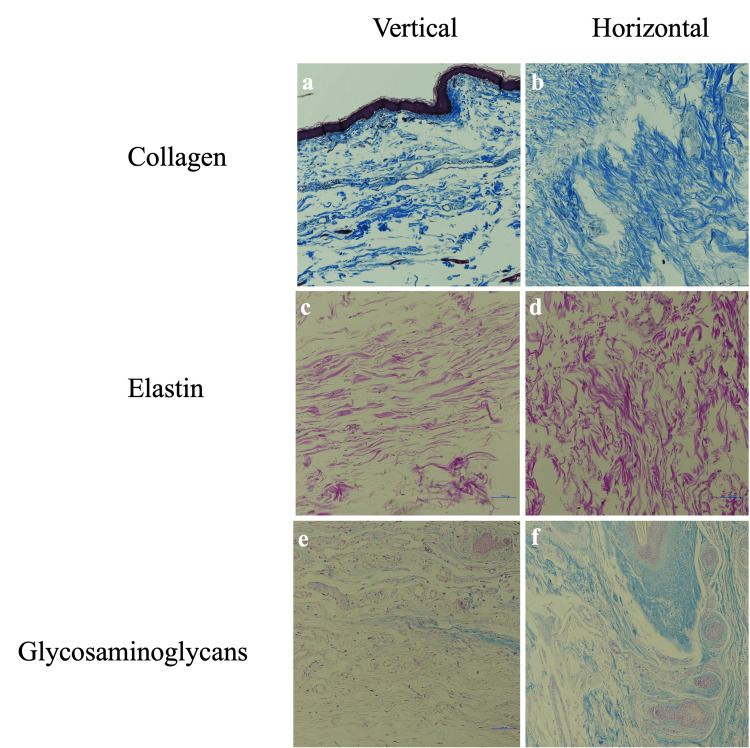
Background Age-related alterations in the dermal extracellular matrix (ECM) drive skin aging and are linked to numerous dermatological conditions, including diminished wound healing and compromised skin integrity. Our study aims to quantify and compare the distribution of collagen, elastic fibers, and glycosaminoglycans (GAGs) across different ages and analyze their patterns in vertical sections of the facial dermis. Methods Skin samples were collected from the under-eye (UE) and forehead (FH) regions of 24 male and female human cadavers aged 59-87. Samples were processed histologically. Collagen, elastic fibers, and GAG content were stained using trichrome, van Gieson, and alcian blue stains, respectively. The data was collected using ImageJ software. Two-way ANOVA with post hoc Tukey's test was used to analyze differences across regions and stain types. Results The FH region showed significantly higher GAGs in horizontal sections compared to vertical (p < 0.0001), with no significant differences in collagen (p = 0.9968) or elastic fibers (p = 0.8762). In the UE region, GAGs were also higher in horizontal sections (p = 0.0001), while collagen (p = 0.3954) and elastic fibers (p > 0.9999) showed no differences. Comparing FH and UE, vertical sections showed significant differences in collagen (p = 0.021) and GAGs (p = 0.0027), with higher values in FH. Horizontal sections showed significantly higher GAGs in FH (p = 0.001), with no differences in collagen (p = 0.5709) or elastic fibers (p > 0.9999). ECM changes were significant with age, but no differences were observed based on gender. Conclusions These findings offer novel insights into the structural and functional differences in the facial dermis, which can inform targeted anti-aging treatments, improve strategies for wound healing, and guide personalized dermatological interventions for skin integrity and rejuvenation.
背景 真皮细胞外基质(ECM)的年龄相关变化驱动皮肤老化,并与多种皮肤病相关,包括伤口愈合减弱和皮肤完整性受损。我们的研究旨在量化和比较不同年龄段胶原蛋白、弹性纤维和糖胺聚糖(GAGs)的分布,并分析它们在面部真皮垂直切片中的模式。方法 从24名年龄在59 - 87岁的男性和女性人类尸体的下眼睑(UE)和额头(FH)区域采集皮肤样本。样本进行组织学处理。胶原蛋白、弹性纤维和GAG含量分别使用三色染色、范吉森染色和阿尔辛蓝染色进行染色。数据使用ImageJ软件收集。采用双向方差分析及事后Tukey检验分析不同区域和染色类型之间的差异。结果 与垂直切片相比,FH区域水平切片中的GAGs显著更高(p < 0.0001),胶原蛋白(p = 0.9968)或弹性纤维(p = 0.8762)无显著差异。在UE区域,水平切片中的GAGs也更高(p = 0.0001),而胶原蛋白(p = 0.3954)和弹性纤维(p > 0.9999)无差异。比较FH和UE,垂直切片在胶原蛋白(p = 0.021)和GAGs(p = 0.0027)方面存在显著差异,FH中的值更高。水平切片显示FH中的GAGs显著更高(p = 0.001),胶原蛋白(p = 0.5709)或弹性纤维(p > 0.9999)无差异。ECM变化随年龄显著,但基于性别未观察到差异。结论 这些发现为面部真皮的结构和功能差异提供了新的见解,可为针对性的抗衰老治疗提供信息,改进伤口愈合策略,并指导针对皮肤完整性和年轻化的个性化皮肤科干预。