Bavaro Anna Rita, De Bellis Palmira, Linsalata Vito, Rucci Serena, Predieri Stefano, Cianciabella Marta, Tamburino Rachele, Cardinali Angela
Institute of Sciences of Food Production (ISPA), National Research Council (CNR), Via G. Amendola 122/O, 70126 Bari, Italy.
Institute of BioEconomy (IBE), National Research Council (CNR), Via P. Gobetti 101, 40129 Bologna, Italy.
Antioxidants (Basel). 2025 Apr 16;14(4):475. doi: 10.3390/antiox14040475.
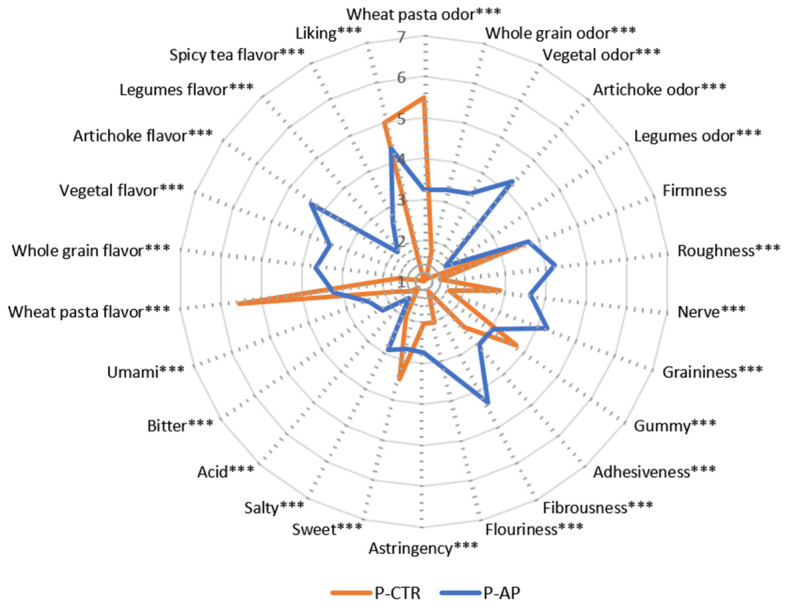
The incorporation of artichoke bracts, a by-product of artichoke processing, into pasta formulations represents an innovative approach to enhancing the nutritional and functional properties of this staple food while promoting environmental sustainability. This study aimed to evaluate the impact of artichoke powder (AP) enrichment (10% / replacement of semolina) on the technological, nutritional, antioxidant, and sensory properties of pasta. The enriched pasta (P-AP) was compared to control pasta (P-CTR) through comprehensive physicochemical analyses, including cooking performance, polyphenol characterization, and in vitro digestion. Polyphenol analysis revealed that chlorogenic acid, dicaffeoylquinic acids, and flavonoids accounted for 87% of total identified phenolic compounds in P-AP. Despite a 42% reduction in free polyphenols due to cooking, in vitro digestion revealed a 47% increase in total identified polyphenols, attributed to the release of bound polyphenols. Antioxidant assays (DPPH, ABTS, and FRAP) confirmed a significantly higher antioxidant capacity in P-AP compared to P-CTR. Additionally, P-AP exhibited a lower predicted glycemic index (pGI = 56.67) than the control (pGI = 58.41), a beneficial feature for blood glucose regulation. Sensory analysis highlighted distinct differences between samples, with P-AP showing stronger vegetal, artichoke, and legume-like notes, as well as higher intensity in bitterness and astringency. While panelists rated P-CTR higher in overall liking, enriched pasta maintained acceptable sensory characteristics. These findings support the valorization of artichoke by-products in pasta production, demonstrating their potential to enhance nutritional quality and functional properties while contributing to a circular economy.
将洋蓟加工的副产品洋蓟苞片添加到面食配方中,是一种创新方法,可增强这种主食的营养和功能特性,同时促进环境可持续性。本研究旨在评估洋蓟粉(AP)富集(10%/替代粗粒小麦粉)对面食的工艺、营养、抗氧化和感官特性的影响。通过全面的理化分析,包括烹饪性能、多酚特性分析和体外消化试验,将富集面食(P-AP)与对照面食(P-CTR)进行比较。多酚分析表明,绿原酸、二咖啡酰奎宁酸和黄酮类化合物占P-AP中已鉴定出的总酚类化合物的87%。尽管烹饪后游离多酚减少了42%,但体外消化试验显示,已鉴定出的总多酚增加了47%,这归因于结合态多酚的释放。抗氧化试验(DPPH、ABTS和FRAP)证实,P-AP的抗氧化能力明显高于P-CTR。此外,P-AP的预测血糖生成指数(pGI = 56.67)低于对照(pGI = 58.41),这对血糖调节具有有益作用。感官分析突出了样品之间的明显差异,P-AP表现出更强的植物味、洋蓟味和类似豆类的味道,以及更高强度的苦味和涩味。虽然小组成员对P-CTR的总体喜好评分更高,但富集面食保持了可接受的感官特性。这些发现支持了洋蓟副产品在面食生产中的价值提升,表明它们有潜力提高营养质量和功能特性,同时促进循环经济。