Zemariam Alemu Birara, Alamaw Addis Wondmagegn, Molla Rediet Woldesenbet, Habtie Tesfaye Engdaw, Bizuayehu Molla Azmeraw, Haile Ribka Nigatu, Kitaw Tegene Atamenta, Abate Biruk Beletew, Adisu Mollalign Aligaz
Department of Pediatrics and Child Health Nursing, School of Nursing, College of Medicine and Health Science, Woldia University, Woldia, Ethiopia.
Department of Emergency and Critical Care Nursing, School of Nursing, College of Medicine and Health Science, Woldia University, Woldia, Ethiopia.
PLoS One. 2025 Apr 29;20(4):e0321113. doi: 10.1371/journal.pone.0321113. eCollection 2025.
Micronutrient (MN) deficiency is a major global health concern, especially in developing countries like Ethiopia. However, there is a lack of comprehensive monitoring and information regarding MN intake status. This study aimed to assess the spatial distribution and factors influencing the intake of MN-rich foods among children aged 6-23 months in Ethiopia.
This study utilized the Ethiopian 2016 Demographic and Health Survey dataset with 2562 weighted children. The Bernoulli model was applied using Kuldorff's SaTScan version 9.6 software. The spatial distributions of MN-rich food intake were visualized using ArcGIS pro version 3.0 software. Model comparison was conducted using log likelihood ratio and corrected Akakie Information Criteria. A multi-scale geographical weighted regression analysis was performed using MGWR version 2.0 software. A P-value threshold of less than 0.05 was used to identify spatially significant predictors.
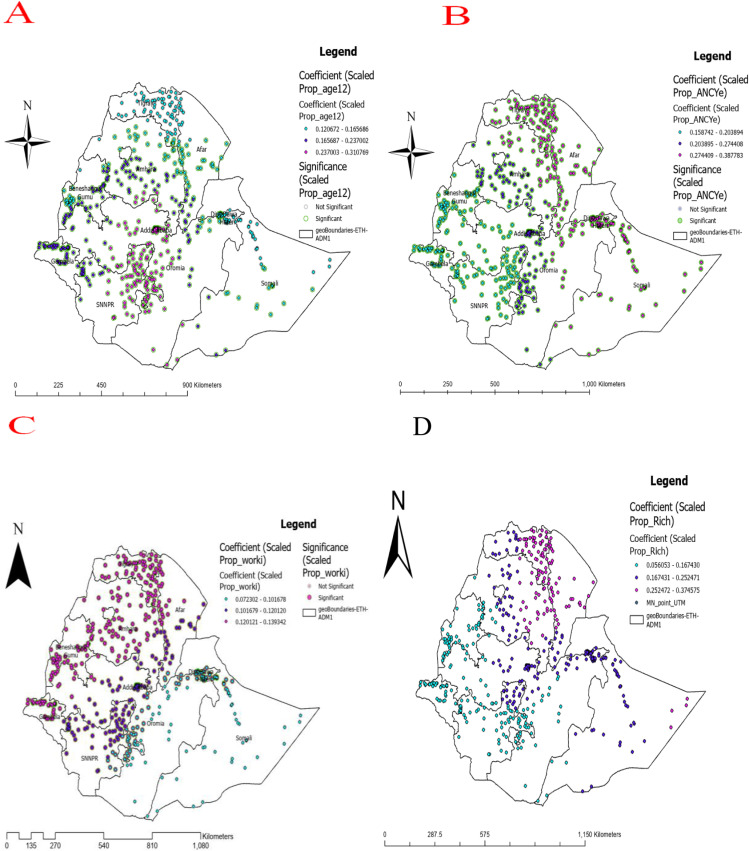
Overall, 69% (95% CI: 60.87, 77.43) of children aged 6-23 months in Ethiopia were found to have consumed foods rich in MN. The intake of these nutrient-rich foods exhibited significant clustering in specific regions, including Addis Ababa, Dire Dawa, Harari, certain parts of Benishangul, and the Gambella region. Spatial scan statistics analysis identified a total of 65 primary spatial clusters. Children residing within the primary clusters were found to be 29% more likely to have an intake of foods rich in MN compared to those living outside the identified clusters (RR = 1.29, LLR = 25.34, P < 0.001). Key spatially significant predictors included higher household wealth status; children aged 13-23 months, the presence of antenatal care, and mothers with any job.
The consumption of foods rich in MN in Ethiopia displayed non-random spatial patterns. To tackle the problem of inadequate intake of these nutritious foods and address the burden of MN deficiency among children aged 6-23 months, it is essential for policymakers and health planners to implement targeted nutrition interventions in the identified areas and factors.
微量营养素(MN)缺乏是一个重大的全球健康问题,在埃塞俄比亚等发展中国家尤为突出。然而,关于MN摄入状况缺乏全面的监测和信息。本研究旨在评估埃塞俄比亚6至23个月儿童中富含MN食物的摄入空间分布及影响因素。
本研究使用了埃塞俄比亚2016年人口与健康调查数据集,其中有2562名加权儿童。使用Kuldorff的SaTScan 9.6版软件应用伯努利模型。使用ArcGIS pro 3.0版软件可视化富含MN食物摄入的空间分布。使用对数似然比和校正的赤池信息准则进行模型比较。使用MGWR 2.0版软件进行多尺度地理加权回归分析。使用小于0.05的P值阈值来识别空间上显著的预测因素。
总体而言,埃塞俄比亚6至23个月的儿童中,69%(95%置信区间:60.87,77.43)被发现食用了富含MN的食物。这些营养丰富食物的摄入在特定地区呈现出显著的聚集性,包括亚的斯亚贝巴、德雷达瓦、哈拉里、贝尼尚古尔的某些地区以及甘贝拉地区。空间扫描统计分析共识别出65个主要空间集群。与居住在已识别集群之外的儿童相比,居住在主要集群内的儿童摄入富含MN食物的可能性高出29%(相对风险=1.29,对数似然比=25.34,P<0.001)。关键的空间显著预测因素包括较高的家庭财富状况;13至23个月的儿童、产前护理的存在以及有工作的母亲。
埃塞俄比亚富含MN食物的消费呈现出非随机的空间模式。为解决这些营养丰富食物摄入不足的问题并应对6至23个月儿童中MN缺乏的负担,政策制定者和卫生规划者必须在已识别的地区和因素中实施有针对性的营养干预措施。