Kubinski Hannah C, Despres Hannah W, Johnson Bryan A, Schmidt Madaline M, Jaffrani Sara A, Turner Allyson H, Fanuele Conor D, Mills Margaret G, Lokugamage Kumari G, Dumas Caroline M, Shirley David J, Estes Leah K, Pekosz Andrew, Crothers Jessica W, Roychoudhury Pavitra, Greninger Alexander L, Jerome Keith R, Di Genova Bruno Martorelli, Walker David H, Ballif Bryan A, Ladinsky Mark S, Bjorkman Pamela J, Menachery Vineet D, Bruce Emily A
Department of Microbiology and Molecular Genetics, Robert Larner, M.D. College of Medicine, University of Vermont, Burlington, Vermont, United States of America.
Department of Microbiology and Immunology, University of Texas Medical Branch, Galveston, Texas, United States of America.
PLoS Biol. 2025 Apr 29;23(4):e3003115. doi: 10.1371/journal.pbio.3003115. eCollection 2025 Apr.
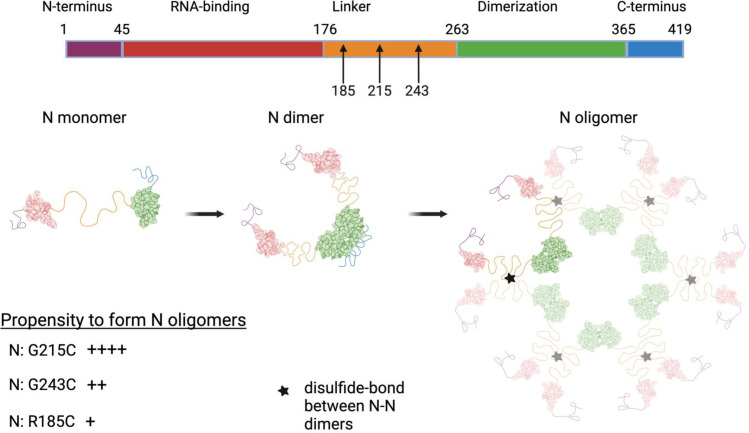
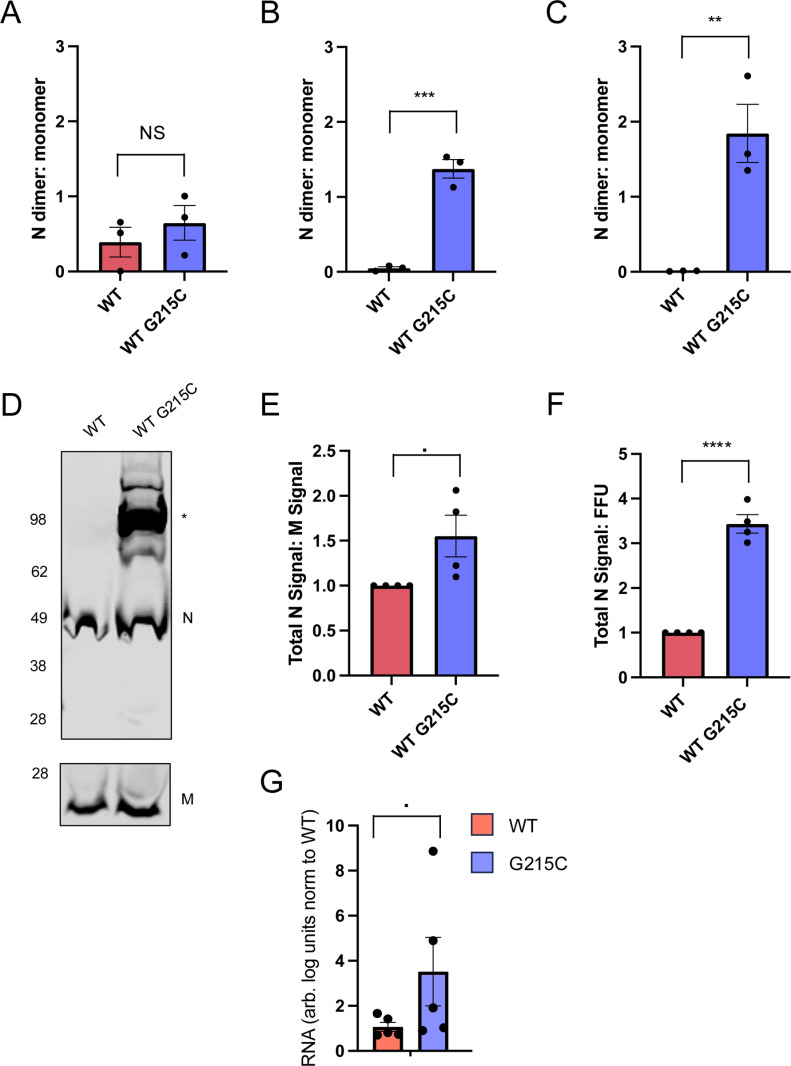
The evolution of SARS-CoV-2 variants and their respective phenotypes represents an important set of tools to understand basic coronavirus biology as well as the public health implications of individual mutations in variants of concern. While mutations outside of spike are not well studied, the entire viral genome is undergoing evolutionary selection, with several variants containing mutations in the central disordered linker region of the nucleocapsid (N) protein. Here, we identify a mutation (G215C), characteristic of the Delta variant, that introduces a novel cysteine into this linker domain, which results in the formation of a more stable N-N dimer. Using reverse genetics, we determined that this cysteine residue is necessary and sufficient for stable dimer formation in a WA1 SARS-CoV-2 background, where it results in significantly increased viral growth both in vitro and in vivo. Mechanistically, we show that the N:G215C mutant has more encapsidation as measured by increased RNA binding to N, N incorporation into virions, and electron microscopy showing that individual virions are larger, with elongated morphologies.
严重急性呼吸综合征冠状病毒2(SARS-CoV-2)变体的进化及其各自的表型是理解冠状病毒基本生物学特性以及关注变体中单个突变对公共卫生影响的重要工具集。虽然刺突蛋白之外的突变研究较少,但整个病毒基因组都在经历进化选择,有几个变体在核衣壳(N)蛋白的中央无序连接区域含有突变。在这里,我们鉴定出一种德尔塔变体特有的突变(G215C),该突变在这个连接域引入了一个新的半胱氨酸,导致形成更稳定的N-N二聚体。利用反向遗传学,我们确定在WA1 SARS-CoV-2背景下,这个半胱氨酸残基对于稳定二聚体的形成是必要且充分的,这导致其在体外和体内的病毒生长显著增加。从机制上讲,我们表明,通过增加RNA与N的结合、N掺入病毒粒子以及电子显微镜显示单个病毒粒子更大且形态拉长来衡量,N:G215C突变体具有更多的衣壳化作用。