Tan Rukeng, Zhu Yiyao, Chen Zengyu, Feng Xinkai, Liang Yujie, Zhang Sien, Abuduxiku Nuerbiya, Liao Guiqing, Yang Le
Hospital of Stomatology, Sun Yat-sen University, 56th Lingyuanxi Road, Guangzhou, 510055, Guangdong, China.
Guangdong Province Key Laboratory of Stomatology, No. 74, 2nd Zhongshan Road, Guangzhou, 510080, Guangdong, China.
BMC Cancer. 2025 Apr 29;25(1):801. doi: 10.1186/s12885-025-14188-8.
Chronic hepatitis B virus (HBV) infection poses a significant global public health challenge and is found closely related to extrahepatic cancers, including head and neck cancer. Oral squamous cell carcinoma (OSCC) is the major category of head and neck cancer. This retrospective study was conducted to explore the clinical correlation and survival analysis of OSCC patients with HBV.
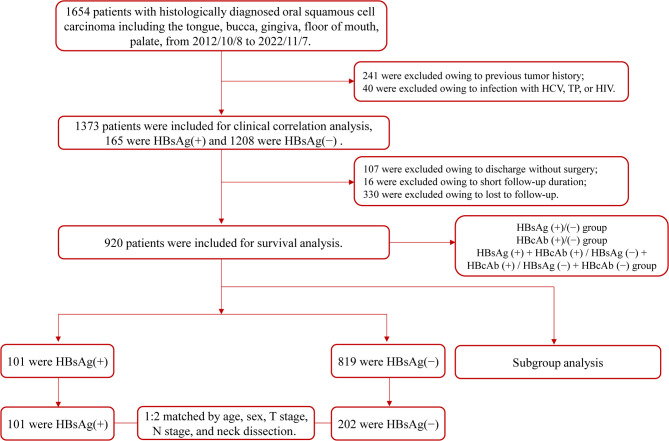
The study involved 1,373 patients with OSCC treated at the Hospital of Stomatology, Sun Yat-sen University from 2012 to 2022. Propensity score matching was used to analyze the clinical correlations and survival outcomes, specifically overall survival (OS) and disease-free survival (DFS), in patients with or without hepatitis B surface antigen (HBsAg) seropositivity. Subgroup analyses were conducted for both the early and advanced stages of OSCC. The benefits of neck dissection in OSCC patients with HBV infection were further investigated.
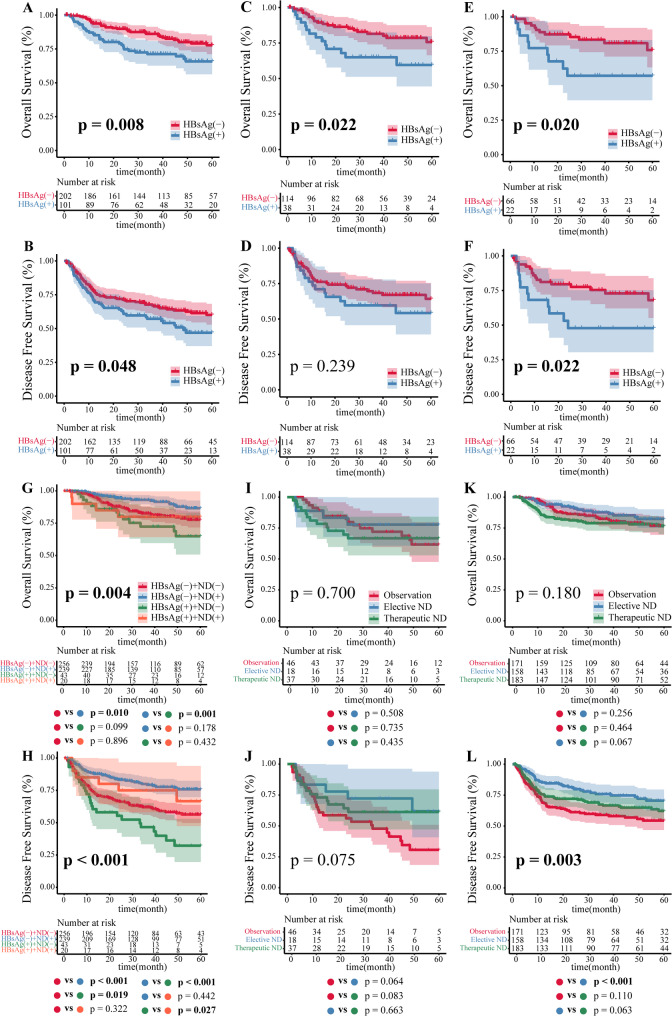
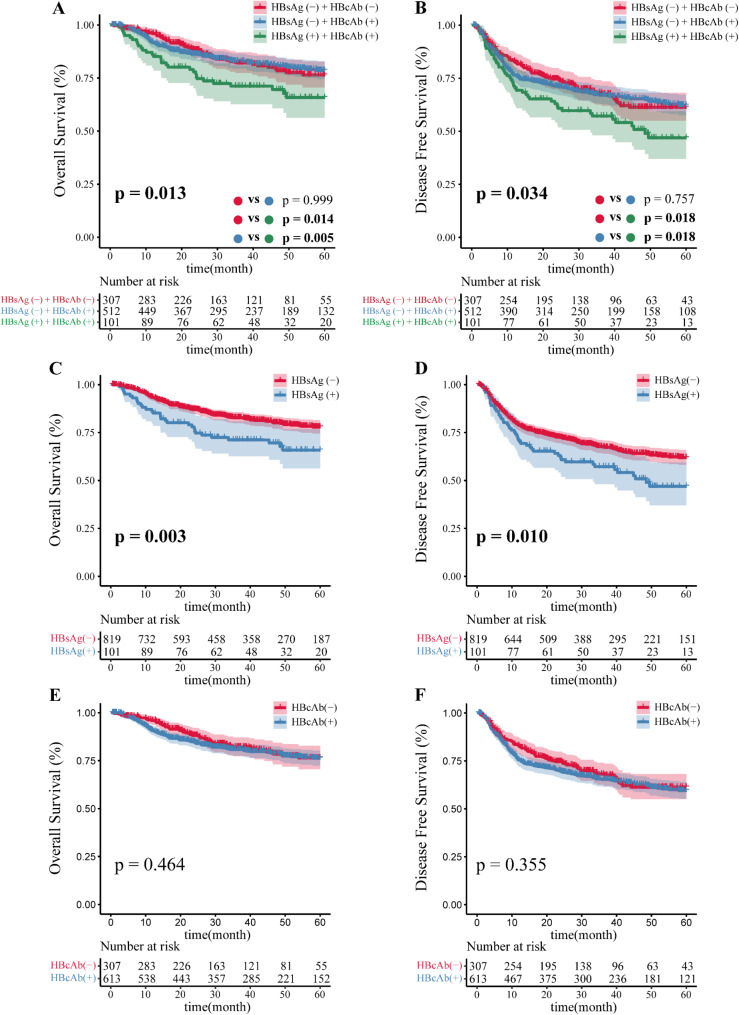
The prevalence of HBV infection in our cohort was 12.0%. The HBsAg (+) group had a higher percentage of individuals under 60 (73.3% versus 63.7%, p = 0.016). Post-matching for age, sex, pathological T category, pathological N category, and neck dissection, the OSCC patients with HBsAg (+) had lower 5-year OS and DFS rates rather than HBsAg (-) patients, especially those with advanced stage and cervical lymph node metastasis. HBsAg (-) was confirmed as an independent protective prognostic indicator for both OS (hazard ratio [HR] = 0.52; 95% confidence interval [CI] = 0.34-0.79; p = 0.002) and DFS (HR = 0.69, 95% CI = 0.50-0.96; p = 0.027). Notably, elective neck dissection was recognized as an independent protective factor influencing 5-year OS and DFS. While DOI and pathological N category were both confirmed as the risk factors for prognosis.
HBsAg is a potential prognostic marker for OSCC. It is essential to screen for HBV infection prior to initiating tumor treatment. Additionally, serological testing, antiviral prophylaxis and therapy play crucial roles in preventing HBV reactivation during the course of tumor treatment. In cases of early OSCC associated with HBV infection, elective neck dissection has been shown to reduce the rates of recurrence and metastasis significantly.
慢性乙型肝炎病毒(HBV)感染是一项重大的全球公共卫生挑战,且发现其与包括头颈癌在内的肝外癌症密切相关。口腔鳞状细胞癌(OSCC)是头颈癌的主要类型。本回顾性研究旨在探讨OSCC患者与HBV的临床相关性及生存分析。
该研究纳入了2012年至2022年在中山大学附属口腔医院接受治疗的1373例OSCC患者。采用倾向评分匹配法分析乙肝表面抗原(HBsAg)血清学阳性或阴性患者的临床相关性及生存结局,特别是总生存期(OS)和无病生存期(DFS)。对OSCC的早期和晚期阶段均进行了亚组分析。进一步研究了颈淋巴结清扫术对HBV感染的OSCC患者的益处。
我们队列中HBV感染的患病率为12.0%。HBsAg(+)组60岁以下个体的比例更高(73.3%对63.7%,p = 0.016)。在按年龄、性别、病理T分期、病理N分期和颈淋巴结清扫术进行匹配后,HBsAg(+)的OSCC患者的5年OS和DFS率低于HBsAg(-)的患者,尤其是那些处于晚期且有颈部淋巴结转移的患者。HBsAg(-)被确认为OS(风险比[HR]=0.52;95%置信区间[CI]=0.34-0.79;p = 0.002)和DFS(HR = 0.69,95%CI = 0.50-0.96;p = 0.027)的独立保护性预后指标。值得注意的是,选择性颈淋巴结清扫术被认为是影响5年OS和DFS的独立保护因素。而DOI和病理N分期均被确认为预后的危险因素。
HBsAg是OSCC的一个潜在预后标志物。在开始肿瘤治疗前筛查HBV感染至关重要。此外,血清学检测、抗病毒预防和治疗在预防肿瘤治疗过程中HBV再激活方面发挥着关键作用。在与HBV感染相关的早期OSCC病例中,选择性颈淋巴结清扫术已被证明可显著降低复发和转移率。