Patel Nehali, Surman Sherri L, Jones Bart G, Penkert Rhiannon R, Ringwald-Smith Karen, DeLuca Kim, Richardson Julie, Zheng Ying, Tang Li, Hurwitz Julia L
Department of Infectious Diseases, St. Jude Children's Research Hospital, Memphis, TN 38105, USA.
Department of Chemistry and Biochemistry, Institute of Molecular Biology, University of Oregon, Eugene, OR 97403, USA.
Biomolecules. 2025 Apr 7;15(4):540. doi: 10.3390/biom15040540.
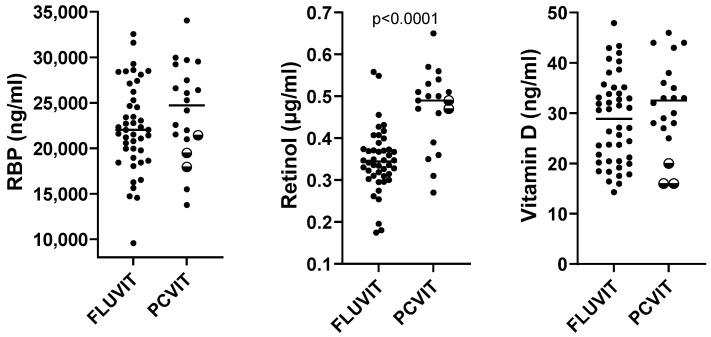
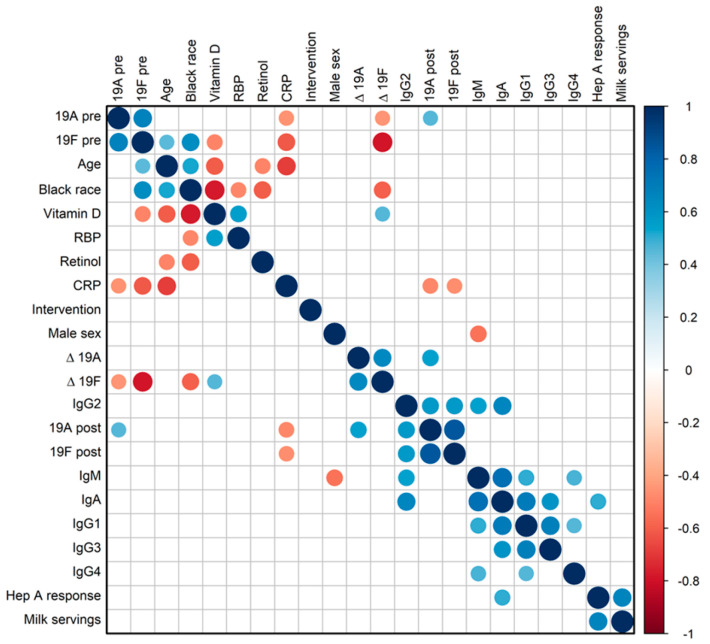
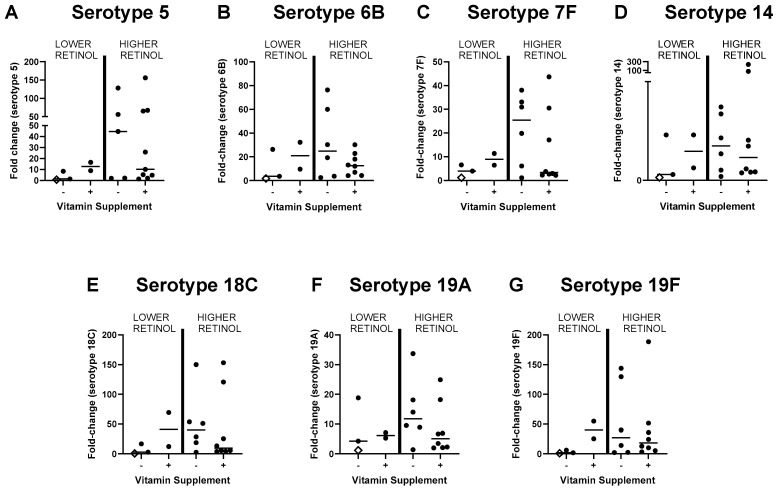
Previous studies have shown that high-dose vitamin supplements can improve vaccine-induced immune responses and pathogen protection in the context of vitamin deficiencies. To further elucidate the influence of vitamin supplements on immune responses toward pediatric vaccines, we performed a randomized controlled clinical trial (PCVIT) of 20 healthy children 1-4 years of age in Memphis, Tennessee. Study participants received a booster vaccine for pneumococcus and a primary vaccine for hepatitis A virus with or without a high-dose, oral, liquid supplement of 10,000 IU retinyl palmitate. We found that the children enrolled in PCVIT had higher baseline vitamin levels than previously described older children and adults living in Memphis. Only one child in PCVIT had a serum retinol level of less than 0.3 µg/mL. The children frequently consumed milk and baby foods that were likely vitamin-fortified, providing an explanation for the relatively high vitamin levels. Most children in PCVIT responded well to pneumococcus and hepatitis A vaccines by pathogen-specific antibody upregulation. The one child with a serum retinol level below 0.3 µg/mL did not receive a vitamin supplement and exhibited the lowest fold-change in antibody responses toward pneumococcal serotypes. A correlation matrix encompassing demographics, vitamin levels, vaccine-induced immune responses, C-reactive protein, and total serum immunoglobulin isotypes, including IgG2 and IgA, identified variables associated with vaccination outcomes. Perhaps because children were predominantly retinol-sufficient at baseline, the high-dose vitamin A supplement exhibited no benefit to vaccine-induced immune responses. In fact, when vitamin supplemented and vitamin unsupplemented groups were compared among participants with the highest baseline retinol levels, there was a trend toward weaker vaccine-induced immune responses in the vitamin supplemented group. Results encourage the performance of larger clinical studies before high-dose vitamin supplements are recommended for populations that are otherwise vitamin-replete.
先前的研究表明,在维生素缺乏的情况下,高剂量维生素补充剂可改善疫苗诱导的免疫反应和病原体防护能力。为了进一步阐明维生素补充剂对儿童疫苗免疫反应的影响,我们在田纳西州孟菲斯市对20名1至4岁的健康儿童进行了一项随机对照临床试验(PCVIT)。研究参与者接种了肺炎球菌加强疫苗和甲型肝炎病毒初级疫苗,同时服用或不服用10000国际单位棕榈酸视黄酯的高剂量口服液体补充剂。我们发现,参与PCVIT的儿童基线维生素水平高于先前描述的居住在孟菲斯的大龄儿童和成年人。PCVIT中只有一名儿童血清视黄醇水平低于0.3µg/mL。这些儿童经常食用可能添加了维生素的牛奶和婴儿食品,这解释了他们相对较高的维生素水平。PCVIT中的大多数儿童通过病原体特异性抗体上调对肺炎球菌和甲型肝炎疫苗反应良好。血清视黄醇水平低于0.3µg/mL的那名儿童未服用维生素补充剂,其对肺炎球菌血清型的抗体反应倍数变化最低。一个包含人口统计学、维生素水平、疫苗诱导的免疫反应、C反应蛋白以及包括IgG2和IgA在内的总血清免疫球蛋白亚型的相关矩阵,确定了与疫苗接种结果相关的变量。也许由于儿童在基线时主要视黄醇充足,高剂量维生素A补充剂对疫苗诱导的免疫反应没有益处。事实上,在基线视黄醇水平最高的参与者中比较补充维生素组和未补充维生素组时,补充维生素组的疫苗诱导免疫反应有减弱的趋势。这些结果促使在建议对其他维生素充足的人群使用高剂量维生素补充剂之前,先进行更大规模的临床研究。