Roberts Anna, Griffiths Natasha, Thiara Kieran, Wallace Sophie, Young Alyson L, Williamson Nicola, Gater Adam, Saeed Omar, Minor Charles, Hawken Natalia
Patient-Centered Outcomes, Adelphi Values, Bollington, UK.
Sanofi UK, Reading, UK.
Neurol Ther. 2025 Jun;14(3):1039-1059. doi: 10.1007/s40120-025-00732-y. Epub 2025 Apr 30.
Chronic inflammatory demyelinating polyneuropathy (CIDP) is a rare type of autoimmune neuropathy, characterized by signs of distal and proximal weakness of the upper and lower limbs, sensory dysfunction, absent or diminished tendon reflexes, and symptoms of numbness, tingling, pain, and fatigue. These signs/symptoms can lead to difficulty walking, climbing stairs, and reduced manual dexterity. Detailed qualitative exploration of the patient experience of CIDP, notably signs/symptoms, its impacts on health-related quality of life, and treatment experience is limited. Qualitative patient experience data is recommended by regulatory bodies to inform patient-focused drug development. This study aimed to qualitatively explore the experience of CIDP from the patient and clinician perspectives.
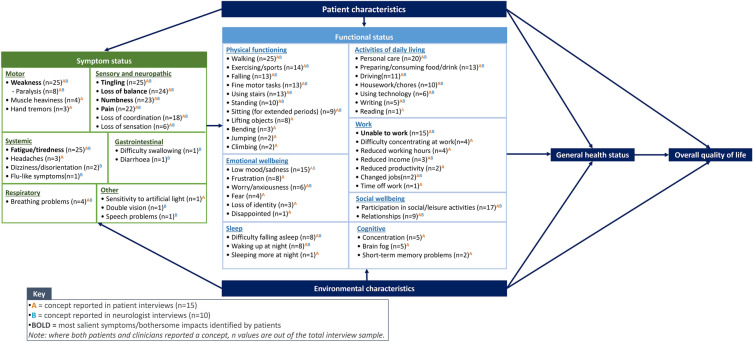
Qualitative concept elicitation telephone interviews were conducted with adult patients with a confirmed diagnosis of CIDP and with neurologists experienced in diagnosing and treating patients with CIDP from the USA. Interview transcripts were analyzed using thematic analysis methods, and findings informed development of a conceptual model.
Overall, 15 patients with CIDP and 10 neurologists were interviewed. A total of 19 signs/symptoms were identified as important and relevant, of which weakness, fatigue, loss of balance, tingling, numbness, pain, and loss of coordination were most frequently reported by patients and neurologists. Except for loss of coordination, these signs/symptoms were also considered most salient to patients. Patients identified fatigue as the most bothersome symptom and weakness and fatigue as the most important to treat. CIDP impacted health-related quality-of-life (HRQoL), including physical functioning (e.g., walking difficulties), activities of daily living (e.g., difficulty with personal care), work (e.g., being unable to work), emotional wellbeing (e.g., depression), social wellbeing (e.g., participation in social/leisure activities), sleep (e.g., difficulty falling asleep), and cognition (e.g., brain fog). Patients reported that current CIDP treatments lacked effectiveness in treating specific symptoms, caused unwanted side effects, and impacted their independence.
Findings contribute novel and detailed qualitative insights into the key signs/symptoms of CIDP and the profound impact of these on patients' HRQoL from both the patient and clinician perspectives. Findings can be used to identify treatment targets and support selection of appropriate clinical outcome assessments for the evaluation of CIDP symptoms and HRQoL impacts in future CIDP clinical trials.
慢性炎症性脱髓鞘性多发性神经病(CIDP)是一种罕见的自身免疫性神经病,其特征为上下肢远端和近端无力、感觉功能障碍、腱反射消失或减弱,以及麻木、刺痛、疼痛和疲劳等症状。这些体征/症状可导致行走困难、爬楼梯困难和手部灵活性下降。对CIDP患者体验的详细定性探索,尤其是体征/症状、其对健康相关生活质量的影响以及治疗体验,目前还很有限。监管机构建议收集定性的患者体验数据,以指导以患者为中心的药物研发。本研究旨在从患者和临床医生的角度对CIDP的体验进行定性探索。
对确诊为CIDP的成年患者以及来自美国的有诊断和治疗CIDP经验的神经科医生进行了定性概念引出电话访谈。使用主题分析方法对访谈记录进行分析,并根据研究结果构建了一个概念模型。
总体而言,共访谈了15名CIDP患者和10名神经科医生。总共确定了19种体征/症状为重要且相关的,其中无力、疲劳、平衡丧失、刺痛、麻木、疼痛和协调能力丧失是患者和神经科医生最常报告的。除协调能力丧失外,这些体征/症状也被认为对患者最为突出。患者认为疲劳是最困扰人的症状,而无力和疲劳是最需要治疗的。CIDP影响了健康相关生活质量(HRQoL),包括身体功能(如行走困难)、日常生活活动(如个人护理困难)、工作(如无法工作)、情绪健康(如抑郁)、社交健康(如参与社交/休闲活动)、睡眠(如入睡困难)和认知(如脑雾)。患者报告说,目前的CIDP治疗在治疗特定症状方面缺乏有效性,会引起不良副作用,并影响他们的独立性。
研究结果从患者和临床医生的角度对CIDP的关键体征/症状及其对患者HRQoL的深远影响提供了新颖而详细的定性见解。这些结果可用于确定治疗靶点,并支持选择合适的临床结局评估方法,以评估未来CIDP临床试验中CIDP症状和HRQoL的影响。