Vitanov Rebeca Ianov, Achterberg Jascha, Akarca Danyal, Astle Duncan E, Baker Kate
MRC Cognition and Brain Sciences Unit, University of Cambridge, Cambridge, UK.
Department of Psychiatry, University of Cambridge, Cambridge, UK.
Eur J Neurosci. 2025 May;61(9):e70124. doi: 10.1111/ejn.70124.
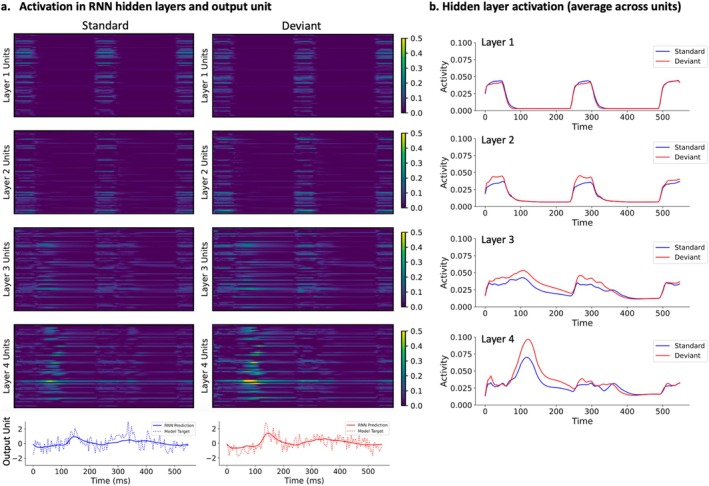
Loss-of-function ZDHHC9 variants are associated with X-linked intellectual disability (XLID), rolandic epilepsy (RE) and developmental language difficulties. This study integrates human neurophysiological data with a computational model to identify a potential neural mechanism explaining ZDHHC9-associated differences in cortical function and cognition. Magnetoencephalography (MEG) data was collected during an auditory roving oddball paradigm from eight individuals with a ZDHHC9 loss-of-function variant (ZDHHC9 group) and seven age-matched individuals without neurological or neurodevelopmental difficulties (control group). Auditory-evoked fields (AEFs) were larger in amplitude and showed a later peak latency in the ZDHHC9 group but demonstrated normal stimulus-specific properties. Magnetic mismatch negativity (mMMN) amplitude was also increased in the ZDHHC9 group, reflected by stronger neural activation during deviant processing relative to the standard. A recurrent neural network (RNN) model was trained to mimic group-level auditory-evoked responses, and subsequently perturbed to test the hypothesised impact of ZDHHC9-driven synaptic dysfunction on neural dynamics. Results of model perturbations showed that reducing inhibition levels by weakening inhibitory weights recapitulates the observed group differences in evoked responses. Stronger reductions in inhibition levels resulted in increased peak amplitude and peak latency of RNN prediction relative to the pre-perturbation predictions. Control experiments in which excitatory connections were strengthened by the same levels did not result in consistently stable activity or AEF-like RNN predictions. Together, these results suggest that reduced inhibition is a plausible mechanism by which loss of ZDHHC9 function alters cortical dynamics during sensory processing.
功能丧失型ZDHHC9变异与X连锁智力障碍(XLID)、罗兰多癫痫(RE)和发育性语言障碍有关。本研究将人类神经生理学数据与计算模型相结合,以确定一种潜在的神经机制,解释与ZDHHC9相关的皮质功能和认知差异。在听觉游动Oddball范式期间,收集了8名具有ZDHHC9功能丧失变异的个体(ZDHHC9组)和7名年龄匹配、无神经或神经发育障碍的个体(对照组)的脑磁图(MEG)数据。ZDHHC9组的听觉诱发电场(AEF)振幅更大,峰值潜伏期更晚,但具有正常的刺激特异性特性。ZDHHC9组的磁失配负波(mMMN)振幅也增加,表现为相对于标准刺激,异常刺激处理期间神经激活更强。训练了一个循环神经网络(RNN)模型来模拟组水平的听觉诱发反应,随后进行扰动,以测试ZDHHC9驱动的突触功能障碍对神经动力学的假设影响。模型扰动结果表明,通过削弱抑制权重来降低抑制水平可重现观察到的诱发反应组间差异。相对于扰动前的预测,抑制水平更强的降低导致RNN预测的峰值振幅和峰值潜伏期增加。通过相同水平增强兴奋性连接的对照实验并未导致一致稳定的活动或类似AEF的RNN预测。总之,这些结果表明,抑制降低是ZDHHC9功能丧失在感觉处理过程中改变皮质动力学的一种合理机制。