Al-Hamami Sarah Salih, Kurucz Samuel, Vondráček Vladimír, Pekar Vladimír, Andrlík Michal, Dědečková Kateřina, Benešová Iva, Haas Alexandra, Ondrová Barbora, Pasztorová Andrea, Vítek Pavel, Kubeš Jiří
Department of Radiation Oncology, Proton Therapy Center Czech, Prague, Czechia.
Department of Medical Physics, Proton Therapy Center Czech, Prague, Czechia.
Front Oncol. 2025 Apr 16;15:1470876. doi: 10.3389/fonc.2025.1470876. eCollection 2025.
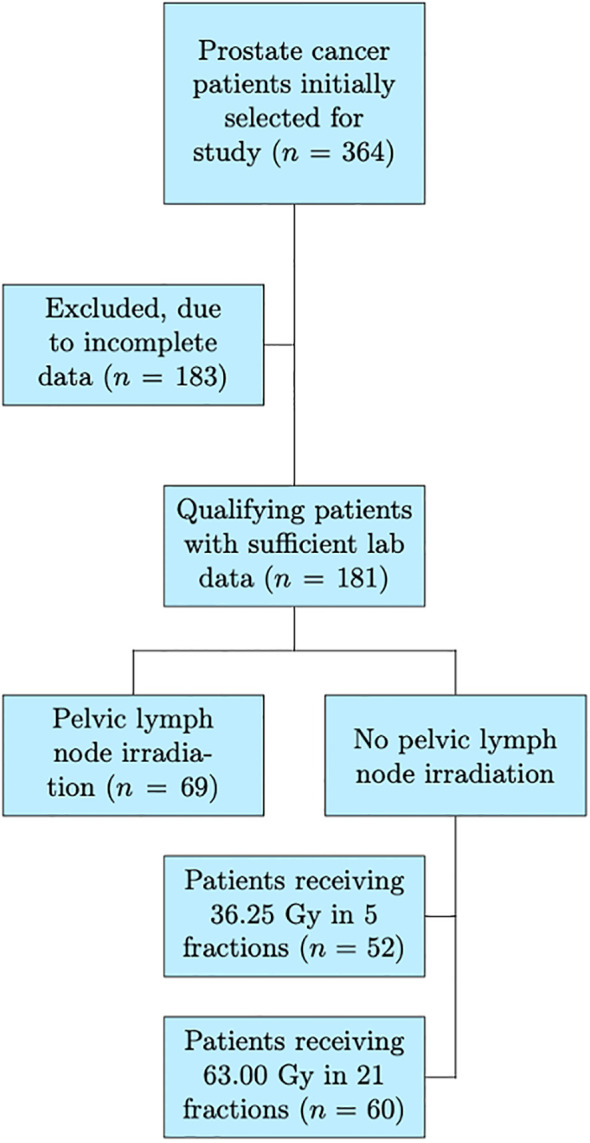
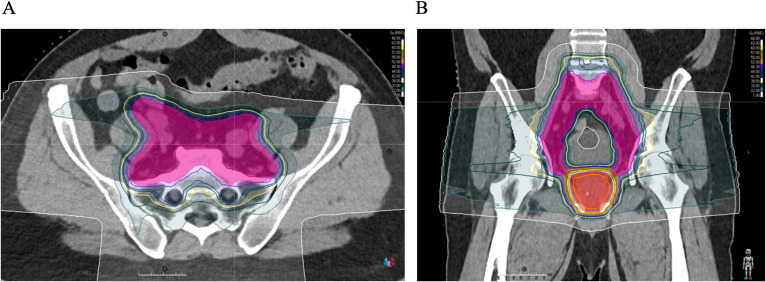
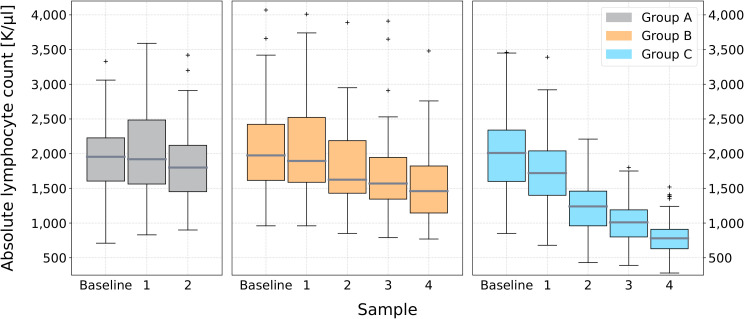
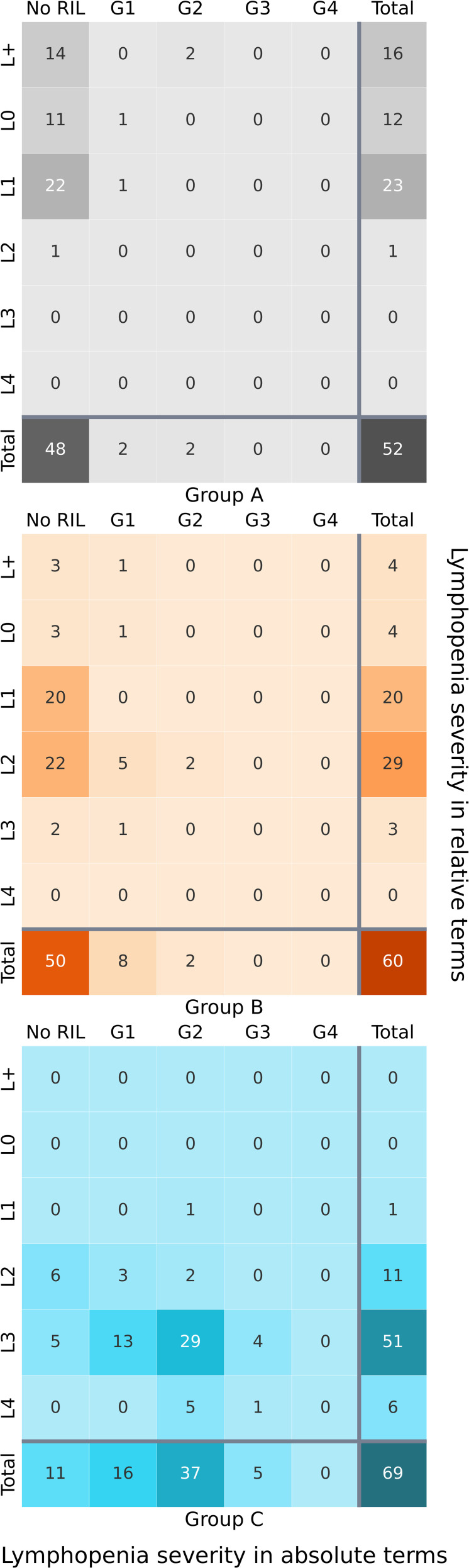
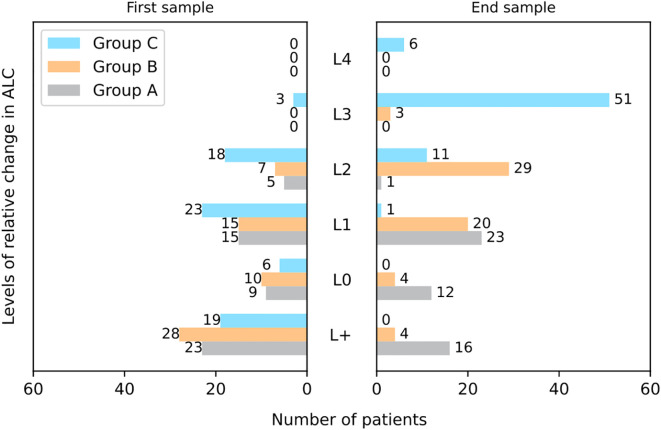
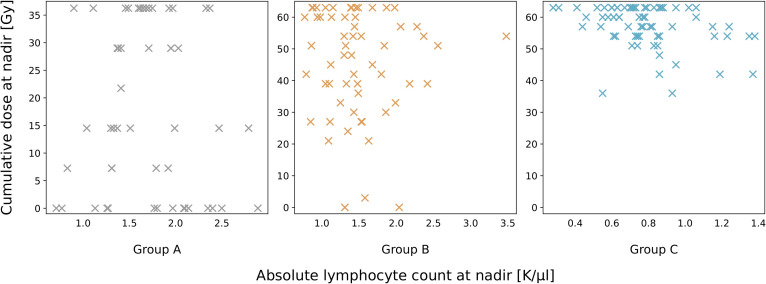
Radiotherapy can be both immunosuppressive and immunostimulatory. Radiation-induced lymphopenia (RIL) is an ongoing challenge in cancer treatment. We investigated weekly changes in the absolute lymphocyte count (ALC) during proton radiotherapy, evaluating the effects of different dosage, fractionation schedules, and pelvic node irradiation (PNI). Prostate cancer patients were prospectively chosen for this study, due to their relatively homogenous treatment plans. Treatment protocols were categorized into three groups: Group A (n=52) received 36.25 Gy/5-fractions, Group B (n=60) underwent 63 Gy/21-fractions and group C (n=69) received 63 Gy/21-fractions plus PNI. To account for individual characteristic differences, a new categorization method was made, according to the change in ALC relative to the baseline. Lymphopenia (ALC < 1000 K/μL) developed in 8%, 17% and 84% of patients in groups A, B, and C, respectively. An initial increase in ALC occurred in 44%, 47% and 28% of groups A, B and C, respectively, and declined with proceeding fractions. Patients with PNI had the most pronounced reduction in their ALC relative to the baseline. Increased dosage and fractionation led to a higher incidence of lymphopenia. Understanding which factors influence ALC in particle therapy is vital for leveraging the immune-enhancing effects of radiotherapy, while minimising its immunosuppressive impacts.
放射治疗既能产生免疫抑制作用,也能产生免疫刺激作用。辐射诱导的淋巴细胞减少症(RIL)是癌症治疗中持续存在的一项挑战。我们研究了质子放疗期间绝对淋巴细胞计数(ALC)的每周变化情况,评估不同剂量、分割方案和盆腔淋巴结照射(PNI)的影响。由于前列腺癌患者的治疗方案相对统一,因此前瞻性地选择他们进行本研究。治疗方案分为三组:A组(n = 52)接受36.25 Gy/5次分割,B组(n = 60)接受63 Gy/21次分割,C组(n = 69)接受63 Gy/21次分割加PNI。为了考虑个体特征差异,根据ALC相对于基线的变化制定了一种新的分类方法。A、B、C三组患者中分别有8%、17%和84%出现淋巴细胞减少(ALC < 1000 K/μL)。A、B、C三组中分别有44%、47%和28%的患者ALC最初出现升高,并随着分割次数的增加而下降。接受PNI的患者相对于基线,其ALC下降最为明显。剂量增加和分割次数增加导致淋巴细胞减少的发生率更高。了解粒子治疗中哪些因素会影响ALC,对于利用放射治疗的免疫增强作用,同时将其免疫抑制影响降至最低至关重要。