Li Yu-Ching, Kuan Yu-Hsiang, Yang Yih, Gau Shuo-Yan, Su Kun-Yu, Tsai Tung-Han, Huang Kuang-Hua, Lee Chien-Ying
Department of Public Health, China Medical University, Taichung, Taiwan.
Division of Family Medicine, Yuan Rung Hospital, Changhua, Taiwan.
Front Pharmacol. 2025 Apr 16;16:1518545. doi: 10.3389/fphar.2025.1518545. eCollection 2025.
In this study, we investigated the association of long-term use of a dipeptidyl peptidase-4 inhibitor (DPP-4i) with the risk of diabetic retinopathy (DR) in patients with diabetes mellitus (DM).
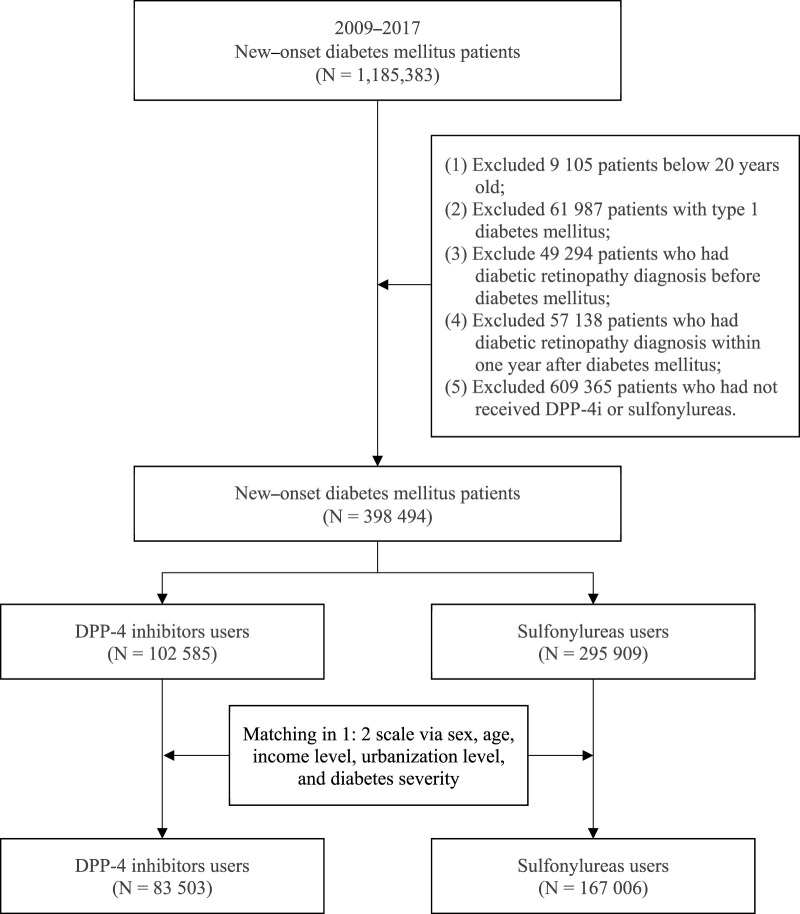
This study was a secondary analysis based on the nationwide database from 2008 to 2022 in Taiwan. Patients with new-onset DM who were treated with either a DPP-4i or sulfonylurea from 2009 to 2017 were included in this study. Patients who received a DPP-4i were included in the case group and further divided on the basis of the cumulative defined daily dose (cDDD) as follows: ≤90, 91-180, 181-300, and >300 cDDD. Propensity score matching was performed to select patients who used a sulfonylurea, and these patients were assigned to the control group. With adjustment for sex, age, income, urbanization level, comorbidities, and other anti-diabetic agents, the Cox proportional hazard model was used to estimate the risk of DR associated with DPP-4i use over the 5-year follow-up.
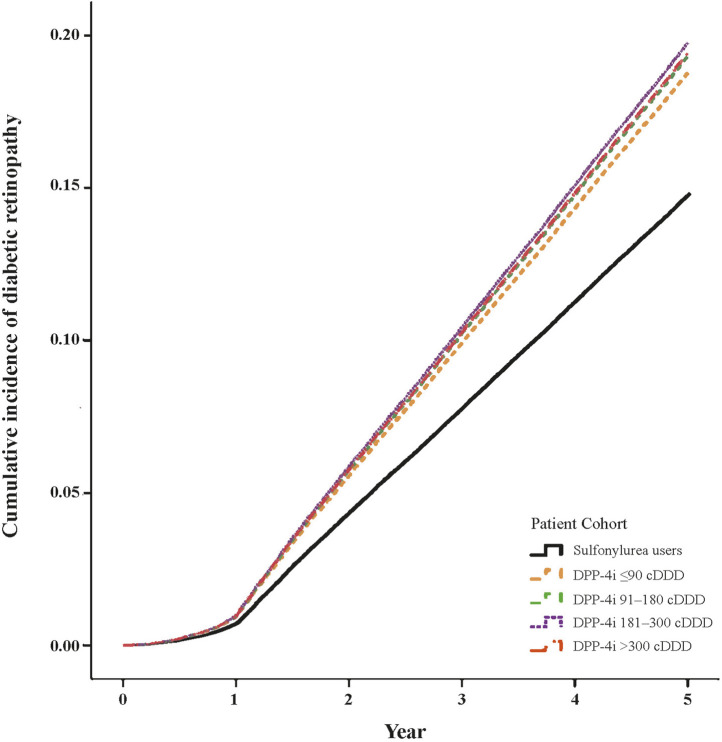
There were 83,503 patients with DPP-4i use and 167,006 patients with sulfonylurea use after matching. Compared with patients with sulfonylurea use, patients with DPP-4i use at ≤90 cDDD had a hazard ratio (HR) of 1.43 (95% confidence interval [CI] = 1.38-1.49) for DR development, whereas those with DPP-4i use at 91-180, 181-300 or >300 cDDD had HRs of 1.66 (95% CI: 1.59-1.74), 1.82 (95% CI: 1.74-1.90), and 2.32 (95% CI: 1.91-2.82) for DR development, respectively. Of the different DPP-4is, linagliptin at ≤90 or 181-300 was associated with the highest risk of DR. Significant differences were discovered at ≤90, 91-181, and 181-300 cDDD in the risk of DR between patients using Saxagliptin versus sitagliptin. Vildagliptin at ≤90 or 91-180 cDDD was associated with an increased risk of DR, but not at 181-300 cDDD.
In patients with DM, DPP-4i at ≤90, 91-180, 181-300 and >300 cDDD was linked to an increased risk of DR over the 5-year follow-up. Sitagliptin at cDDD 181-300 was associated with the greatest DR risk. The potential for DPP-4i to accelerate DR progression should be considered.
在本研究中,我们调查了糖尿病(DM)患者长期使用二肽基肽酶 - 4抑制剂(DPP - 4i)与糖尿病视网膜病变(DR)风险之间的关联。
本研究是基于2008年至2022年台湾地区全国性数据库进行的二次分析。纳入2009年至2017年期间开始使用DPP - 4i或磺脲类药物治疗的新发DM患者。接受DPP - 4i治疗的患者被纳入病例组,并根据累积限定日剂量(cDDD)进一步分为:≤90、91 - 180、181 - 300和>300 cDDD。进行倾向评分匹配以选择使用磺脲类药物的患者,并将这些患者分配到对照组。在调整性别、年龄、收入、城市化水平、合并症和其他抗糖尿病药物后,使用Cox比例风险模型来估计在5年随访期间与使用DPP - 4i相关的DR风险。
匹配后,有83,503例使用DPP - 4i的患者和167,006例使用磺脲类药物的患者。与使用磺脲类药物的患者相比,使用cDDD≤90的DPP - 4i患者发生DR的风险比(HR)为1.43(95%置信区间[CI]=1.38 - 1.49),而使用cDDD为91 - 180、181 - 300或>300的DPP - 4i患者发生DR的HR分别为1.66(95%CI:1.59 - 1.74)、1.82(95%CI:1.74 - 1.90)和2.32(95%CI:1.91 - 2.82)。在不同的DPP - 4i中,cDDD≤90或181 - 300时利格列汀与DR的最高风险相关。在使用沙格列汀与西格列汀的患者之间,cDDD≤90、91 - 181和181 - 300时DR风险存在显著差异。cDDD≤90或91 - 180时维格列汀与DR风险增加相关,但cDDD为181 - 300时无此关联。
在DM患者中,cDDD≤90、91 - 180、181 - 300和>300的DPP - 4i在5年随访期间与DR风险增加相关。cDDD为181 - 300时西格列汀与最大的DR风险相关。应考虑DPP - 4i加速DR进展的可能性。