Qian Zibing, Li Ziyi, Peng Xuebin, Mao Yongwu, Mao Xiaorong, Li Junfeng
The First Clinical Medical College, Lanzhou University, Lanzhou, Gansu, 730000, People's Republic of China.
Department of Infectious Disease, The First Hospital of Lanzhou University, Lanzhou, Gansu, 730000, People's Republic of China.
J Inflamm Res. 2025 Apr 26;18:5655-5672. doi: 10.2147/JIR.S511439. eCollection 2025.
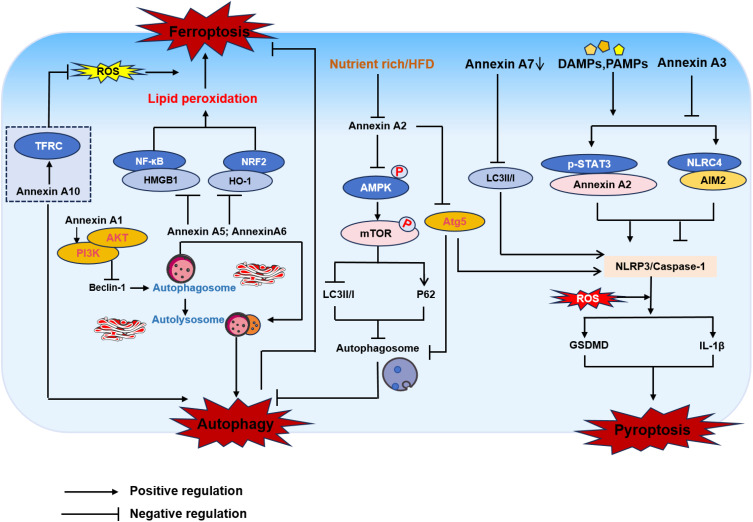
The annexin superfamily proteins, a family of calcium-dependent phospholipid-binding proteins, are involved in a variety of Ca²-regulated membrane events. Annexin A, expressed in vertebrates, has been implicated in a variety of regulated cell death (RCD) pathways, including apoptosis, autophagy, pyroptosis, ferroptosis, and neutrophil extracellular trap-induced cell death (NETosis). Given that inflammation is a key driver of cell death, the roles of Annexin A in inflammation have been extensively studied. In this review, we discuss the regulatory roles of Annexin A in RCD and inflammation, the development of related targeted therapies in translational medicine, and the application of animal models to study these processes. We also analyze current challenges and discuss future directions for improved diagnostic and therapeutic strategies.
膜联蛋白超家族蛋白是一类钙依赖性磷脂结合蛋白,参与多种Ca²⁺调节的膜相关事件。膜联蛋白A在脊椎动物中表达,已被证明参与多种程序性细胞死亡(RCD)途径,包括凋亡、自噬、焦亡、铁死亡和中性粒细胞胞外陷阱诱导的细胞死亡(NETosis)。鉴于炎症是细胞死亡的关键驱动因素,膜联蛋白A在炎症中的作用已得到广泛研究。在本综述中,我们讨论了膜联蛋白A在RCD和炎症中的调节作用、转化医学中相关靶向治疗的进展以及动物模型在研究这些过程中的应用。我们还分析了当前面临的挑战,并讨论了改进诊断和治疗策略的未来方向。