Barcala Gomez Dafne, Pessa Valente Emanuelle, Dalena Paolo, Mariani Ilaria, Arruda Vidal Suely, Gonçalves Mello Maria Júlia, Lima Geyse, Barradas Souza Juliana, Brandão Neto Waldemar, Tenório Rodrigues Vanessa, Malta Castro Bruna, Pessoa Maria Luísa, Medeiros Cisneiros Eduarda, Lazzerini Marzia
Instituto de Medicina Integral (IMIP), Recife 50070-550, PE, Brazil.
Ospedale San Polo, Azienda Sanitaria Universitaria Giuliano Isontina (ASUGI), 34074 Monfalcone, Italy.
Children (Basel). 2025 Apr 12;12(4):496. doi: 10.3390/children12040496.
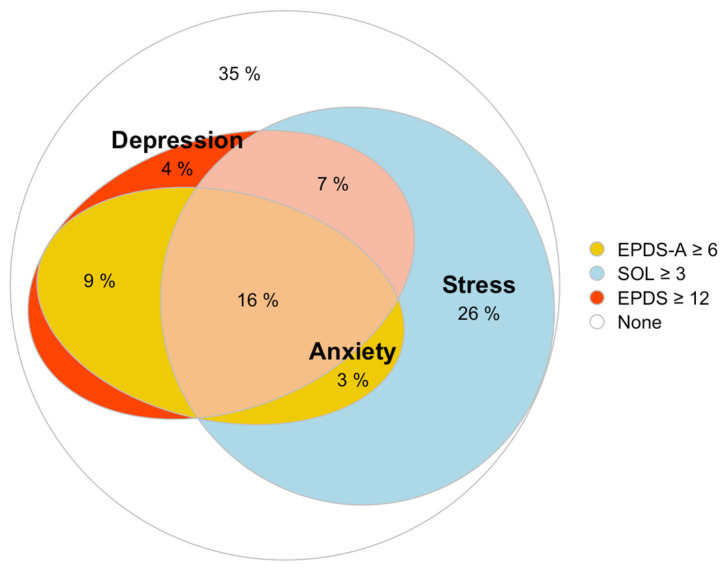
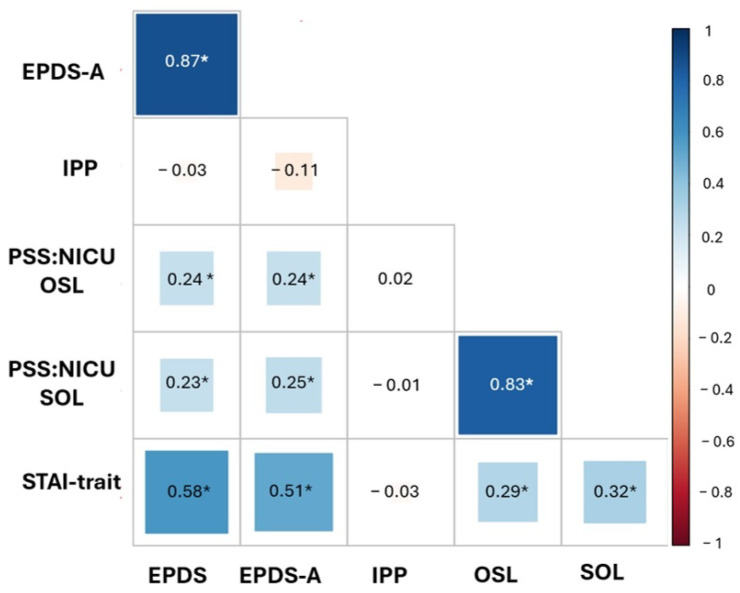
During the COVID-19 pandemic, neonatal care units had to change protocols, and little is known about its impact on parents' mental health. This study aimed to evaluate parental stress, depression, anxiety, and participation in neonatal care in a Brazilian neonatal intensive care unit (NICU) and observe changes over two different periods of the COVID-19 pandemic. Cross-sectional study comparing stress, depression, anxiety, and participation in neonatal care levels between two time periods: T1, high COVID-19 incidence (May 2020 to July 2020 and March 2021 to June 2021) and T2, low COVID-19 incidence (August 2020 to February 2021 and July 2021 to December 2021). High COVID-19 incidence was considered more than 40 confirmed COVID-19-related deaths/day. Validate tools used were the Parental Stressor Scale in NICU (PSS:NICU); the Edinburgh Postnatal Depression Scale (EPDS); the Edinburgh Postnatal Depression Scale-Anxiety subscale (EPDS-A); the State-Trait Anxiety Inventory (STAI); and the Index of Parental Participation (IPP). Stress level was pre-defined as the primary outcome. : 106 parents (98 mothers, 8 fathers) and 111 newborns were included. Overall, 51.9% of parents had a PSS:NICU score ≥ 3 (relevant stress level), 28.3% had an EPDS-A ≥ 6 (indicating anxiety), and 33.0% had an EPDS > 13 (indicating depression). At least one condition was present in 69 (65%) parents, while the three conditions were simultaneously observed in 17 (16%) parents. No significant differences were observed in the frequencies of stress, depression, or anxiety between the two periods. However, median stress occurrence level (SOL) was higher in T1 when compared to T2 (3.24 vs. 2.68; = 0.02), mainly due to "Parental role alteration" (3.80 vs. 3.17; = 0.046). The level of parental participation was not different between the two time periods ( = 0.23). Correlations between stress and both depression and anxiety scores were weak. Parental participation was not significantly correlated to other scores. Elevated levels of stress, depression, and anxiety were observed among NICU parents during both high and low COVID-19 incidence periods. High COVID-19 incidence seems to have particularly influenced stress levels related to parental role alteration. These findings highlight the importance of regularly assessing parental mental health in NICU settings.
在新冠疫情期间,新生儿护理单位不得不改变协议,而其对父母心理健康的影响却鲜为人知。本研究旨在评估巴西一家新生儿重症监护病房(NICU)中父母的压力、抑郁、焦虑状况以及他们参与新生儿护理的情况,并观察新冠疫情两个不同时期的变化。横断面研究比较了两个时间段之间的压力、抑郁、焦虑状况以及参与新生儿护理的水平:T1为新冠发病率高的时期(2020年5月至2020年7月以及2021年3月至2021年6月),T2为新冠发病率低的时期(2020年8月至2021年2月以及2021年7月至2021年12月)。新冠高发病率被定义为每日确诊的与新冠相关的死亡人数超过40人。所使用的经过验证的工具包括新生儿重症监护病房父母压力量表(PSS:NICU);爱丁堡产后抑郁量表(EPDS);爱丁堡产后抑郁量表焦虑子量表(EPDS - A);状态 - 特质焦虑量表(STAI);以及父母参与指数(IPP)。压力水平被预先定义为主要结果。研究纳入了106名父母(98名母亲,8名父亲)和111名新生儿。总体而言,51.9%的父母PSS:NICU得分≥3(相关压力水平),28.3%的父母EPDS - A≥6(表明焦虑),33.0%的父母EPDS>13(表明抑郁)。69名(65%)父母至少存在一种状况,而17名(16%)父母同时存在三种状况。两个时期之间在压力、抑郁或焦虑的发生率上未观察到显著差异。然而,与T2相比,T1时期的压力发生中位数水平(SOL)更高(3.24对2.68;P = 0.02),主要是由于“父母角色改变”(3.80对3.17;P = 0.046)。两个时间段之间父母参与水平没有差异(P = 0.23)。压力与抑郁和焦虑得分之间的相关性较弱。父母参与与其他得分没有显著相关性。在新冠发病率高和低的时期,NICU父母中均观察到压力、抑郁和焦虑水平升高。新冠高发病率似乎特别影响了与父母角色改变相关的压力水平。这些发现凸显了在NICU环境中定期评估父母心理健康的重要性。