Kalligosfyri Panagiota M, Miller Chloe, Cinti Stefano, Patel Bhavik Anil
Department of Pharmacy, University of Naples Federico II, 80131, Naples, Italy.
Centre for Lifelong Health and School of Applied Sciences, University of Brighton, Brighton, BN2 4GJ, UK.
Mikrochim Acta. 2025 May 1;192(5):330. doi: 10.1007/s00604-025-07190-1.
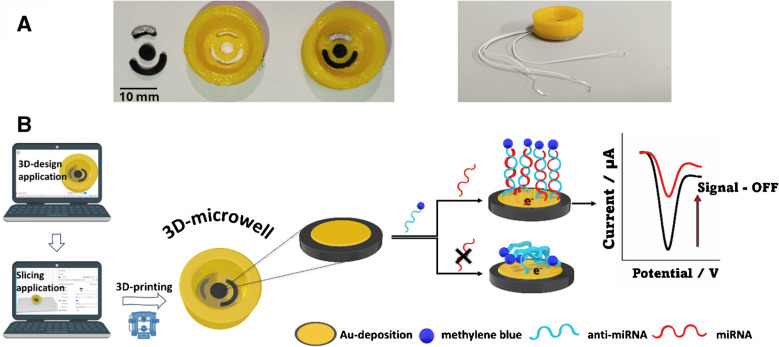
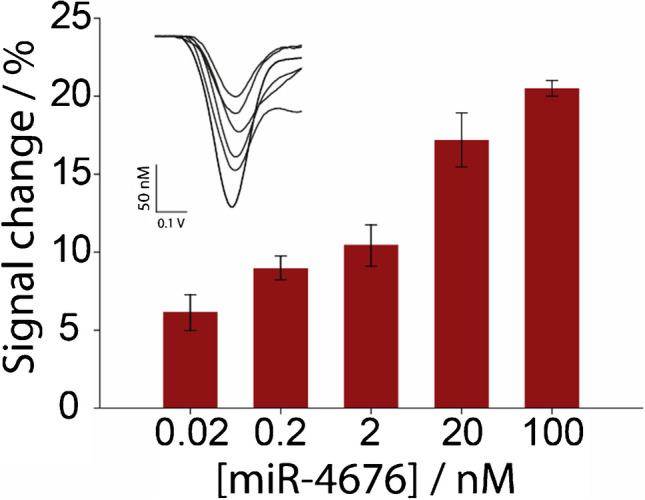
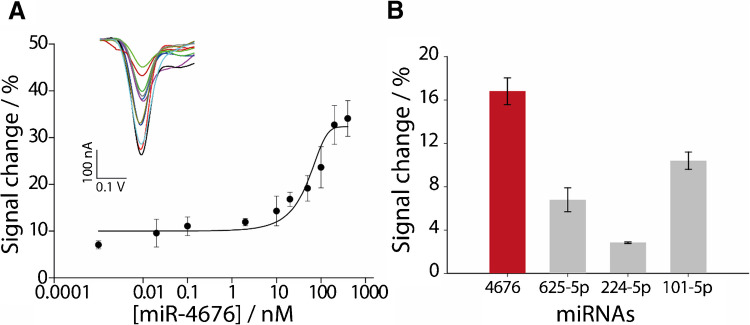
3D printing has enabled the ability to make creative electrochemical well designs suitable for a wide field of electrochemical sensing. The demand for robust electrochemical systems is particularly high in diagnostics, where the rapid detection of emerging biomarkers associated with severe diseases is critical for rapid medical decision-making. This study is aimed at developing a fully 3D-printed electrochemical sensing device featuring a three-electrode system fabricated from conductive printing materials and incorporating a microwell as the sensing platform. The assay principle of a robust electrochemical screen-printed sensor was adapted for this platform, incorporating a well-structured design to enhance fluid control. This structure ensured the uniform distribution of reagents across the sensing surface, improving the reproducibility and consistency of measurements and enabling the reliable detection of a microRNA target associated with lung cancer. The detection process was based on the hybridization of the target miRNA with an immobilized DNA probe labeled with methylene blue as a redox mediator. The sensor was thoroughly characterized and optimized, achieving a dynamic detection range of 0.001 to 400 nM and a lower limit of detection compared to screen-printed sensors, down to the picomolar level. Furthermore, the sensor demonstrated high selectivity for the target miRNA compared to other miRNA sequences, proving its specificity. These results highlighted the potential of 3D printing technology for the development of sensitive and selective tools for biomarker detection, making it a valuable complementary method in the field of diagnostics.
3D打印技术使得制造适用于广泛电化学传感领域的创新性电化学阱设计成为可能。在诊断领域,对强大的电化学系统的需求尤为迫切,因为快速检测与严重疾病相关的新兴生物标志物对于快速医疗决策至关重要。本研究旨在开发一种完全3D打印的电化学传感装置,该装置具有由导电印刷材料制成的三电极系统,并包含一个微孔作为传感平台。一种强大的电化学丝网印刷传感器的检测原理被应用于该平台,采用了结构良好的设计以增强流体控制。这种结构确保了试剂在传感表面的均匀分布,提高了测量的重现性和一致性,并能够可靠地检测与肺癌相关的微小RNA靶标。检测过程基于靶标微小RNA与固定化的DNA探针杂交,该探针标记有作为氧化还原介质的亚甲基蓝。对该传感器进行了全面表征和优化,实现了0.001至400 nM的动态检测范围,与丝网印刷传感器相比检测下限低至皮摩尔水平。此外,与其他微小RNA序列相比,该传感器对靶标微小RNA表现出高选择性,证明了其特异性。这些结果突出了3D打印技术在开发用于生物标志物检测的灵敏和选择性工具方面的潜力,使其成为诊断领域中一种有价值的补充方法。