Guan Hongyu, Xue Jing, Zhang Yunyun, Chang Fang, Liu Wenting
Center for Experimental Economics in Education, Faculty of Education, Shaanxi Normal University, Xian, 710119, China.
College of Economics, Xi'an University of Finance and Economics, Xi'an, China.
BMC Public Health. 2025 May 1;25(1):1616. doi: 10.1186/s12889-025-22861-7.
Rearranging school layouts in rural areas has been one of the most important changes to basic education in China since the early 2000s. The layout adjustment has increased the service radius of rural primary schools and increased the distance for students to go to school. While numerous studies have revealed that reducing commuting time would improve positive emotions, limited attention has been given to examining the relationship between commuting time, academic performance, and mental health in China.
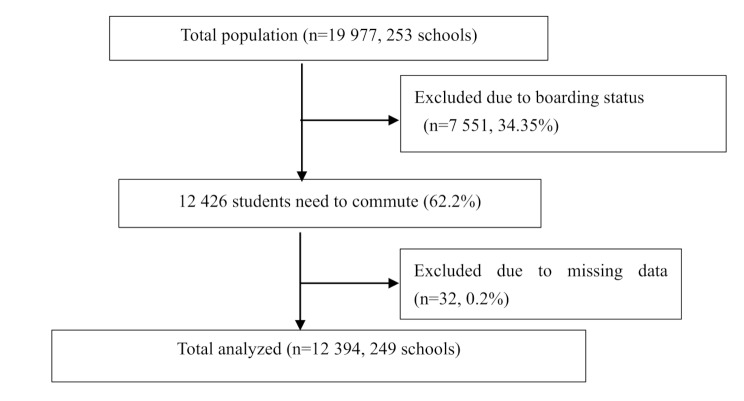
Using survey data from 12,394 students in 249 rural primary schools in 18 counties, this study examines the association of commuting time on academic performance and mental health among rural students in China. Instrumental variable (IV) estimation techniques are utilized to address potential endogeneity issues and provide robust estimates of the relationships under investigation. Academic performance was measured using the Trends in International Mathematics and Science Study (TIMSS) test, and mental health status was measured using the Mental Health Test (MHT).
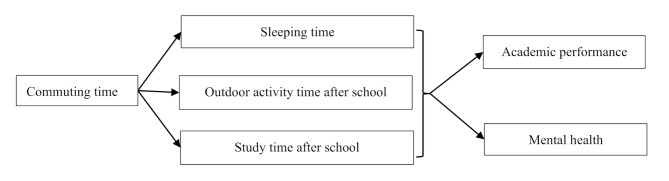
.Lengthy commutes are negatively associated with students' academic performance and mental health. Each additional hour of commuting time is associated with a 0.148 SD decrease in academic performance and a 3.039 increase in mental health test scores for students, indicating a higher risk of mental health problems. Heterogeneity analysis revealed that the effect of commuting time is more pronounced for female students, senior students, students with migrant parents, and students whose parents have lower education levels. Mechanism analysis demonstrates that sleep duration and after-school outdoor activities mediate the relationship between commuting time, academic achievement, and mental health.
This study contributes new evidence regarding the association between commuting time, academic performance, and mental health among rural students in China. The findings offer valuable insights for education policymakers in optimizing school location and layout strategies to support students' academic success and mental well-being.
Permission was received from local Boards of Education in each region and the principals of all schools. The principles of the Declaration of Helsinki were followed throughout. Oral informed consent was obtained from at least one parent for all child participants. Ethical committee approval for this study were obtained from Sun Yat-Sen University (Registration number: 2013MEKY018) and Stanford University (Registration number: 24847). The trial registration number is ISRCTN03252665 (registered at 25/09/2012).
自21世纪初以来,调整农村地区学校布局一直是中国基础教育最重要的变革之一。布局调整扩大了农村小学的服务半径,增加了学生上学的距离。虽然众多研究表明减少通勤时间会改善积极情绪,但在中国,对于研究通勤时间、学业成绩和心理健康之间的关系,关注有限。
本研究利用来自18个县249所农村小学12394名学生的调查数据,考察了中国农村学生通勤时间与学业成绩和心理健康之间的关联。采用工具变量(IV)估计技术来解决潜在的内生性问题,并对所研究的关系提供稳健的估计。学业成绩通过国际数学和科学趋势研究(TIMSS)测试来衡量,心理健康状况通过心理健康测试(MHT)来衡量。
长时间通勤与学生的学业成绩和心理健康呈负相关。通勤时间每增加一小时,学生的学业成绩会下降0.148个标准差,心理健康测试得分会增加3.039分,这表明心理健康问题的风险更高。异质性分析显示,通勤时间对女生、高年级学生、父母为流动人口的学生以及父母教育水平较低的学生的影响更为明显。机制分析表明,睡眠时间和课后户外活动在通勤时间、学业成绩和心理健康之间的关系中起中介作用。
本研究为中国农村学生通勤时间、学业成绩和心理健康之间的关联提供了新的证据。研究结果为教育政策制定者优化学校选址和布局策略以支持学生的学业成功和心理健康提供了有价值的见解。
已获得每个地区当地教育委员会和所有学校校长的许可。自始至终遵循《赫尔辛基宣言》的原则。已获得所有儿童参与者至少一位家长的口头知情同意。本研究已获得中山大学(注册号:2013MEKY018)和斯坦福大学(注册号:24847)伦理委员会的批准。试验注册号为ISRCTN03252665(于2012年9月25日注册)。