Harley Ohisa, Amelia Yufilia Suci, Gustianty Elsa, Soetedjo Nanny N M, Kartasasmita Arief S
Doctoral Program in Medical Sciences, Faculty of Medicine, Padjadjaran University, Terusan Ekologi- No 7, Ir. Soekarno Street Km 21, Jatinangor, Bandung, West Java, 45363, Indonesia.
Netra Eye Clinic, Sumatera Street No. 46 - 68, Bandung, West Java, 40114, Indonesia.
BMC Ophthalmol. 2025 May 1;25(1):265. doi: 10.1186/s12886-025-04075-y.
Diabetic retinopathy (DR) is increasingly prevalent and a major cause of irreversible blindness, particularly in developing countries. Limited access to ophthalmologists often leads to delayed diagnosis, emphasizing the need for more affordable and widely accessible screening methods to facilitate early identification. Recently, several studies have demonstrated variability in findings regarding the relationship between leukocyte differential count ratio biomarkers and DR. This study aims to investigate the association between leukocyte differential count ratios-NLR (Neutrophil-to-Lymphocyte Ratio), PLR (Platelet-to-Lymphocyte Ratio), MLR (Monocyte-to-Lymphocyte Ratio), and SII (Systemic Immune-Inflammation Index)-and the stages of diabetic retinopathy (DR).
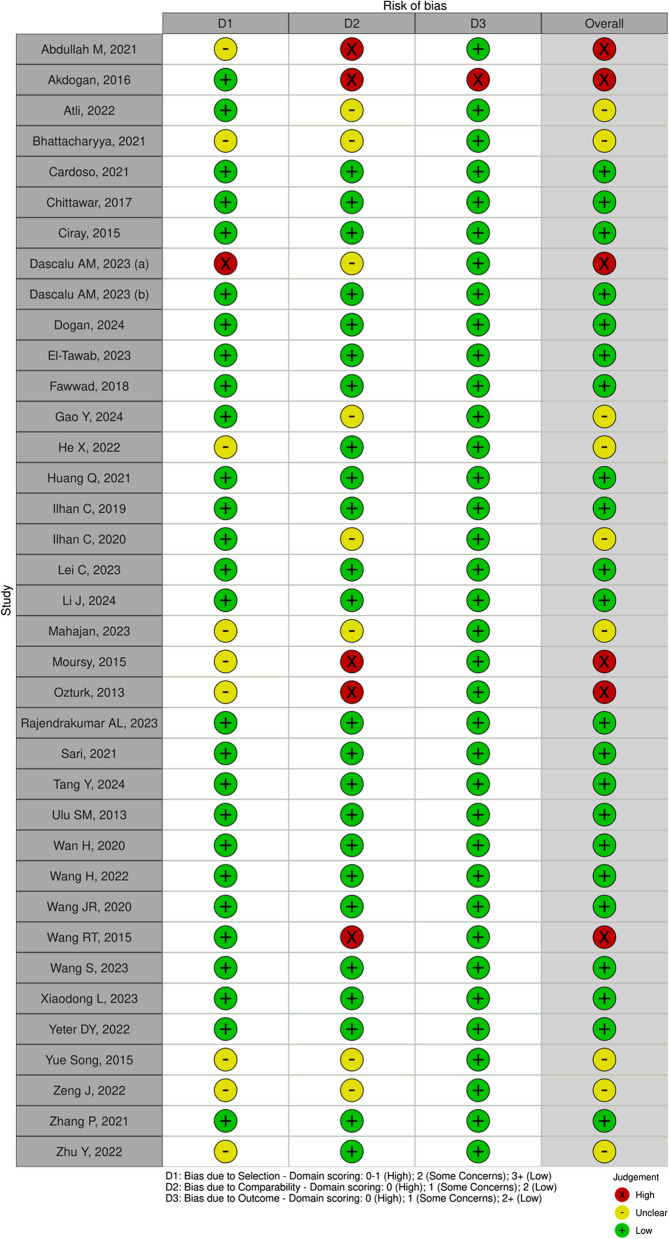
A comprehensive literature search was conducted across several databases up to September 2024, with a focus on identifying studies examining the relationship between the leukocyte differential count ratio profiles and diabetic retinopathy. Review Manager was used to conduct the meta-analyses. The Newcastle Ottawa Scale (NOS) were used to assess the included studies.
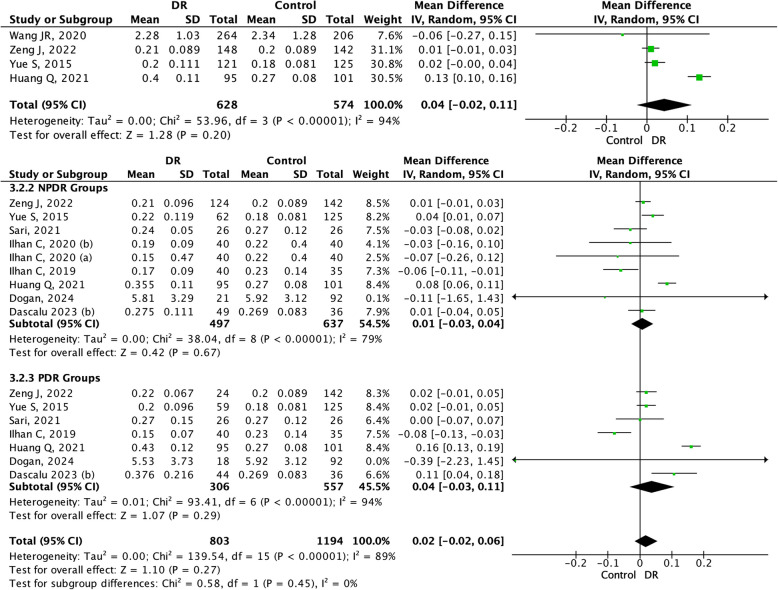
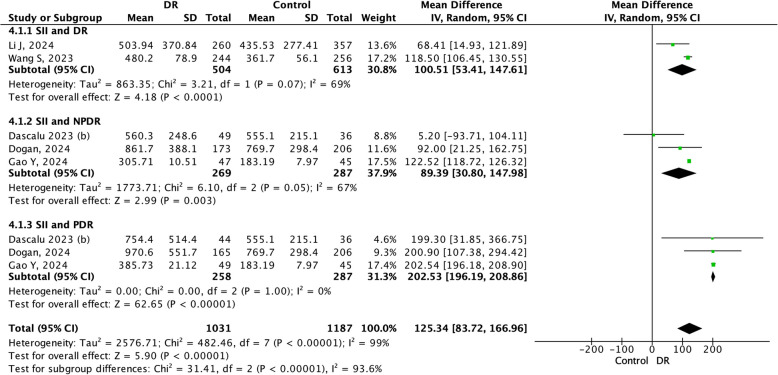
A total of 38 studies were included in the systematic review and 27 studies were included in the meta-analysis. The mean differences in the NLR and PLR values were significantly different among the groups and were higher in the PDR group (0.68 (95%CI 0.42-0.95, p < 0.05) and 19.57 (95%CI 10.68-28.46, p < 0.05; respectively). These findings were followed by significant differences in SII value 202.53 (95% CI 196.19-208.86, p < 0.05). Moreover, the MLR values were not significantly different among the groups (p > 0.05).
NLR, PLR, and SII are associated with both the presence and progression of DR, with increasing levels of NLR and PLR reflecting a higher risk and severity of the disease. However, it is still necessary to justify the need to combine them with other clinical parameters to confirm the diagnosis.
糖尿病视网膜病变(DR)日益普遍,是不可逆失明的主要原因,尤其是在发展中国家。眼科医生数量有限常常导致诊断延迟,这凸显了需要更经济实惠且易于获得的筛查方法,以促进早期识别。最近,几项研究表明,关于白细胞分类计数比率生物标志物与DR之间的关系,研究结果存在差异。本研究旨在调查白细胞分类计数比率——中性粒细胞与淋巴细胞比率(NLR)、血小板与淋巴细胞比率(PLR)、单核细胞与淋巴细胞比率(MLR)以及全身免疫炎症指数(SII)——与糖尿病视网膜病变(DR)各阶段之间的关联。
截至2024年9月,在多个数据库中进行了全面的文献检索,重点是识别研究白细胞分类计数比率谱与糖尿病视网膜病变之间关系的研究。使用Review Manager进行荟萃分析。采用纽卡斯尔渥太华量表(NOS)评估纳入的研究。
系统评价共纳入38项研究,荟萃分析纳入27项研究。NLR和PLR值的平均差异在各组之间具有显著差异,在增殖性糖尿病视网膜病变(PDR)组中更高(分别为0.68(95%可信区间0.42 - 0.95,p < 0.05)和19.57(95%可信区间10.68 - 28.46,p < 0.05)。这些结果之后是SII值存在显著差异,为202.53(95%可信区间196.19 - 208.86,p < 0.05)。此外,各组之间的MLR值没有显著差异(p > 0.05)。
NLR、PLR和SII与DR的存在和进展均相关,NLR和PLR水平升高反映疾病风险和严重程度更高。然而,仍有必要证明将它们与其他临床参数结合以确诊的必要性。