Dergai Oleksandr, Wuu Joanne, Koziczak-Holbro Magdalena, Malaspina Andrea, Granit Volkan, Hernandez Jessica P, Cooley Anne, Sachdev Ruchika, Yu Lili, Bidinosti Michael, Flotte Ludvine, Nash Mark, Jennings Lori L, Berry James D, Bruijn Lucie I, Brachat Sophie, Benatar Michael
Novartis Diseases of Aging and Regenerative Medicine, Novartis Biomedical Research, CH-4002 Basel, Switzerland.
Department of Neurology and ALS Center, University of Miami Miller School of Medicine, Miami, FL, USA.
medRxiv. 2025 Apr 25:2025.04.23.25326161. doi: 10.1101/2025.04.23.25326161.
Biomarkers with clear contexts-of-use are important tools for ALS therapy development. Understanding their longitudinal trajectory in the untreated state is key to their use as potential markers of pharmacodynamic response. To this end, we undertook a large-scale proteomic study in well-phenotyped cohorts to identify biomarker candidates of ALS disease state and disease progression.
Clinical phenotypic data and biofluid samples, collected from patients with ALS and healthy controls through multiple longitudinal natural history studies, were used to identify biomarker candidates. SOMAmer (Slow Off-rate Modified Aptamer)-based relatively quantitative measurement of ~7,000 proteins was performed in plasma and CSF, with immunoassay validation of candidates of interest.
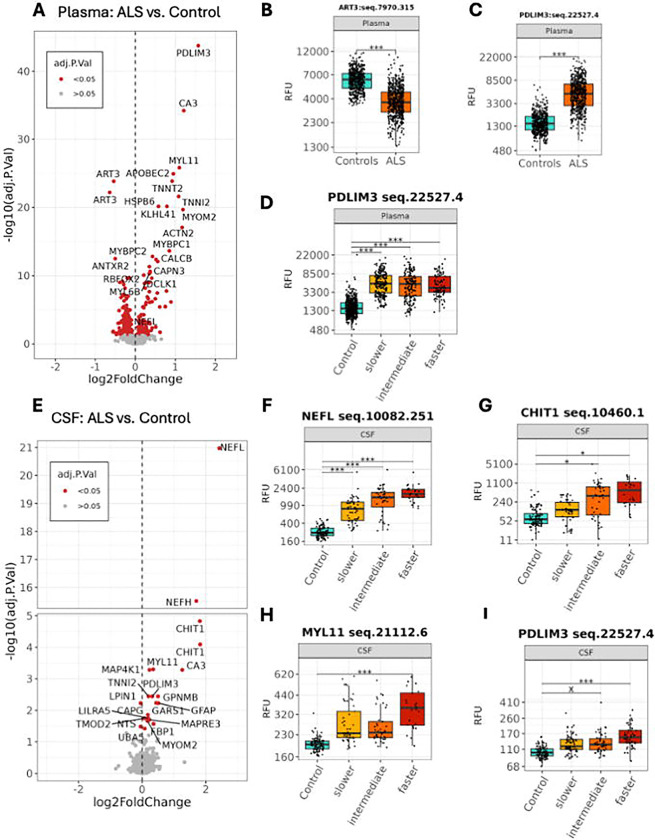
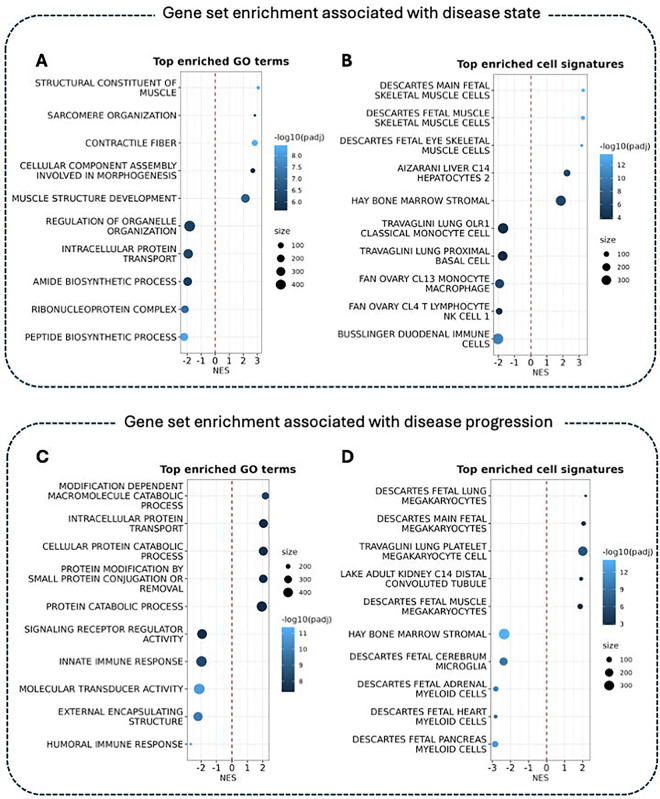
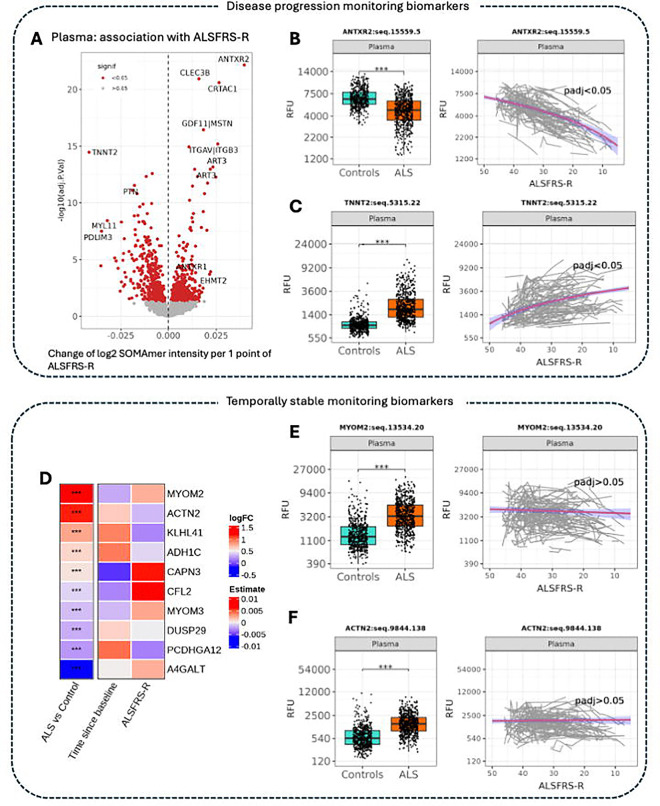
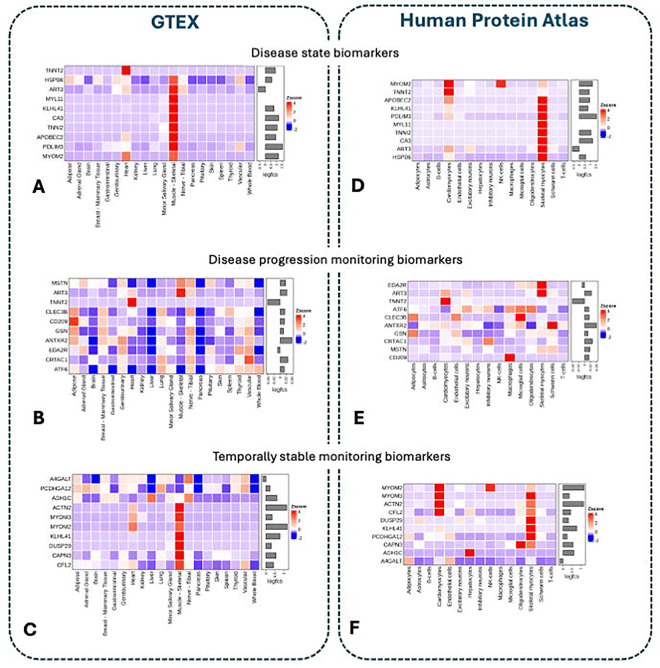
We identified 329 plasma proteins significantly differentially regulated between ALS and controls (adjusted p-value <0.05), with 25 showing >40% relative abundance. PDLIM3, TNNT2, and MYL11 had the greatest log-fold elevation, while ANTXR2 and ART3 had the greatest log-fold reduction. A similar set of plasma proteins was found to increase (e.g. PDLIM3, TNNT2, MYL11) or decrease (e.g. ANTXR2, ART3, MSTN) with disease progression. CSF proteins with the greatest log-fold elevation included NEFL, NEFH, CHIT1, CA3, MYL11 and GPNMB. These results were confirmed in an independent replication cohort. Moreover, tissue-specific signature enrichment suggests a significant contribution of muscle as a source of these biomarkers. Immunoassays provided orthogonal validation of plasma TNNT2 and CSF GPNMB.
We identified an array of novel biomarkers with the potential to serve as response biomarkers to aid therapy development, as well as to shed light on the underlying biology of disease.
具有明确应用背景的生物标志物是肌萎缩侧索硬化症(ALS)治疗开发的重要工具。了解它们在未治疗状态下的纵向变化轨迹是将其用作药效学反应潜在标志物的关键。为此,我们在表型良好的队列中进行了一项大规模蛋白质组学研究,以确定ALS疾病状态和疾病进展的生物标志物候选物。
通过多项纵向自然史研究从ALS患者和健康对照中收集的临床表型数据和生物流体样本,用于确定生物标志物候选物。在血浆和脑脊液中对约7000种蛋白质进行了基于SOMAmer(慢解离修饰适体)的相对定量测量,并对感兴趣的候选物进行了免疫测定验证。
我们鉴定出329种血浆蛋白在ALS患者和对照之间存在显著差异调节(校正p值<0.05),其中25种蛋白的相对丰度变化>40%。PDLIM3、TNNT2和MYL11的对数倍升高最大,而ANTXR2和ART3的对数倍降低最大。随着疾病进展,发现一组类似的血浆蛋白增加(如PDLIM3、TNNT2、MYL11)或减少(如ANTXR2、ART3、MSTN)。对数倍升高最大的脑脊液蛋白包括NEFL、NEFH、CHIT1、CA3、MYL11和GPNMB。这些结果在一个独立的复制队列中得到了证实。此外,组织特异性特征富集表明肌肉作为这些生物标志物来源的显著贡献。免疫测定为血浆TNNT2和脑脊液GPNMB提供了正交验证。
我们鉴定出一系列新型生物标志物,它们有可能作为反应生物标志物来辅助治疗开发,并阐明疾病的潜在生物学机制。