Lee Su Ji, Hwang Jihye, Kang Min Gyu, Cho Minjae, Ha Yoon, Cho Sung-Rae
Department and Research Institute of Rehabilitation Medicine, Yonsei University College of Medicine, Seoul, Republic of Korea.
Graduate Program of Biomedical Engineering, Yonsei University College of Medicine, Seoul, Republic of Korea.
Global Spine J. 2025 May 2:21925682251337396. doi: 10.1177/21925682251337396.
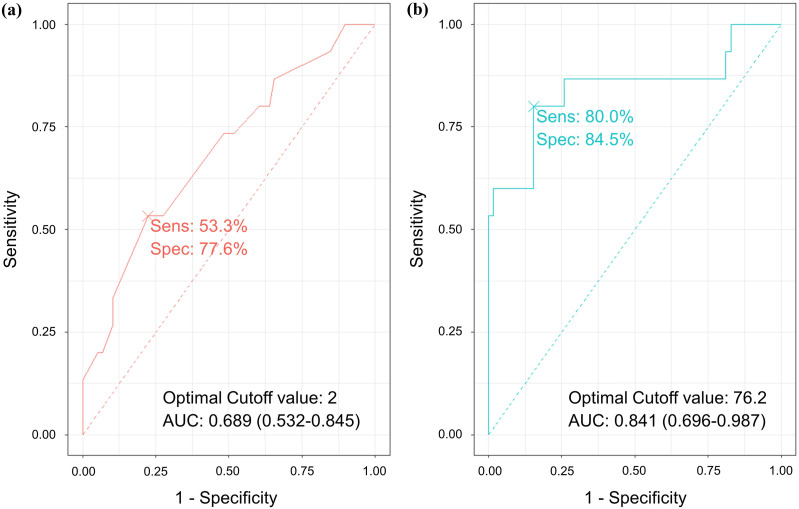
Study DesignRetrospective cohort study.ObjectivesThis study aimed to identify factors influencing postoperative outcomes of cervical spondylotic myelopathy (CSM) in individuals with cerebral palsy (CP).MethodsData from admitted individuals were retrospectively reviewed. Individuals whose modified Barthel index score, assessed at least 6 months after surgery, declined by 1 or more grades compared to their preoperative score were classified into the poor outcome (PO) group. Multivariate logistic regression analysis was performed to assess risk factors for poor postoperative outcomes.ResultsOf the 73 participants, 15 were in the PO group and 58 in the non-PO group. Duration (OR 1.99, 95% CI 1.25-3.65, = .01), signal change grade 2 (OR 10.44, 95% CI 1.32-118.01, = .034), and spinal cord compression ratio, M2 (OR 0.85, 95% CI, 0.73-0.96, = .02) on preoperative MRI were identified as significant factors associated with the risk of poor postoperative outcomes. Based on the receiver operating characteristic curve analysis, the cutoff values for duration and cord compression metric were determined as 2 years (AUC = 0.689, 95% CI 0.532-0.845) and 76.2% (AUC = 0.841, 95% CI 0.696-0.987), respectively.ConclusionsThis study identified key predictors of poor postoperative outcomes in individuals with CP undergoing surgery for CSM. Symptom duration exceeding 2 years, signal change grade 2, and spinal cord compression ratio below 76.2% on preoperative MRI were found to be predictors of poor outcome. These results underscore the importance of early intervention and detailed preoperative radiological assessment to improve surgical outcomes in this population.
研究设计
回顾性队列研究。
目的
本研究旨在确定影响脑瘫(CP)患者颈椎病性脊髓病(CSM)术后结局的因素。
方法
对入院患者的数据进行回顾性分析。将术后至少6个月评估的改良Barthel指数评分较术前评分下降1个或更多等级的患者分类为预后不良(PO)组。进行多因素逻辑回归分析以评估术后不良结局的危险因素。
结果
73名参与者中,15名在PO组,58名在非PO组。术前MRI上的病程(OR 1.99,95% CI 1.25 - 3.65,P = 0.01)、信号改变2级(OR 10.44,95% CI 1.32 - 118.01,P = 0.034)和脊髓压迫率M2(OR 0.85,95% CI 0.73 - 0.96,P = 0.02)被确定为与术后不良结局风险相关的重要因素。基于受试者工作特征曲线分析,病程和脊髓压迫指标的截断值分别确定为2年(AUC = 0.689,95% CI 0.532 - 0.845)和76.2%(AUC = 0.841,95% CI 0.696 - 0.987)。
结论
本研究确定了接受CSM手术的CP患者术后不良结局的关键预测因素。术前MRI显示症状持续时间超过2年、信号改变2级和脊髓压迫率低于76.2%是不良结局的预测因素。这些结果强调了早期干预和详细的术前放射学评估对改善该人群手术结局的重要性。