Xing Xin, Yin Shi-Qi, Li Xia-Qing, Li Hui, Ma Hong-Tai, Tulamaiti Aziguli, Xiao Shu-Yu, Liu Yu-Tong, Zhang Hao, Zhang Zhigang, Huo Yan-Miao, Yang Xiao-Mei, Yang Yan, Zhang Xue-Li
Shanghai Fengxian District Central Hospital, School of Medicine, Anhui University of Science and Technology, Shanghai, China.
Shanghai University of Medicine and Health Sciences Affiliated Sixth People's Hospital South Campus, Shanghai, China.
J Immunother Cancer. 2025 May 2;13(5):e010908. doi: 10.1136/jitc-2024-010908.
Immune evasion is a crucial event in the progression of pancreatic ductal adenocarcinoma (PDAC). The identification of new immunotherapeutic targets may provide a promising platform for advancing PDAC treatment. This study aims to investigate the role of beta-1,4-galactosyltransferase-5 (B4GALT5) in immune evasion by pancreatic cancer cells and evaluate its potential as an immunotherapeutic target.
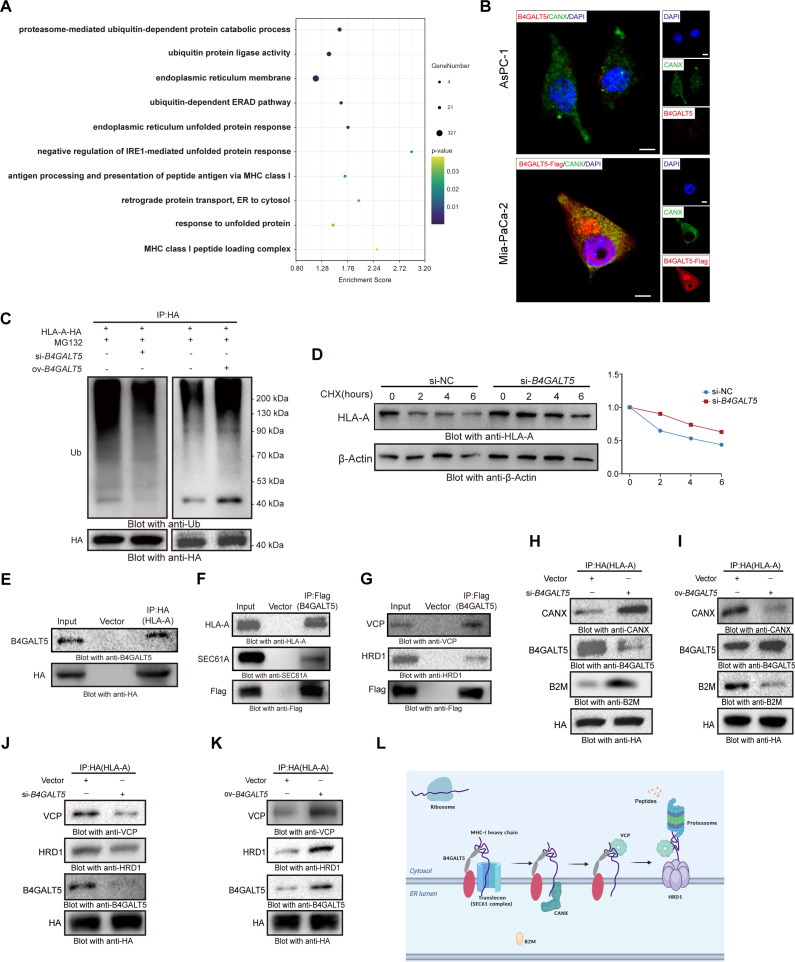
We conducted a comprehensive analysis using RNA sequencing data and tissue microarrays from patients with PDAC to investigate the association between B4GALT5 expression and patient prognosis. Using animal models, we further explored the impact of B4GALT5 on the quantity and activity of tumor-infiltrating CD8 T cells. RNA sequencing and co-immunoprecipitation were used to explore the mechanism by which B4GALT5 regulates major histocompatibility complex (MHC-I) levels.
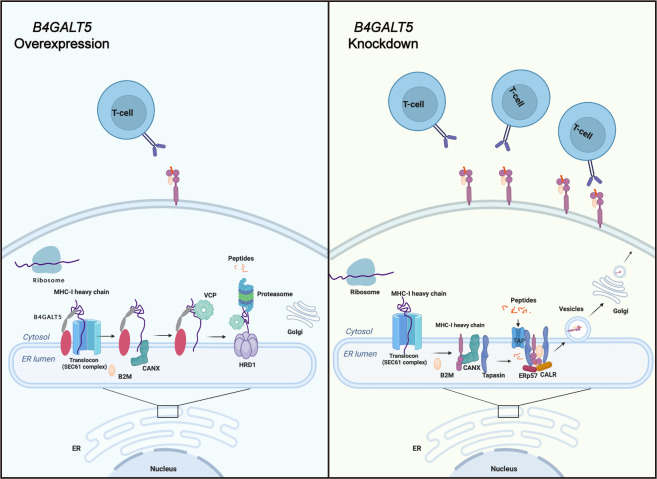
Our study demonstrates that high expression of B4GALT5 in tumor cells is significantly associated with poor prognosis in patients with PDAC and reduced cytotoxic activity of tumor-infiltrating CD8 T cells. Specifically, B4GALT5 suppresses MHC-I expression in tumor cells through the endoplasmic reticulum-associated degradation pathway, enabling them to evade immune surveillance by CD8 T cells.
B4GALT5 impairs CD8 T-cell recognition of tumor cells by regulating MHC-I levels, thereby promoting immune evasion. This makes B4GALT5 a highly promising immunotherapeutic target for improving the poor prognosis of patients with PDAC.
免疫逃逸是胰腺导管腺癌(PDAC)进展中的关键事件。鉴定新的免疫治疗靶点可能为推进PDAC治疗提供一个有前景的平台。本研究旨在探讨β-1,4-半乳糖基转移酶-5(B4GALT5)在胰腺癌细胞免疫逃逸中的作用,并评估其作为免疫治疗靶点的潜力。
我们使用来自PDAC患者的RNA测序数据和组织芯片进行了全面分析,以研究B4GALT5表达与患者预后之间的关联。利用动物模型,我们进一步探究了B4GALT5对肿瘤浸润性CD8 T细胞数量和活性的影响。采用RNA测序和免疫共沉淀法来探索B4GALT5调节主要组织相容性复合体(MHC-I)水平的机制。
我们的研究表明,肿瘤细胞中B4GALT5的高表达与PDAC患者的不良预后显著相关,且肿瘤浸润性CD8 T细胞的细胞毒性活性降低。具体而言,B4GALT5通过内质网相关降解途径抑制肿瘤细胞中的MHC-I表达,使其能够逃避CD8 T细胞的免疫监视。
B4GALT5通过调节MHC-I水平损害CD8 T细胞对肿瘤细胞的识别,从而促进免疫逃逸。这使得B4GALT5成为改善PDAC患者不良预后极有前景的免疫治疗靶点。