Zuo Ying, Yang Guang, Cheng Haoxuan, Zhang Lufa
School of International and Public Affairs, Shanghai Jiao Tong University, No. 1954, Huashan Road, Xuhui District, Shanghai, 200030, China.
Institute of Health Yangtze River Delta, Shanghai Jiao Tong University, Address: No. 1954, Huashan Road, Xuhui District, Shanghai, 200030, China.
BMC Public Health. 2025 May 2;25(1):1629. doi: 10.1186/s12889-025-22882-2.
Since the 2009 healthcare reform, the Chinese government has been committed to establishing a universal healthcare system. This study aims to investigate the complex reasons behind rural residents' decision to forgo participation in the medical insurance system by examining causal relationships and interactions.
This study employs content analysis, conducting in-depth interviews with 42 stakeholders, including government administration departments, tax departments, medical insurance departments, village committees, and residents who have withdrawn from the health insurance system.
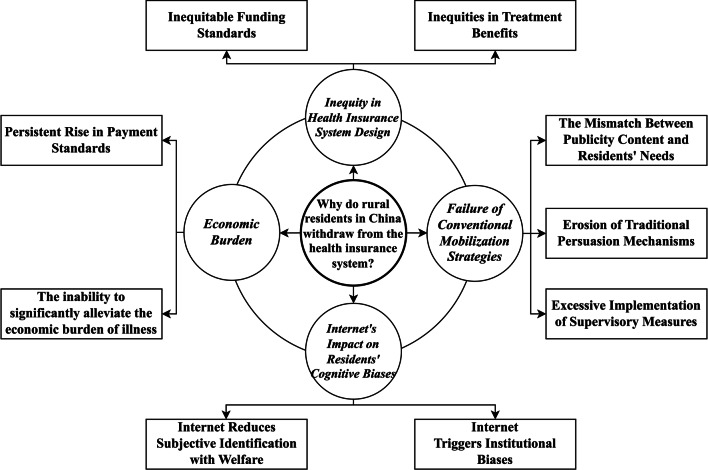
The study finds that the primary reasons rural residents withdraw from the medical insurance system are fourfold: heavy economic burdens, unfair design of the medical insurance system, failure of conventional mobilization strategies, and the internet's impact on residents' cognitive biases.
The decision of rural residents in China to withdraw from the medical insurance system is influenced not only by economic factors but also by the system's design and various aspects of rural governance. Moving forward, the Chinese government should optimize the medical insurance system's design, implement more flexible mobilization and persuasion strategies, and prioritize the identification and regulation of misleading information.
自2009年医疗改革以来,中国政府一直致力于建立全民医疗体系。本研究旨在通过考察因果关系和相互作用,探究农村居民决定放弃参加医疗保险制度背后的复杂原因。
本研究采用内容分析法,对42名利益相关者进行了深入访谈,这些利益相关者包括政府行政部门、税务部门、医疗保险部门、村委会以及已退出医疗保险制度的居民。
研究发现,农村居民退出医疗保险制度的主要原因有四个方面:经济负担过重、医疗保险制度设计不公平、传统动员策略失效以及互联网对居民认知偏差的影响。
中国农村居民退出医疗保险制度的决定不仅受到经济因素的影响,还受到制度设计和农村治理各方面的影响。展望未来,中国政府应优化医疗保险制度设计,实施更灵活的动员和劝说策略,并优先识别和规范误导性信息。