Paulus Michelle Carmen, Melchers Max, van Es Anouck, Kouw Imre Willemijn Kehinde, van Zanten Arthur Raymond Hubert
Department of Intensive Care Medicine & Research, Gelderse Vallei Hospital, Willy Brandtlaan 10, 6716 RP, Ede, The Netherlands.
Division of Human Nutrition and Health, Nutritional Biology, Wageningen University & Research, HELIX (Building 124), Stippeneng 4, 6708 WE, Wageningen, The Netherlands.
Crit Care. 2025 May 2;29(1):175. doi: 10.1186/s13054-025-05396-6.
Severe protein catabolism is a major aspect of critical illness and leads to pronounced muscle wasting and, consequently, extended intensive care unit (ICU) stay and increased mortality. The urea-to-creatinine ratio (UCR) has emerged as a promising biomarker for assessing protein catabolism in critical illness, which is currently lacking. This review aims to elucidate the role of UCR in the context of critical illness.
This scoping review adhered to the PRISMA Extension for Scoping Reviews guidelines. A comprehensive literature search was conducted on the 3rd of September 2024, across Embase, PubMed, ScienceDirect, and Cochrane Library to identify studies related to (1) critically ill adult patients and (2) reporting at least a single UCR value. A meta-analysis was conducted for ≥ 5 studies with identical outcome parameters.
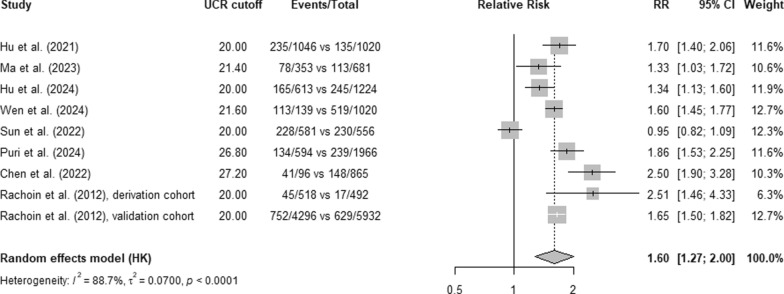
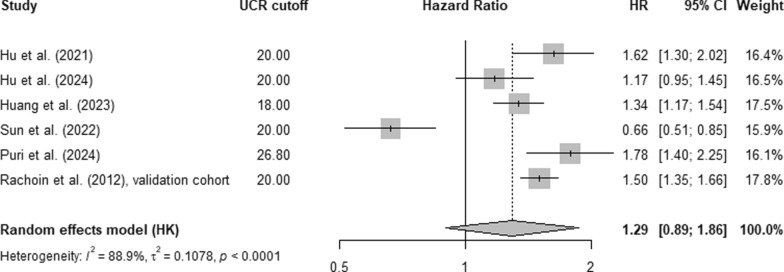
Out of 1,450 studies retrieved, 47 were included in this review, focusing on UCR's relation to protein catabolism and persistent critical illness (10 studies), mortality (16 studies), dietary protein interventions (2 studies), and other outcomes (19 studies), such as delirium, and neurological and cardiac adverse events. UCR is inversely correlated to muscle cross-sectional area over time and associated to length of ICU stay, emphasising its potential role in identifying patients with ongoing protein catabolism. A UCR (BUN-to-creatinine in mg/dL) of ≥ 20 (equivalent to a urea-to-creatinine in mmol/L of approximately 80) upon ICU admission, in comparison with a value < 20, was associated with a relative risk of 1.60 (95% CI 1.27-2.00) and an adjusted hazard ratio of 1.29 (95% CI 0.89-1.86) for in-hospital mortality.
UCR elevations during critical illness potentially indicate muscle protein catabolism and the progression to persistent critical illness, and high levels at ICU admission could be associated with mortality. UCR increments during ICU stay may also indicate excessive exogenous dietary protein intake, overwhelming the body's ability to use it for whole-body or muscle protein synthesis. Dehydration, gastrointestinal bleeding, kidney and liver dysfunction, and renal replacement therapy may also influence UCR and are considered potential pitfalls when assessing catabolic phases of critical illness by UCR. Patient group-specific cut-off values are warranted to ensure its validity and application in clinical practice.
严重的蛋白质分解代谢是危重病的一个主要方面,会导致明显的肌肉萎缩,进而导致重症监护病房(ICU)住院时间延长和死亡率增加。尿素与肌酐比值(UCR)已成为评估危重病中蛋白质分解代谢的一个有前景的生物标志物,而目前这方面尚缺乏相关研究。本综述旨在阐明UCR在危重病中的作用。
本范围综述遵循PRISMA扩展的范围综述指南。于2024年9月3日在Embase、PubMed、ScienceDirect和Cochrane图书馆进行了全面的文献检索,以识别与以下内容相关的研究:(1)成年危重病患者;(2)至少报告一个UCR值。对≥5项具有相同结局参数的研究进行了荟萃分析。
在检索到的1450项研究中,本综述纳入了47项,重点关注UCR与蛋白质分解代谢和持续性危重病的关系(10项研究)、死亡率(16项研究)、膳食蛋白质干预(2项研究)以及其他结局(19项研究),如谵妄以及神经和心脏不良事件。随着时间的推移,UCR与肌肉横截面积呈负相关,并与ICU住院时间相关,这突出了其在识别持续蛋白质分解代谢患者方面的潜在作用。与ICU入院时UCR(以mg/dL为单位的血尿素氮与肌酐比值)<20相比,UCR≥20(相当于以mmol/L为单位的尿素与肌酐比值约为80)与住院死亡率的相对风险为1.60(95%CI 1.27 - 2.00)以及调整后的风险比为1.29(95%CI 0.89 - 1.86)相关。
危重病期间UCR升高可能表明肌肉蛋白质分解代谢以及向持续性危重病的进展,而ICU入院时的高水平可能与死亡率相关。ICU住院期间UCR升高也可能表明外源性膳食蛋白质摄入过多,超出了身体将其用于全身或肌肉蛋白质合成的能力。脱水、胃肠道出血、肾和肝功能障碍以及肾脏替代治疗也可能影响UCR,在通过UCR评估危重病的分解代谢阶段时被视为潜在的陷阱。需要针对特定患者群体的临界值以确保其在临床实践中的有效性和应用。