
探索人格特质集群对乳腺癌幸存者生活质量的影响:一项为期18个月的前瞻性随访研究。
Exploring the Impact of Personality Trait Clusters on the Quality of Life of Breast Cancer Survivors: An 18-Month Prospective Follow-Up Study.
作者信息
Song In Mok, Cho Eun Young, Baek Ji Hyun, Lee Se Kyung
机构信息
Department of Psychiatry, Samsung Medical Center, Sungkyunkwan University School of Medicine, Seoul, Korea.
Department of Psychiatry, Maritime Medical Center, Changwon, Korea.
出版信息
Cancer Med. 2025 May;14(9):e70842. doi: 10.1002/cam4.70842.
OBJECTIVE
To investigate the impact of personality trait clusters on the quality of life (QoL) of breast cancer survivors (BCS) during the first 18 months following diagnosis.
METHODS
A cohort of 476 newly diagnosed breast cancer patients was recruited between January 2017 and August 2018 from a single academic hospital in Seoul, Korea. Five-factor models of personality traits were assessed at baseline. QoL evaluations were performed prior to surgery and up to 18 months post-surgery. K-means clustering analysis was employed to construct personality clusters. Long-term QoL trajectories in BCS were compared between clusters, adjusting for individual resilience. Furthermore, a polygenic risk score (PRS) for neuroticism was calculated, exploring its relationships with neuroticism and personality trait clusters identified in this study.
RESULTS
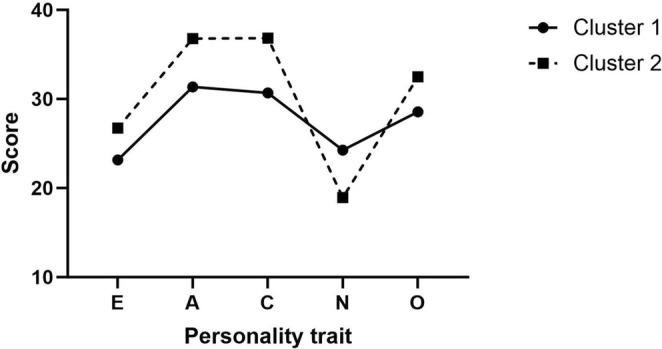
Cluster analysis suggested that a two-cluster model was more appropriate than a three-cluster model. The two clusters were characterized by (1) low neuroticism and high scores in the other four traits, and (2) high neuroticism and low scores in the other four traits. Patients in cluster 2 exhibited significantly lower baseline QoL scores compared to those in other clusters, from baseline through 18 months post-surgery. The PRS for neuroticism showed a significant association with neuroticism scores (p = 0.032) after adjusting for age and depression scores. No significant differences in PRS were observed between the clusters. Additionally, the PRS for neuroticism was not significantly associated with QoL.
CONCLUSION
Our findings underscore the influence of individual personality traits on long-term QoL in BCS. These results suggest the potential for targeted interventions to enhance long-term QoL based on personalized personality profiles.
目的
探讨人格特质集群对乳腺癌幸存者(BCS)诊断后前18个月生活质量(QoL)的影响。
方法
2017年1月至2018年8月期间,从韩国首尔的一家学术医院招募了476名新诊断的乳腺癌患者。在基线时评估人格特质的五因素模型。在手术前和手术后长达18个月进行生活质量评估。采用K均值聚类分析构建人格集群。在调整个体复原力的情况下,比较各集群中BCS的长期生活质量轨迹。此外,计算了神经质的多基因风险评分(PRS),探讨其与本研究中确定的神经质和人格特质集群的关系。
结果
聚类分析表明,两集群模型比三集群模型更合适。这两个集群的特征分别为:(1)低神经质,在其他四个特质上得分高;(2)高神经质,在其他四个特质上得分低。与其他集群相比,集群2中的患者从基线到术后18个月的基线生活质量得分显著更低。在调整年龄和抑郁评分后,神经质的PRS与神经质评分显著相关(p = 0.032)。各集群之间在PRS上未观察到显著差异。此外,神经质的PRS与生活质量无显著关联。
结论
我们的研究结果强调了个体人格特质对BCS长期生活质量的影响。这些结果表明,基于个性化人格概况进行有针对性干预以提高长期生活质量具有潜力。

 Zotero 插件