Oud Lavi, Garza John
Division of Pulmonary and Critical Care Medicine, Department of Internal Medicine, Texas Tech University Health Sciences Center at the Permian Basin, Odessa, TX 79763, USA.
Department of Pediatrics, Texas Tech University Health Sciences Center at the Permian Basin, Odessa, TX 79763, USA.
J Clin Med Res. 2025 Apr;17(4):187-199. doi: 10.14740/jocmr6189. Epub 2025 Mar 17.
Reports on the comparative mortality among mechanically ventilated patients with coronavirus disease 2019 (COVID-19) and influenza show conflicting findings, but studies focused largely on the early phase of the pandemic, using historical influenza comparators. We sought to examine the population-level comparative mortality among mechanically ventilated patients with COVID-19 during the latter pandemic years using contemporaneous influenza comparators.
We used a statewide dataset to identify mechanically ventilated hospitalizations aged ≥ 18 years with COVID-19 or influenza in Texas between October 2021 and March 2023. Their comparative short-term mortality (in-hospital death or discharge to hospice) was estimated using overlap propensity score weighting (primary model), entropy balance, and hierarchical logistic models.
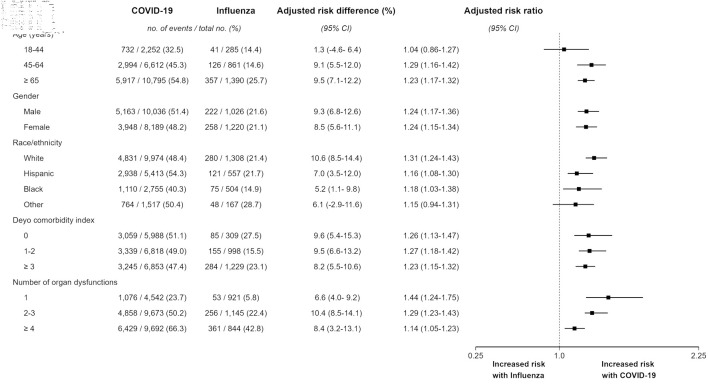
Among 22,195 mechanically ventilated hospitalizations, 19,659 (88.6%) had COVID-19 and 2,536 (11.4%) had influenza. Compared to mechanically ventilated hospitalizations with influenza, those with COVID-19 were more commonly racial or ethnic minority (49.3% vs. 48.4%) and had lower mean (standard deviation (SD)) Deyo comorbidity index (2.04 (2.03) vs. 2.53 (1.91)), but higher number of organ dysfunctions (2.60 (1.37) vs. 2.13 (1.27)), respectively. Short-term mortality among mechanically ventilated hospitalizations with COVID-19 and influenza was 49.1% vs. 20.7%. The risk of short-term mortality was attenuated but remained higher among hospitalizations with COVID-19 in the primary model (adjusted risk ratio: 1.24 (95% confidence interval (CI): 1.18 - 1.30); adjusted risk difference 8.8% (95% CI: 6.7 - 10.4)), with consistent findings in alternative models, subgroups, and sensitivity analyses.
Population-level short-term mortality among mechanically ventilated hospitalizations with COVID-19 has been higher than that among those with influenza during the latter years of the pandemic.
关于2019冠状病毒病(COVID-19)和流感机械通气患者的比较死亡率报告结果相互矛盾,但研究主要集中在疫情早期,使用历史流感对照。我们试图使用同期流感对照,研究疫情后期COVID-19机械通气患者的人群水平比较死亡率。
我们使用一个全州范围的数据集,确定2021年10月至2023年3月期间德克萨斯州年龄≥18岁的因COVID-19或流感而接受机械通气住院治疗的患者。使用重叠倾向评分加权(主要模型)、熵平衡和分层逻辑模型估计他们的比较短期死亡率(院内死亡或转至临终关怀机构)。
在22195例机械通气住院患者中,19659例(88.6%)患有COVID-19,2536例(11.4%)患有流感。与流感机械通气住院患者相比,COVID-19机械通气住院患者更常见为少数种族或族裔(49.3%对48.4%),且平均(标准差(SD))Deyo合并症指数较低(2.04(2.03)对2.53(1.91)),但器官功能障碍数量较多(2.60(1.37)对2.13(1.27))。COVID-19和流感机械通气住院患者的短期死亡率分别为49.1%和20.7%。在主要模型中,COVID-19住院患者的短期死亡风险有所降低,但仍较高(调整风险比:1.24(95%置信区间(CI):1.18 - 1.30);调整风险差异8.8%(95%CI:6.7 - 10.4)),在替代模型、亚组和敏感性分析中结果一致。
在疫情后期,COVID-19机械通气住院患者的人群水平短期死亡率高于流感患者。