• 文献检索
  • 文档翻译
  • 深度研究
  • 学术资讯
  • Suppr Zotero 插件Zotero 插件
  • 邀请有礼
  • 套餐&价格
  • 历史记录
应用&插件
Suppr Zotero 插件Zotero 插件浏览器插件Mac 客户端Windows 客户端微信小程序
定价
高级版会员购买积分包购买API积分包
服务
文献检索文档翻译深度研究API 文档MCP 服务
关于我们
关于 Suppr公司介绍联系我们用户协议隐私条款
关注我们

Suppr 超能文献

核心技术专利:CN118964589B侵权必究
粤ICP备2023148730 号-1Suppr @ 2026

文献检索

告别复杂PubMed语法,用中文像聊天一样搜索,搜遍4000万医学文献。AI智能推荐,让科研检索更轻松。

立即免费搜索

文件翻译

保留排版,准确专业,支持PDF/Word/PPT等文件格式,支持 12+语言互译。

免费翻译文档

深度研究

AI帮你快速写综述,25分钟生成高质量综述,智能提取关键信息,辅助科研写作。

立即免费体验

新型冠状病毒肺炎与甲型流感所致急性呼吸窘迫综合征机械通气患者呼吸力学的差异。

Differences of respiratory mechanics in mechanical ventilation of acute respiratory distress syndrome between patients with COVID-19 and Influenza A.

机构信息

Division of Pulmonology, Department of Internal Medicine, National Health Insurance Service Ilsan Hospital, Goyang, Republic of Korea.

Division of Pulmonary and Critical Care Medicine, Department of Internal Medicine, Severance Hospital, Yonsei University College of Medicine, 50-1 Yonsei-ro, Seodaemun-gu, Seoul, 03722, Republic of Korea.

出版信息

Respir Res. 2024 Mar 7;25(1):112. doi: 10.1186/s12931-024-02730-4.

DOI:10.1186/s12931-024-02730-4
PMID:38448933
原文链接:https://pmc.ncbi.nlm.nih.gov/articles/PMC10919012/
Abstract

BACKGROUND

Whether COVID-19-induced acute respiratory distress syndrome (ARDS) should be approached differently in terms of mechanical ventilation therapy compared to other virus-induced ARDS is debatable. Therefore, we aimed to ascertain whether the respiratory mechanical characteristics of COVID-19-induced ARDS differ from those of influenza A induced ARDS, in order to establish a rationale for mechanical ventilation therapy in COVID-19-induced ARDS.

METHODS

This was a retrospective cohort study comparing patients with COVID-19-induced ARDS and influenza A induced ARDS. We included intensive care unit (ICU) patients with COVID-19 or Influenza A aged ≥ 19, who were diagnosed with ARDS according to the Berlin definition between January 2015 and July 2021. Ventilation parameters for respiratory mechanics were collected at specific times on days one, three, and seven after intubation.

RESULTS

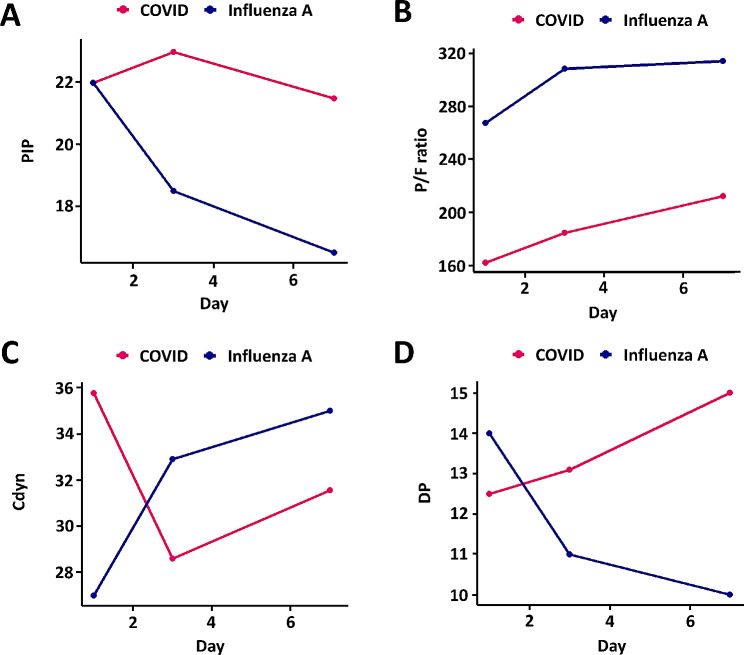
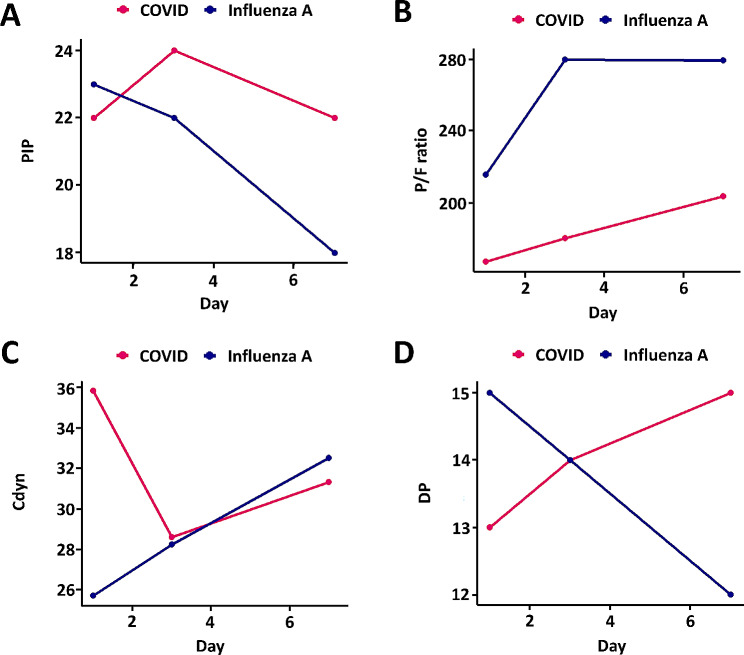
The median age of the 87 participants was 71.0 (62.0-78.0) years old, and 63.2% were male. The ratio of partial pressure of oxygen in arterial blood to the fractional of inspiratory oxygen concentration in COVID-19-induced ARDS was lower than that in influenza A induced ARDS during the initial stages of mechanical ventilation (influenza A induced ARDS 216.1 vs. COVID-19-induced ARDS 167.9, p = 0.009, day 1). The positive end expiratory pressure remained consistently higher in the COVID-19 group throughout the follow-up period (7.0 vs. 10.0, p < 0.001, day 1). COVID-19 and influenza A initially showed different directions for peak inspiratory pressure and dynamic compliance; however, after day 3, both groups exhibited similar directions. Dynamic driving pressure exhibited opposite trends between the two groups during mechanical ventilation.

CONCLUSIONS

Respiratory mechanics show clear differences between COVID-19-induced ARDS and influenza A induced ARDS. Based on these findings, we can consider future treatment strategies for COVID-19-induced ARDS.

摘要

背景

与其他病毒引起的 ARDS 相比,COVID-19 引起的急性呼吸窘迫综合征(ARDS)在机械通气治疗方面是否应该有所不同,这是有争议的。因此,我们旨在确定 COVID-19 引起的 ARDS 的呼吸力学特征是否与流感 A 引起的 ARDS 不同,以便为 COVID-19 引起的 ARDS 的机械通气治疗建立依据。

方法

这是一项回顾性队列研究,比较了 COVID-19 引起的 ARDS 患者和流感 A 引起的 ARDS 患者。我们纳入了年龄≥19 岁的 2015 年 1 月至 2021 年 7 月期间在 ICU 因 COVID-19 或流感 A 而诊断为 ARDS 的患者。在插管后第 1、3 和 7 天收集特定时间的呼吸力学通气参数。

结果

87 名参与者的中位年龄为 71.0(62.0-78.0)岁,63.2%为男性。在机械通气的初始阶段,COVID-19 引起的 ARDS 患者的动脉血氧分压与吸入氧浓度的分数比值低于流感 A 引起的 ARDS(流感 A 引起的 ARDS 为 216.1,COVID-19 引起的 ARDS 为 167.9,p=0.009,第 1 天)。在整个随访期间,COVID-19 组的呼气末正压一直保持较高(第 1 天为 7.0,第 10.0,p<0.001)。COVID-19 和流感 A 最初在吸气峰压和动态顺应性方面表现出不同的方向;然而,在第 3 天后,两组均表现出相似的方向。在机械通气过程中,两组之间的动态驱动压表现出相反的趋势。

结论

COVID-19 引起的 ARDS 和流感 A 引起的 ARDS 的呼吸力学表现出明显的差异。基于这些发现,我们可以考虑 COVID-19 引起的 ARDS 的未来治疗策略。
https://cdn.ncbi.nlm.nih.gov/pmc/blobs/8a62/10919012/5e3f11fa182f/12931_2024_2730_Fig2_HTML.jpg
https://cdn.ncbi.nlm.nih.gov/pmc/blobs/8a62/10919012/732532ce31c1/12931_2024_2730_Fig1_HTML.jpg
https://cdn.ncbi.nlm.nih.gov/pmc/blobs/8a62/10919012/5e3f11fa182f/12931_2024_2730_Fig2_HTML.jpg
https://cdn.ncbi.nlm.nih.gov/pmc/blobs/8a62/10919012/732532ce31c1/12931_2024_2730_Fig1_HTML.jpg
https://cdn.ncbi.nlm.nih.gov/pmc/blobs/8a62/10919012/5e3f11fa182f/12931_2024_2730_Fig2_HTML.jpg

相似文献

1
Differences of respiratory mechanics in mechanical ventilation of acute respiratory distress syndrome between patients with COVID-19 and Influenza A.新型冠状病毒肺炎与甲型流感所致急性呼吸窘迫综合征机械通气患者呼吸力学的差异。
Respir Res. 2024 Mar 7;25(1):112. doi: 10.1186/s12931-024-02730-4.
2
Longitudinal changes in compliance, oxygenation and ventilatory ratio in COVID-19 versus non-COVID-19 pulmonary acute respiratory distress syndrome.COVID-19 与非 COVID-19 性急性呼吸窘迫综合征患者顺应性、氧合和通气比值的纵向变化。
Crit Care. 2021 Jul 15;25(1):248. doi: 10.1186/s13054-021-03665-8.
3
[Analysis of clinical treatment of acute respiratory distress syndrome assisted by artificial intelligence].[人工智能辅助急性呼吸窘迫综合征的临床治疗分析]
Zhonghua Wei Zhong Bing Ji Jiu Yi Xue. 2024 Apr;36(4):369-376. doi: 10.3760/cma.j.cn121430-20231027-00916.
4
Comparing Clinical Outcomes of COVID-19 and Influenza-Induced Acute Respiratory Distress Syndrome: A Propensity-Matched Analysis.比较 COVID-19 和流感引起的急性呼吸窘迫综合征的临床结局:一项倾向评分匹配分析。
Viruses. 2023 Apr 5;15(4):922. doi: 10.3390/v15040922.
5
Risk factor analysis of nosocomial lower respiratory tract infection in influenza-related acute respiratory distress syndrome.流感相关性急性呼吸窘迫综合征患者下呼吸道医院感染的危险因素分析。
Ther Adv Respir Dis. 2020 Jan-Dec;14:1753466620942417. doi: 10.1177/1753466620942417.
6
[Diagnostic value of mechanical power in patients with moderate to severe acute respiratory distress syndrome: an analysis using the data from MIMIC-III].[机械功率在中重度急性呼吸窘迫综合征患者中的诊断价值:一项基于MIMIC-III数据的分析]
Zhonghua Wei Zhong Bing Ji Jiu Yi Xue. 2022 Jan;34(1):35-40. doi: 10.3760/cma.j.cn121430-20210630-00978.
7
Flow controlled ventilation in Acute Respiratory Distress Syndrome associated with COVID-19: A structured summary of a study protocol for a randomised controlled trial.COVID-19 相关急性呼吸窘迫综合征的流量控制通气:一项随机对照试验研究方案的结构化总结。
Trials. 2020 Sep 11;21(1):781. doi: 10.1186/s13063-020-04708-1.
8
Ultra-low tidal volume ventilation for COVID-19-related ARDS in France (VT4COVID): a multicentre, open-label, parallel-group, randomised trial.法国 COVID-19 相关 ARDS 的超低潮气量通气(VT4COVID):一项多中心、开放标签、平行组、随机试验。
Lancet Respir Med. 2023 Nov;11(11):991-1002. doi: 10.1016/S2213-2600(23)00221-7. Epub 2023 Jul 12.
9
Rapidly improving acute respiratory distress syndrome in COVID-19: a multi-centre observational study.COVID-19 相关的急性呼吸窘迫综合征急剧恶化:一项多中心观察性研究。
Respir Res. 2022 Apr 14;23(1):94. doi: 10.1186/s12931-022-02015-8.
10
Respiratory physiology of COVID-19-induced respiratory failure compared to ARDS of other etiologies.COVID-19 导致呼吸衰竭的呼吸生理学与其他病因导致的 ARDS 的比较。
Crit Care. 2020 Aug 28;24(1):529. doi: 10.1186/s13054-020-03253-2.

引用本文的文献

1
Comparative Evaluation of Risk of Death in Mechanically Ventilated Patients With COVID-19 and Influenza: A Population-Based Cohort Study.新型冠状病毒肺炎与流感机械通气患者死亡风险的比较评估:一项基于人群的队列研究。
J Clin Med Res. 2025 Apr;17(4):187-199. doi: 10.14740/jocmr6189. Epub 2025 Mar 17.

本文引用的文献

1
An Update on Management of Adult Patients with Acute Respiratory Distress Syndrome: An Official American Thoracic Society Clinical Practice Guideline.成人急性呼吸窘迫综合征管理的最新进展:美国胸科学会临床实践指南。
Am J Respir Crit Care Med. 2024 Jan 1;209(1):24-36. doi: 10.1164/rccm.202311-2011ST.
2
ESICM guidelines on acute respiratory distress syndrome: definition, phenotyping and respiratory support strategies.急性呼吸窘迫综合征 ESICM 指南:定义、表型和呼吸支持策略。
Intensive Care Med. 2023 Jul;49(7):727-759. doi: 10.1007/s00134-023-07050-7. Epub 2023 Jun 16.
3
Respiratory Physiology of COVID-19 and Influenza Associated Acute Respiratory Distress Syndrome.
新型冠状病毒肺炎和流感相关急性呼吸窘迫综合征的呼吸生理学
J Clin Med. 2022 Oct 22;11(21):6237. doi: 10.3390/jcm11216237.
4
Prone position improves ventilation-perfusion mismatch in patients with severe acute respiratory distress syndrome.俯卧位可改善重症急性呼吸窘迫综合征患者的通气-灌注不匹配。
Med Intensiva (Engl Ed). 2023 Mar;47(3):175-178. doi: 10.1016/j.medine.2022.09.001. Epub 2022 Sep 9.
5
Comparison of acute respiratory distress syndrome in patients with COVID-19 and influenza A (H7N9) virus infection.比较 COVID-19 与甲型流感(H7N9)病毒感染患者的急性呼吸窘迫综合征。
Int J Infect Dis. 2022 Sep;122:593-598. doi: 10.1016/j.ijid.2022.06.053. Epub 2022 Jul 3.
6
COVID-19 infection: an overview on cytokine storm and related interventions.COVID-19 感染:细胞因子风暴及相关干预措施概述。
Virol J. 2022 May 26;19(1):92. doi: 10.1186/s12985-022-01814-1.
7
Venovenous extracorporeal membrane oxygenation in patients with acute covid-19 associated respiratory failure: comparative effectiveness study.静脉-静脉体外膜肺氧合在急性 COVID-19 相关呼吸衰竭患者中的应用:比较有效性研究。
BMJ. 2022 May 4;377:e068723. doi: 10.1136/bmj-2021-068723.
8
Effects of different positive end-expiratory pressure titration strategies during prone positioning in patients with acute respiratory distress syndrome: a prospective interventional study.急性呼吸窘迫综合征患者俯卧位时不同呼气末正压滴定策略的效果:一项前瞻性干预研究。
Crit Care. 2022 Mar 26;26(1):82. doi: 10.1186/s13054-022-03956-8.
9
COVID-19 vaccination program in South Korea: A long journey toward a new normal.韩国的新冠疫苗接种计划:迈向新常态的漫长征程。
Health Policy Technol. 2022 Jun;11(2):100601. doi: 10.1016/j.hlpt.2022.100601. Epub 2022 Jan 31.
10
The impact of free vaccination policies under the Korean Influenza National Immunization Program: Trends in influenza vaccination rates in South Korea from 2010 to 2019.韩国流感全国免疫计划下免费接种政策的影响:2010 年至 2019 年韩国流感疫苗接种率趋势。
PLoS One. 2022 Jan 20;17(1):e0262594. doi: 10.1371/journal.pone.0262594. eCollection 2022.