Zhang Xiuping, Sun Meizhen, Xue Guofang, Zhao Yongxiong, Du Taotao, Guan Xueying, Xu Yong
The Second Hospital of Shanxi Medical University, Taiyuan, China.
Shanxi Medical University, Taiyuan, China.
Epilepsia Open. 2025 Jun;10(3):866-879. doi: 10.1002/epi4.70048. Epub 2025 May 5.
The therapeutic ketogenic diet is typically used in epilepsy treatments, yet there has been insufficient understanding regarding the knowledge, attitudes, and practices (KAP) of epilepsy patients concerning this dietary therapy. This study aims to investigate the KAP of epilepsy patients regarding ketogenic diet therapy, with the goal of identifying gaps in knowledge and attitudes that may impact clinical outcomes.
A cross-sectional study was conducted between November 2023 and December 2023 at three epilepsy centers in Shanxi Province: the First Hospital of Shanxi Medical University, the Second Hospital of Shanxi Medical University, and Taiyuan Epilepsy Hospital. Data, including demographic characteristics and KAP scores, were collected via online questionnaires, yielding a total of 612 valid responses, with 320 (52.29%) males.
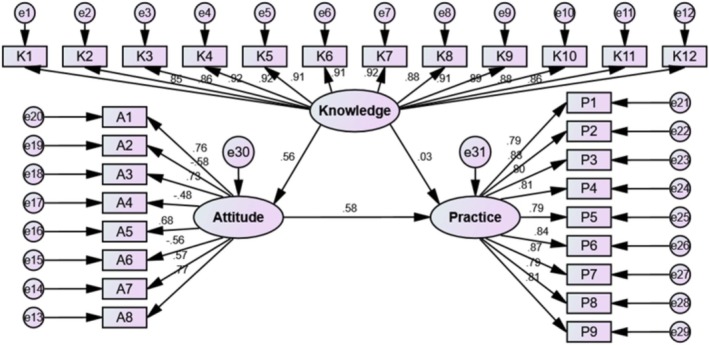
The mean KAP scores were calculated as follows: knowledge score 4.99 ± 6.72 (possible range: 0-24), attitude score 24.82 ± 2.34 (possible range: 8-40), and practice score 29.48 ± 8.49 (possible range: 9-45). Multivariate analysis revealed that the attitude score (OR = 1.443, 95% CI: [1.296-1.607], p < 0.001) and an epilepsy duration of 5-10 years (OR = 3.086, 95% CI: [1.716-5.548], p < 0.001) were independently associated with positive practice. Additionally, Structural Equation Modeling indicated that knowledge (β = 0.034, p = 0.012) and attitude (β = 0.583, p = 0.010) directly influenced practice, while knowledge also directly affected attitude (β = 0.565, p = 0.013), with an indirect effect on practice through attitude (β = 0.329, p = 0.009).
The study found insufficient knowledge, suboptimal attitudes, and negative practices toward the ketogenic diet among epilepsy patients. This underscores the need for targeted educational interventions to enhance patient engagement and optimize clinical outcomes.
This study looked at how much epilepsy patients know about, feel about, and use the ketogenic diet as a treatment. We found that patients generally know little about the diet, have mixed feelings, and do not use it much. Better understanding and positive attitudes were linked to better use of the diet. The results suggest that more education could help patients use the diet more effectively, which might improve their health outcomes.
治疗性生酮饮食通常用于癫痫治疗,但癫痫患者对这种饮食疗法的知识、态度和实践(KAP)了解不足。本研究旨在调查癫痫患者对生酮饮食疗法的KAP,以找出可能影响临床结果的知识和态度差距。
2023年11月至2023年12月在山西省的三个癫痫中心进行了一项横断面研究,这三个中心分别是山西医科大学第一医院、山西医科大学第二医院和太原癫痫病医院。通过在线问卷收集包括人口统计学特征和KAP评分在内的数据,共获得612份有效回复,其中男性320人(52.29%)。
计算出的平均KAP评分如下:知识评分为4.99±6.72(可能范围:0 - 24),态度评分为24.82±2.34(可能范围:8 - 40),实践评分为29.48±8.49(可能范围:9 - 45)。多变量分析显示,态度评分(OR = 1.443,95% CI:[1.296 - 1.607],p < 0.001)和癫痫病程5 - 10年(OR = 3.086,95% CI:[1.716 - 5.548],p < 0.001)与积极实践独立相关。此外,结构方程模型表明,知识(β = 0.034,p = 0.012)和态度(β = 0.583,p = 0.010)直接影响实践,而知识也直接影响态度(β = 0.565,p = 0.013),并通过态度对实践产生间接影响(β = 0.329,p = 0.009)。
该研究发现癫痫患者对生酮饮食的知识不足、态度欠佳且实践消极。这凸显了开展有针对性的教育干预以提高患者参与度并优化临床结果的必要性。
本研究考察了癫痫患者对生酮饮食作为一种治疗方法的了解程度、感受和使用情况。我们发现患者通常对这种饮食了解甚少,态度不一,且使用不多。更好的理解和积极的态度与更好地使用这种饮食有关。结果表明,更多的教育可以帮助患者更有效地使用这种饮食,这可能会改善他们的健康状况。