Funaioli Tiziana, Cesari Cristiana, Berti Beatrice, Bortoluzzi Marco, Femoni Cristina, Forti Francesca, Iapalucci Maria Carmela, Scorzoni Giorgia, Zacchini Stefano
Dipartimento di Chimica e Chimica Industriale, Università di Pisa, Via G. Moruzzi 13, 56124 Pisa, Italy.
Dipartimento di Chimica Industriale "Toso Montanari", Università di Bologna, Via P. Gobetti 85, 40129 Bologna, Italy.
Inorg Chem. 2025 May 19;64(19):9744-9757. doi: 10.1021/acs.inorgchem.5c01014. Epub 2025 May 6.
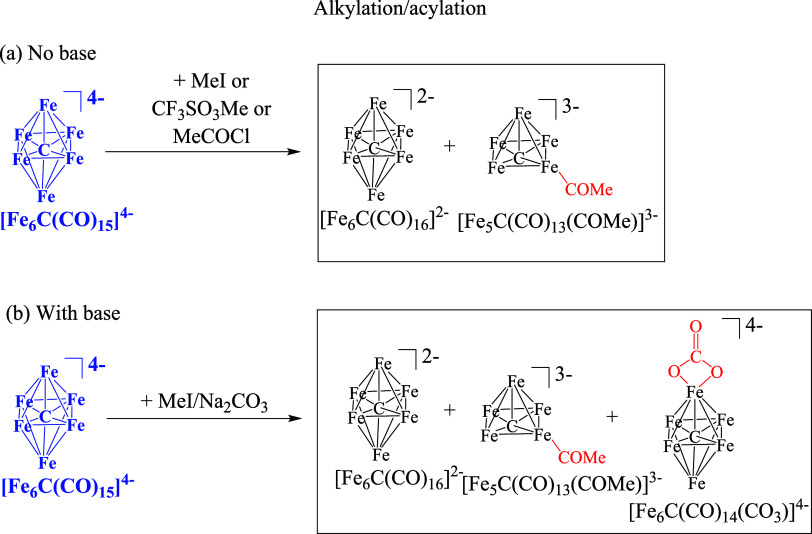
A chemical and electrochemical investigation of the redox chemistry of [FeC(CO)] is reported and supported by computational studies. Depending on the experimental conditions, the original FeC cage is retained or partially degraded to FeC. Chemical oxidation of [FeC(CO)] with [CpFe][PF], [CH][BF], or MeNO affords the previously reported [FeC(CO)], whereas oxidation in the presence of a base (NaCO or NaOH) results in the new carbonate-carbide cluster [FeC(CO)(CO)]. Oxidation of [FeC(CO)] in the presence of a phosphine ligand produces the heteroleptic species [FeC(CO)(PTA)] and [FeC(CO)(PPh)]. Reaction of [FeC(CO)] with alkylating or acylating agents (MeI, CFSOMe, and MeCOCl) affords the acetyl-carbide cluster [FeC(CO)(COMe)], with partial oxidative degradation of the original FeC cage. The new clusters have been spectroscopically and structurally characterized. The redox chemistry of [FeC(CO)] was further investigated by electrochemical and spectroelectrochemical methods. According to computational outcomes, the spectroelectrochemical oxidation of [FeC(CO)] follows an EEC mechanism, leading to the formation of [FeC(CO)]. The [FeC(CO)] intermediate can accumulate and be spectroscopically detected. These new chemical and electrochemical findings have been supported and corroborated by computational methods. DFT calculations suggest an EEC pathway also for the reverse electrochemical process, , reduction of [FeC(CO)] to [FeC(CO)].
报道了对[FeC(CO)]氧化还原化学的化学和电化学研究,并得到了计算研究的支持。根据实验条件,原始的FeC笼保持不变或部分降解为FeC。用[CpFe][PF]、[CH][BF]或MeNO对[FeC(CO)]进行化学氧化,得到先前报道的[FeC(CO)],而在碱(NaCO或NaOH)存在下氧化则产生新的碳酸 - 碳化物簇[FeC(CO)(CO)]。在膦配体存在下氧化[FeC(CO)]会生成杂配体物种[FeC(CO)(PTA)]和[FeC(CO)(PPh)]。[FeC(CO)]与烷基化或酰化剂(MeI、CFSOMe和MeCOCl)反应生成乙酰 - 碳化物簇[FeC(CO)(COMe)],同时原始的FeC笼会发生部分氧化降解。这些新簇已通过光谱和结构表征。通过电化学和光谱电化学方法进一步研究了[FeC(CO)]的氧化还原化学。根据计算结果,[FeC(CO)]的光谱电化学氧化遵循EEC机制,导致形成[FeC(CO)]。[FeC(CO)]中间体可以积累并通过光谱检测到。这些新的化学和电化学发现得到了计算方法的支持和证实。DFT计算表明,对于反向电化学过程,即[FeC(CO)]还原为[FeC(CO)],也存在EEC途径。