Chen Yipeng, Chen Ting, Xu Wenfeng, Yu Xiaoqin, Tang Xiujuan, Wang Ying, Yin Jun
School of Environmental Science and Engineering, Zhejiang Gongshang University, Hangzhou, 310012, China.
International Science and Technology Cooperation Platform for Low-Carbon Recycling of Waste and Green Development, Zhejiang Gongshang University, Hangzhou, 310012, China.
Appl Microbiol Biotechnol. 2025 May 7;109(1):112. doi: 10.1007/s00253-025-13480-8.
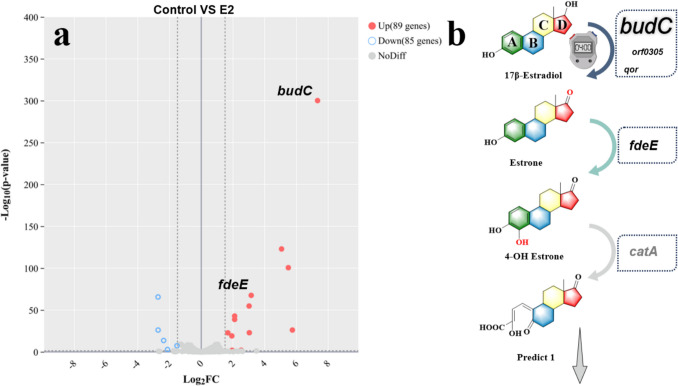
Estrogens, particularly 17β-estradiol, are prevalent endocrine-disrupting chemicals in aquatic environments, posing risks to ecosystems and human health. Biodegradation is considered one of the most effective and environmentally friendly methods for removing estrogen. In this study, a novel bacterial strain, Microbacterium proteolyticum ZJSU01, was isolated from pig manure. It completely degraded 5 mg/L of 17β-estradiol (E2) within 4 h, as well as its major transformation product, estrone (E1). The strain ZJSU01 displayed strong adaptability to high temperatures (37℃, 42℃) and a broad pH range (6-11), E2 (5 mg/L) could be completely removed by the strain under these conditions. Transformation intermediates were analyzed using UHPLC and HPLC-Q-TOF-MS to identify key metabolites and trace the degradation pathways. Four potential degradation pathways were identified, including the 4,5-seco pathway, which is widely conserved in most E2-degrading bacteria. Whole-genome sequencing predicted a chromosome with a size of 3,828,432 bp, and a series of functional genes, and transcriptomics analysis identified several genes involved in E2 degradation. The budC gene, a member of the short-chain dehydrogenases/reductases (SDRs) family, was identified as critical for E2 degradation and exhibited a nearly 170-fold upregulation. Meanwhile, genes such as fdeE and catA were associated with downstream degradation. Microbacterium proteolyticum ZJSU01 demonstrated strong acid-base and high-temperature resilience, highlighting its strong potential for practical applications due to its degradation capability and adaptability. This strain could be applied in wastewater treatment to effectively remove estrogenic pollutants from contaminated water. KEY POINTS: • Microbacterium proteolyticum ZJSU01 removed 100% of E2 (10、5、1 mg/L) within 4 h. • Strain ZJSU01 showed great tolerance to high temperature and acid-base conditions. • A novel gene, budC, was identified as the primary driver of E2 degradation by ZJSU01.
雌激素,尤其是17β-雌二醇,是水生环境中普遍存在的内分泌干扰化学物质,对生态系统和人类健康构成风险。生物降解被认为是去除雌激素最有效且最环保的方法之一。在本研究中,从猪粪中分离出一种新型细菌菌株——解蛋白微小杆菌ZJSU01。它能在4小时内完全降解5mg/L的17β-雌二醇(E2)及其主要转化产物雌酮(E1)。菌株ZJSU01对高温(37℃、42℃)表现出很强的适应性,且在较宽的pH范围(6 - 11)内也能适应,在此条件下该菌株能完全去除E2(5mg/L)。使用超高效液相色谱(UHPLC)和高效液相色谱-四极杆飞行时间质谱(HPLC-Q-TOF-MS)分析转化中间体,以鉴定关键代谢产物并追踪降解途径。确定了四条潜在的降解途径,包括在大多数降解E2的细菌中广泛保守的4,5-裂环途径。全基因组测序预测其染色体大小为3,828,432bp,并含有一系列功能基因,转录组学分析鉴定出了几个参与E2降解的基因。芽殖酵母C基因(budC)是短链脱氢酶/还原酶(SDR)家族的成员,被确定为对E2降解至关重要,且表达上调了近170倍。同时,诸如fdeE和catA等基因与下游降解相关。解蛋白微小杆菌ZJSU01表现出很强的耐酸碱和耐高温能力,因其降解能力和适应性突出,在实际应用中具有很大潜力。该菌株可应用于废水处理,以有效去除受污染水中的雌激素污染物。要点:• 解蛋白微小杆菌ZJSU01在4小时内去除了100%的E2(10、5、1mg/L)。• 菌株ZJSU01对高温和酸碱条件具有很强的耐受性。• 一个新基因芽殖酵母C基因(budC)被确定为ZJSU01降解E2的主要驱动因素。