Cojocaru Andreea Iuliana, Kefi Kaouthar, Masson Jean-Daniel, Tiret Laurent, Relaix Frederic, Taglietti Valentina
Univ Paris-Est Créteil, INSERM, U955 IMRB, F-94010, Créteil, France.
École Nationale Vétérinaire d'Alfort, U955 IMRB, F-94700, Maisons-Alfort, France.
Skelet Muscle. 2025 May 7;15(1):12. doi: 10.1186/s13395-025-00381-7.
Duchenne Muscular Dystrophy (DMD) is a progressive neuromuscular disorder characterized by impaired muscle repair. Forskolin (FSK), an adenylyl cyclase activator, has shown potential in enhancing muscle regeneration and limiting muscle stem cell senescence. This study aimed to evaluate the effects of FSK on muscle repair, fibrosis, inflammation, and long-term muscle function in DMD using a preclinical rat model.
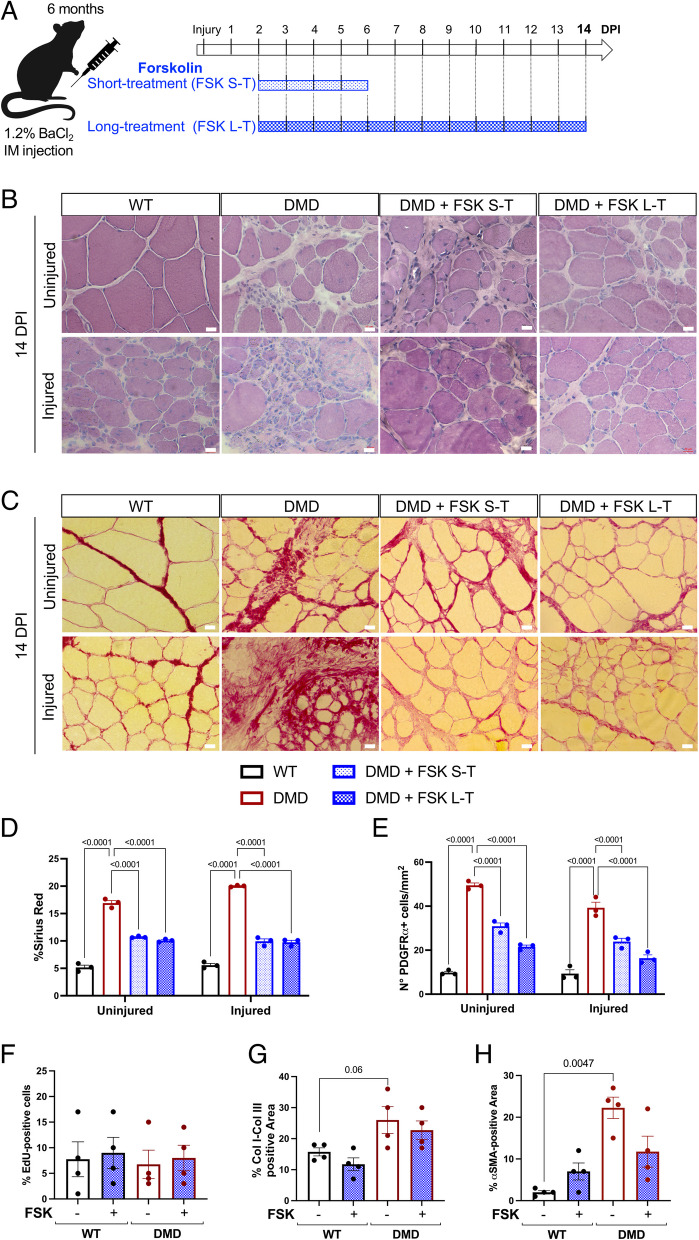
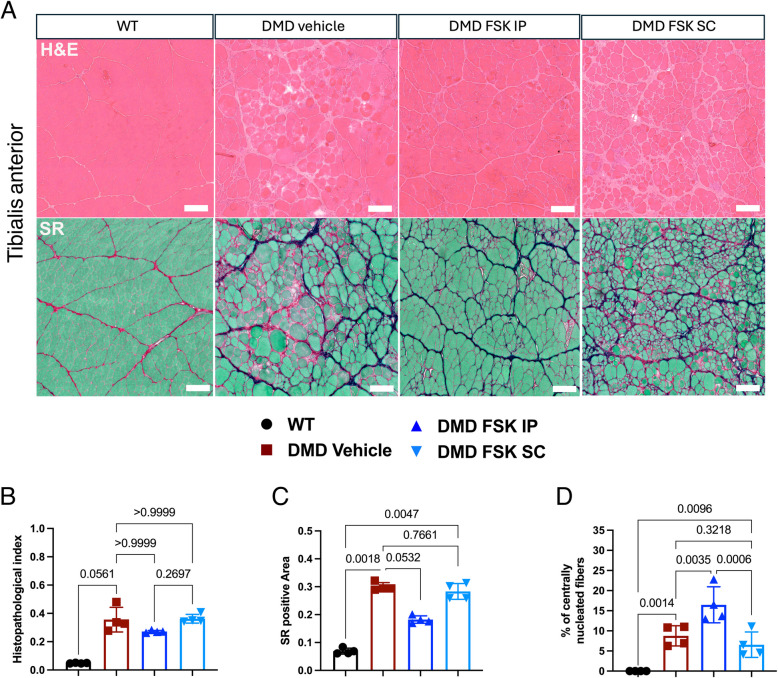
BaCl-induced muscle injury was performed on 6-month-old DMD (R-DMDdel52) and wild-type (WT) rats. FSK was supplied via short-term and long-term administration. Muscle tissues were harvested 14 days post-injury for histological analysis, including hematoxylin and eosin and Sirius red staining. Immunofluorescence was used to assess fibroadipogenic progenitors (FAPs), regeneration, muscle stem cells, and macrophage phenotypes. Moreover, we performed a study by chronically administering FSK to DMD rats from 1 to 7 months of age, either intraperitoneally (IP) or subcutaneously (SC). Functional assessments included grip strength test, in vivo muscle force measurements, plethysmography and electrocardiograms. Post-sacrifice, Tibialis anterior, diaphragm and heart tissues were histologically analyzed, to evaluate muscle architecture, fibrosis, and histopathological indices.
FSK treatment significantly improved muscle histology and reduced fibrosis in both uninjured and injured DMD muscles by decreasing the number of FAPs. Long-term FSK treatment in the acute injury model enhanced muscle regeneration, increased MuSC proliferation, and reduced senescence. FSK also modulated inflammation by reducing pro-inflammatory macrophages and promoting a shift to a restorative phenotype. However, despite these histological improvements, FSK treatment from 1 to 7 months resulted in limited functional benefits and worsened ventricular histology in the heart.
FSK shows promising results in improving muscle regeneration and reducing fibrosis in DMD, but concerns remain regarding its limited chronic functional benefits and potential adverse effects on cardiac tissue. Our results highlight the need for optimized adenylyl cyclase activators for therapeutic use in DMD patients.
杜兴氏肌肉营养不良症(DMD)是一种进行性神经肌肉疾病,其特征为肌肉修复受损。福斯可林(FSK)是一种腺苷酸环化酶激活剂,已显示出在增强肌肉再生和限制肌肉干细胞衰老方面的潜力。本研究旨在使用临床前大鼠模型评估FSK对DMD肌肉修复、纤维化、炎症和长期肌肉功能的影响。
对6个月大的DMD(R-DMDdel52)和野生型(WT)大鼠进行氯化钡诱导的肌肉损伤。通过短期和长期给药提供FSK。在损伤后14天收获肌肉组织进行组织学分析,包括苏木精和伊红染色以及天狼星红染色。免疫荧光用于评估纤维脂肪生成祖细胞(FAP)、再生、肌肉干细胞和巨噬细胞表型。此外,我们对1至7个月大的DMD大鼠进行了长期腹腔内(IP)或皮下(SC)给予FSK的研究。功能评估包括握力测试、体内肌肉力量测量、体积描记法和心电图。处死后,对胫前肌、膈肌和心脏组织进行组织学分析,以评估肌肉结构、纤维化和组织病理学指标。
FSK治疗通过减少FAP数量,显著改善了未受伤和受伤的DMD肌肉的组织学,并减少了纤维化。急性损伤模型中的长期FSK治疗增强了肌肉再生,增加了肌肉干细胞增殖,并减少了衰老。FSK还通过减少促炎巨噬细胞并促进向修复性表型的转变来调节炎症。然而,尽管有这些组织学改善,但1至7个月的FSK治疗导致功能益处有限,且心脏心室组织学恶化。
FSK在改善DMD肌肉再生和减少纤维化方面显示出有前景的结果,但对于其有限的慢性功能益处以及对心脏组织的潜在不良影响仍存在担忧。我们的结果强调了需要优化腺苷酸环化酶激活剂以用于DMD患者的治疗。