Berezicka Anna, Sułowska Justyna, Szumera Magdalena
Faculty of Materials Science and Ceramics, AGH University of Krakow, Al. A. Mickiewicza 30, 30-059 Krakow, Poland.
Molecules. 2025 Apr 9;30(8):1684. doi: 10.3390/molecules30081684.
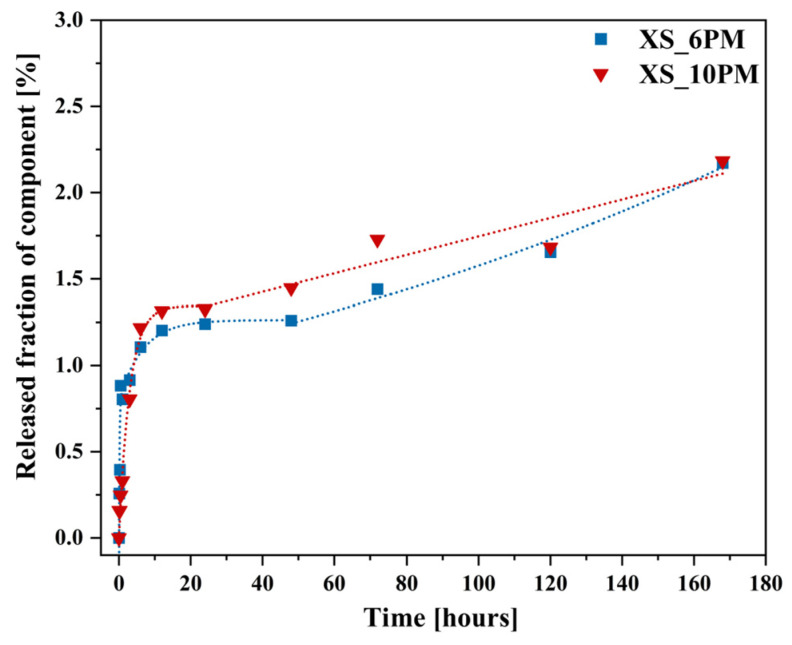
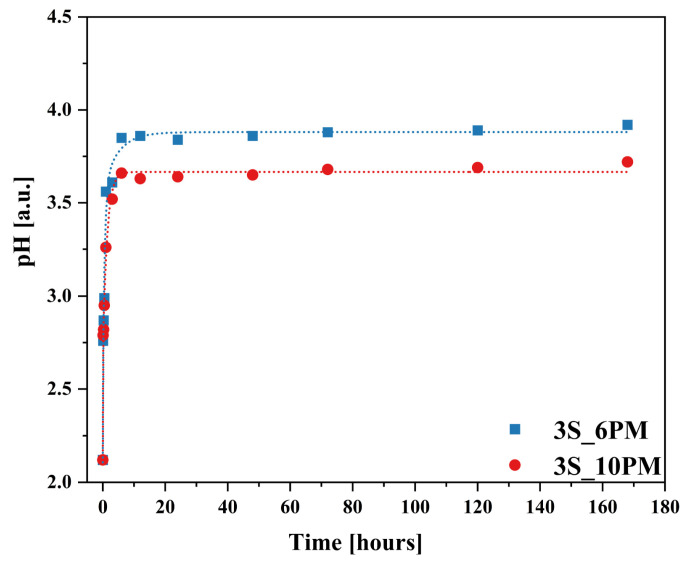
Vitreous carriers of essential nutrients should release elements in response to plant demand, minimizing over-fertilization risks. This study focused on designing and characterizing sulfate-bearing slow-release fertilizers based on four glass series (41SiO∙6(10)PO∙20KO-33(29)MgO/CaO/MgO + CaO) with increasing sulfate content. Structural analysis identified a network dominated by QSi2 units, with some QSi3 species and isolated QP0 units. This fragmented structure resulted in high solubility in acidic environments while maintaining water resistance. Such dual behavior is a direct consequence of the delicate balance between depolymerized silicate chains and isolated orthophosphate units, which ensure rapid ion exchange under acidic conditions while preventing uncontrolled leaching in neutral media. Nutrient leaching depended on SO content, affecting matrix rigidity, and on the type of alkaline earth modifier and PO content. Dissolution kinetics showed an initial rapid release phase, followed by stabilization governed by silicate hydrolysis. Thermal analysis linked network flexibility to dissolution behavior-CaO promoted an open structure with high SiO release, MgO increased rigidity, while their co-addition reduced ion diffusion and silica dissolution. The thermal behavior of the glasses provided indirect insight into their structural rigidity, revealing how compositional variations influence the mechanical stability of the network. This structural rigidity, inferred from glass transition and crystallization phenomena, was found to correlate with the selective dissolution profiles observed in acidic versus neutral environments. These results reveal complex interactions between composition, structure, and nutrient release, shaping the agricultural potential of these glasses.
必需养分的玻璃体载体应根据植物需求释放元素,将过度施肥风险降至最低。本研究聚焦于设计和表征基于四个玻璃系列(41SiO∙6(10)PO∙20KO-33(29)MgO/CaO/MgO + CaO)且硫酸盐含量不断增加的含硫酸盐缓释肥料。结构分析确定了一个以QSi2单元为主的网络,还有一些QSi3物种和孤立的QP0单元。这种碎片化结构导致在酸性环境中具有高溶解性,同时保持耐水性。这种双重行为是解聚的硅酸盐链与孤立的正磷酸盐单元之间微妙平衡的直接结果,这确保了在酸性条件下快速离子交换,同时防止在中性介质中不受控制的淋溶。养分淋溶取决于SO含量(影响基质刚性)、碱土改性剂类型和PO含量。溶解动力学显示出一个初始快速释放阶段,随后由硅酸盐水解控制达到稳定。热分析将网络灵活性与溶解行为联系起来——CaO促进形成具有高SiO释放的开放结构,MgO增加刚性,而它们的共同添加减少了离子扩散和二氧化硅溶解。玻璃的热行为为其结构刚性提供了间接见解,揭示了成分变化如何影响网络的机械稳定性。从玻璃转变和结晶现象推断出这种结构刚性,发现其与在酸性和中性环境中观察到选择性溶解曲线相关。这些结果揭示了成分、结构和养分释放之间的复杂相互作用,塑造了这些玻璃的农业潜力。