Gialluisi Alessandro, Costanzo Simona, De Bartolo Maria Ilenia, Veronesi Giovanni, Renzi Matteo, Cembalo Assuntina, Tirozzi Alfonsina, Falciglia Stefania, Ricci Moreno, Bonanni Americo, Martone Francesco, Zazzaro Gaetano, Pepe Antonietta, Belvisi Daniele, Ferrario Marco Mario, Gianfagna Francesco, Cerletti Chiara, Donati Maria Benedetta, Massari Stefania, Berardelli Alfredo, de Gaetano Giovanni, Iacoviello Licia
Research Unit of Epidemiology and Prevention, IRCCS NEUROMED, Pozzilli, Italy.
Department of Medicine and Surgery, LUM University, Casamassima, Italy.
NPJ Parkinsons Dis. 2025 May 7;11(1):101. doi: 10.1038/s41531-025-00935-y.
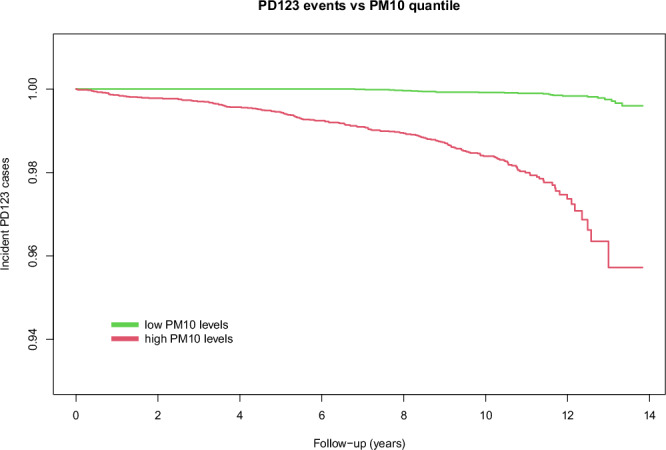
Air pollution has been associated with Parkinson's Disease (PD) risk, although this relationship remains unclear. We estimated yearly levels of exposure to ten air pollutants (period 2006-2018) in an Italian population cohort, the Moli-sani study (N = 24,325; ≥35 years; 51.9% women), and derived three principal components, testing their associations with incident PD risk over 23,841 participants (213 cases, median(IQR) follow-up 11.2(2.0) years). This revealed a statistically significant association of PC1 (explaining 38.2% of common variance, tagging PM10 levels), independent on sociodemographic, professional and lifestyles covariates (Hazard Ratio [95%CI] = 1.04[1.02-1.07]). The association was confirmed testing average PM10 levels during follow-up (18[13-24]% increase of PD risk per 1 μg/m increase of PM10). Among different circulating markers, lipoprotein a explained a significant proportion of this association (2.8[0.9; 8.4]%). These findings suggest PM10 as a target to lower PD risk at the population level and a potential implication of lipoprotein a in PD etiology.
空气污染与帕金森病(PD)风险相关,尽管这种关系尚不清楚。我们在意大利莫利萨尼研究队列(N = 24325;年龄≥35岁;女性占51.9%)中估算了2006年至2018年期间十种空气污染物的年度暴露水平,并得出三个主成分,在23841名参与者(213例病例,中位随访时间11.2(2.0)年)中测试它们与PD发病风险的关联。这显示PC1(解释38.2%的共同方差,代表PM10水平)与PD发病风险存在统计学显著关联,且独立于社会人口统计学、职业和生活方式协变量(风险比[95%置信区间]=1.04[1.02 - 1.07])。通过测试随访期间的平均PM10水平(PM10每增加1μg/m³,PD风险增加18[13 - 24]%)证实了这种关联。在不同的循环标志物中,脂蛋白a在这种关联中占很大比例(2.8[0.9;8.4]%)。这些发现表明,PM10是在人群水平降低PD风险的一个靶点,且脂蛋白a在PD病因学中可能具有潜在影响。