Cvachovec Paula, Bicu Alicia S, Schmidt Ralf, Siefert Victor, Eckl Miriam, Willam Marvin, Clausen Sven, Froelich Matthias F, Schoenberg Stefan O, Ehmann Michael, Buergy Daniel, Fleckenstein Jens, Giordano Frank A, Boda-Heggemann Judit, Dreher Constantin
Department of Radiation Oncology, University Medical Centre Mannheim, Medical Faculty Mannheim, University of Heidelberg, Theodor-Kutzer Ufer 1-3, 68167, Mannheim, Germany.
DKFZ-Hector Cancer Institute, University Medical Centre Mannheim, Mannheim, Germany.
Sci Rep. 2025 May 7;15(1):15863. doi: 10.1038/s41598-025-99920-x.
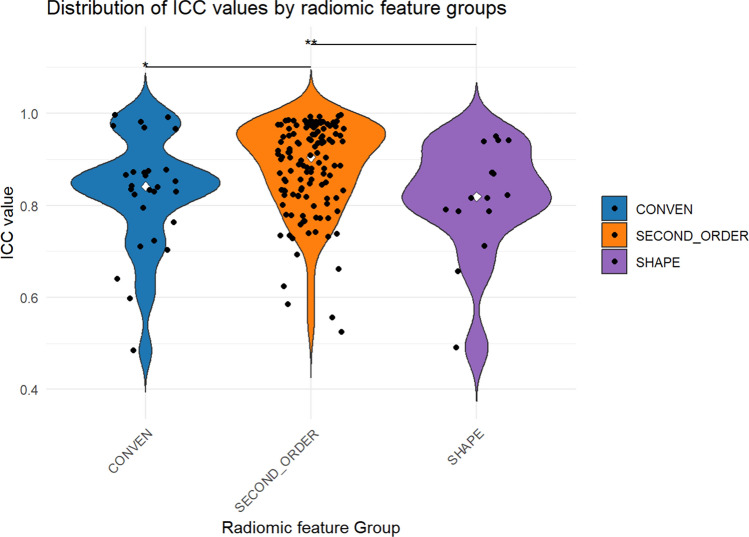
CT-guided adaptive radiotherapy (aRT) based on HyperSight-CBCT provides high-quality imaging, allowing quantitative radiomic feature analysis as a monitoring tool. This study comprehensively evaluates the stability of radiomic features, as potential imaging biomarkers, in pelvic structures of prostate cancer patients treated with adaptive stereotactic body radiation therapy (SBRT). Between December 2023 and July 2024, 32 patients with localized prostate cancer underwent adaptive SBRT at the Ethos linear accelerator (Varian, Siemens Healthineers) with HyperSight-CBCT imaging. Longitudinal stability was assessed by intraclass correlation coefficient (ICC) over five fractions of aRT for target structures and non-hollow organs at risk. In pooled organs at risk, 93.0% of features showed very high stability (ICC > 0.9) compared to 67.4% in pooled target structures, indicating significantly lower stability for target structures (p = 0.00009129). Second-order features demonstrated greater stability than conventional and shape-based features (p = 0.0433, p = 0.0252). Fraction number significantly affected longitudinal prostate feature variability (p = 0.0135). This study comprehensively analyzed HyperSight-CBCT imaging to evaluate longitudinal stability of radiomic features during adaptive SBRT for prostate cancer. The trends observed will provide a framework for future CT-guided aRT studies, facilitating quantitative imaging analysis of radiological biomarkers for clinical translation and improving personalized treatment.
基于HyperSight-CBCT的CT引导自适应放疗(aRT)可提供高质量成像,允许将定量影像组学特征分析用作监测工具。本研究全面评估了影像组学特征作为潜在成像生物标志物在接受自适应立体定向体部放疗(SBRT)的前列腺癌患者盆腔结构中的稳定性。在2023年12月至2024年7月期间,32例局限性前列腺癌患者在配备HyperSight-CBCT成像的Ethos直线加速器(瓦里安,西门子医疗)上接受了自适应SBRT。通过组内相关系数(ICC)评估了aRT五个分次中靶结构和非中空危及器官的纵向稳定性。在合并的危及器官中,93.0%的特征显示出非常高的稳定性(ICC>0.9),而合并靶结构中的这一比例为67.4%,表明靶结构的稳定性显著较低(p=0.00009129)。二阶特征显示出比传统特征和基于形状的特征更高的稳定性(p=0.0433,p=0.0252)。分次次数显著影响前列腺纵向特征的变异性(p=0.0135)。本研究全面分析了HyperSight-CBCT成像,以评估前列腺癌自适应SBRT期间影像组学特征的纵向稳定性。观察到的趋势将为未来的CT引导aRT研究提供一个框架,促进用于临床转化的放射生物标志物的定量成像分析,并改善个性化治疗。