Zavala Eleonor, Doggett Elizabeth, Nicklin Andrew, Karron Ruth A, Faden Ruth R
Department of International Health, Bloomberg School of Public Health, Johns Hopkins University, 615 N. Wolfe St, Baltimore, MD, 21205, USA.
Jhpiego, 1615 Thames Street, Baltimore, MD, 21231, USA.
Int J Equity Health. 2025 May 7;24(1):127. doi: 10.1186/s12939-025-02497-0.
Despite increasing vaccine availability and evidence and expert recommendations to support administration, some countries maintained restrictive policies regarding COVID-19 vaccination in pregnancy throughout the pandemic. This global analysis explores the role of gender equity, country income level, and vaccine availability in predicting national policies on COVID-19 vaccine administration in pregnancy.
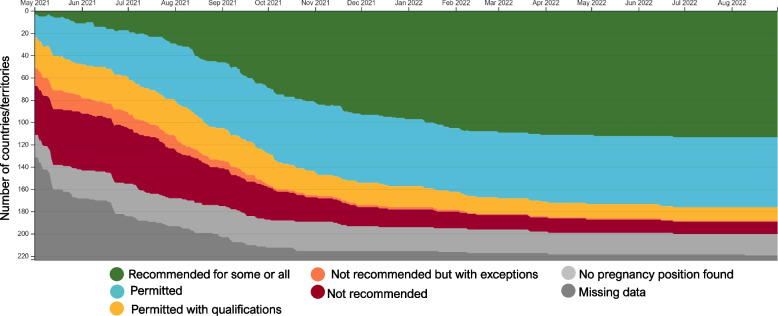
Policies were collected from May 2021 to January 2023 from 224 countries/territories using publicly available information posted on national public health authority web pages. Policies were categorized into 6 types, representing different levels of permissiveness, from recommended for some or all to not recommended, and changes in national policies were captured over time. Outcomes were defined as: 1) prevalence of restrictive policies at a specific time point; 2) country-level change from restrictive policy/no position at an earlier time point to a permissive policy at a later timepoint. Simple and multivariable logistic regressions were performed to explore the association between the outcomes and potential policy predictors, including income level, mRNA vaccine availability, and the Global Gender Gap Index (GGGI).
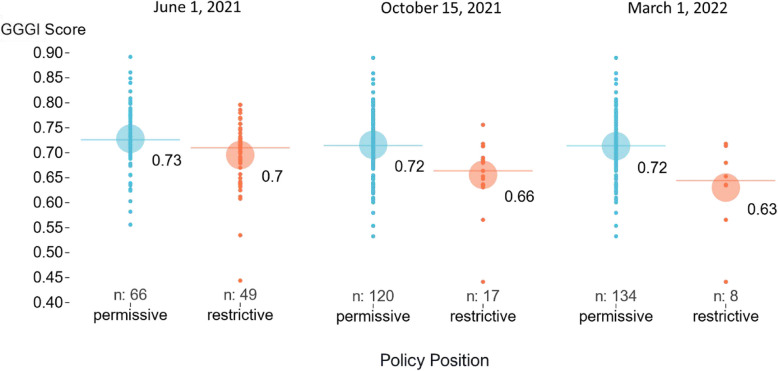
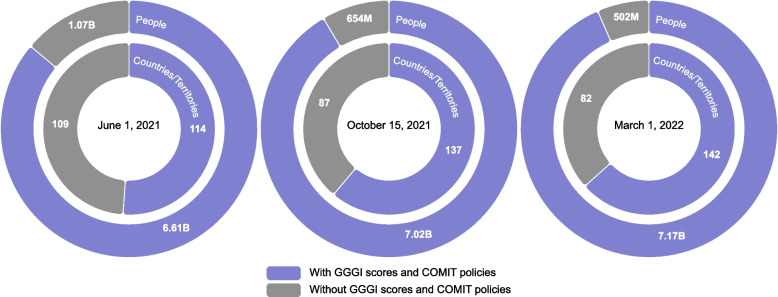
Complete cross-sectional data were available for 114 countries as of June 2021, 137 countries as of October 2021, and 142 countries as of March 2022. The number of maternal immunization policies increased and became steadily more permissive between 2021 and 2022. Availability of mRNA vaccines and higher income level were associated with reduced odds of a restrictive policy at the 2021 timepoints, and higher GGGI scores were associated with reduced odds of restrictive policies at all timepoints. After adjusting for income level and mRNA vaccine availability, higher GGGI scores reduced the relative odds of a restrictive COVID-19 vaccine policy by 10% (aOR: 0.90, 95CI: 0.81, 0.99) in October 2021 and 14% (aOR: 0.86, 95%CI: 0.76, 0.97) in March 2021. Higher GGGI scores were also associated with increased odds of a policy switch from restrictive/no position in June 2021 to permissive in October 2021 (aOR: 1.12, 95%CI: 1.00, 1.24).
Gender inequity was associated with greater odds of a restrictive policy for use of COVID-19 vaccines in pregnancy, suggesting that gender biases may influence fair policymaking for pregnant people in pandemic preparedness and response.
尽管疫苗供应增加,且有证据和专家建议支持接种,但在整个疫情期间,一些国家对孕妇接种新冠疫苗仍维持限制性政策。这项全球分析探讨了性别平等、国家收入水平和疫苗供应情况在预测各国关于孕妇接种新冠疫苗政策方面的作用。
2021年5月至2023年1月期间,利用各国国家公共卫生当局网页上公布的公开信息,从224个国家/地区收集政策。政策被分为6种类型,代表不同程度的宽松程度,从推荐部分或全部人群接种到不推荐接种,并记录了各国政策随时间的变化。结果定义为:1)特定时间点限制性政策的流行率;2)国家层面从早期的限制性政策/无立场转变为后期的宽松政策。进行了单变量和多变量逻辑回归分析,以探讨结果与潜在政策预测因素之间的关联,包括收入水平、mRNA疫苗供应情况和全球性别差距指数(GGGI)。
截至2021年6月,有114个国家可获得完整的横断面数据;截至2021年10月,有137个国家;截至2022年3月,有142个国家。2021年至2022年期间,孕产妇免疫政策的数量增加,且逐渐变得更加宽松。在2021年的各个时间点,mRNA疫苗的供应和较高的收入水平与限制性政策的几率降低相关,而较高的GGGI得分与所有时间点的限制性政策几率降低相关。在调整收入水平和mRNA疫苗供应情况后,较高的GGGI得分在2021年10月将新冠疫苗限制性政策的相对几率降低了10%(调整优势比:0.90,95%置信区间:0.81,0.99),在2021年3月降低了14%(调整优势比:0.86,95%置信区间:0.76,0.97)。较高的GGGI得分还与2021年6月从限制性/无立场政策转变为2021年10月宽松政策的几率增加相关(调整优势比:1.12,95%置信区间:1.00,1.24)。
性别不平等与孕妇接种新冠疫苗的限制性政策几率较高相关,这表明性别偏见可能会影响在大流行防范和应对中针对孕妇的公平政策制定。