Mahmoud Hawa D, Kent Sarah C, Ibrahim Fatima E, Mohamed Najma, Abdulahi Fatima A, O'Neal Meagan N, Kanajam Priya, Diego Ellen K
Department of Family Medicine, College of Health Sciences, Amoud University, Borama.
Afr J Prim Health Care Fam Med. 2025 Apr 23;17(1):e1-e14. doi: 10.4102/phcfm.v17i1.4742.
Continuous positive airway pressure (CPAP) therapy is the standard of care for neonatal respiratory distress and improves survival when implemented in low-resource settings. Clinical audits at the Borama Regional Hospital (BRH) Neonatal Intensive Care Unit (NICU) revealed multiple barriers to effective CPAP, including insufficient pressure, a lack of neonatal-sized nasal prongs, and patient interface challenges.
Improve respiratory distress by increasing effective CPAP delivery for neonates 30 days of age from 52% to 90% in 6 months.
Single-centre referral hospital in the Awdal region of Somaliland.
Quality improvement (QI) initiative with outcomes displayed using statistical process control (SPC) charts.
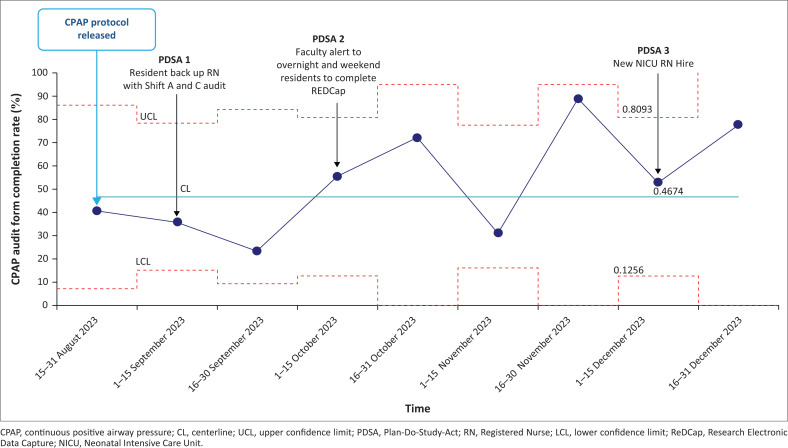
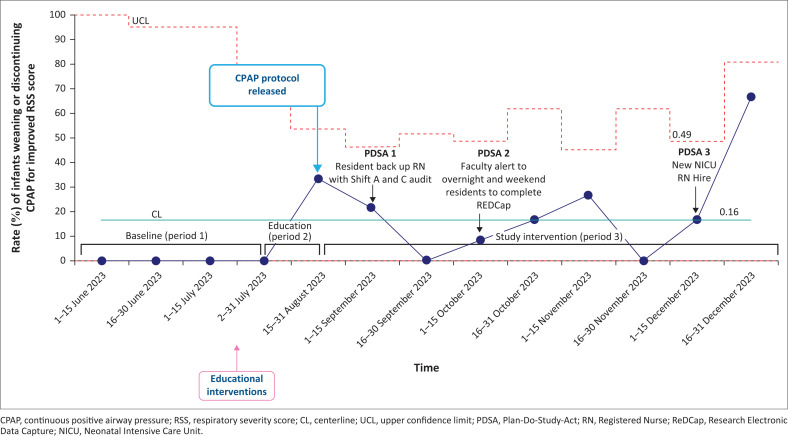
Eleven residents, three medical interns and seven NICU nurses completed the educational training. Forty-five patients were initiated on the locally designed bubble CPAP (bCPAP) device with a 47% (122/261) CPAP safety checklist completion rate for the three daily nursing shifts. We achieved our study aim by increasing the adherence rate to the 7-item bCPAP device set up from a baseline of 52% to 91%. The rate of infants weaned or discontinued from bCPAP for improved respiratory severity score (RSS) increased from 0% to 18% but did not demonstrate process change. There was no increase in adverse event rates (air leak, nasal columella breakdown and nasal irritation).
We demonstrated increased effective bCPAP delivery and decreased respiratory distress.Contribution: This study outlines low-cost, customisable QI strategies to address commonly encountered gaps for effective bCPAP delivery in low-resource settings without access to commercially available CPAP devices or speciality-trained providers.
持续气道正压通气(CPAP)疗法是新生儿呼吸窘迫的标准治疗方法,在资源匮乏地区实施时可提高生存率。博拉马地区医院(BRH)新生儿重症监护病房(NICU)的临床审计发现,有效实施CPAP存在多重障碍,包括压力不足、缺乏新生儿尺寸的鼻导管以及患者界面问题。
在6个月内将30日龄新生儿的有效CPAP使用率从52%提高到90%,以改善呼吸窘迫状况。
索马里兰奥达勒地区的单中心转诊医院。
开展质量改进(QI)项目,使用统计过程控制(SPC)图表展示结果。
11名住院医师、3名医学实习生和7名NICU护士完成了教育培训。45名患者开始使用当地设计的气泡式CPAP(bCPAP)设备,三个日常护理班次的CPAP安全检查表完成率为47%(122/261)。我们通过将7项bCPAP设备设置的依从率从基线的52%提高到91%,实现了研究目标。因呼吸严重程度评分(RSS)改善而停用或中断bCPAP的婴儿比例从0%增加到18%,但未显示出过程变化。不良事件发生率(漏气、鼻小柱破损和鼻刺激)没有增加。
我们证明了bCPAP的有效使用率有所提高,呼吸窘迫状况有所减轻。贡献:本研究概述了低成本、可定制的QI策略,以解决在资源匮乏地区无法获得商用CPAP设备或专业培训人员的情况下,有效实施bCPAP时常见的差距。