Departamento de Pediatria, Escola Paulista de Medicina - Universidade Federal de São Paulo (UNIFESP), Rua Marselhesa 630, São Paulo, Vila Clementino, 04020-060, Brazil.
Fundação Sistema Estadual de Análise de Dados (SEADE Foundation), Avenida Professor Lineu Prestes, 913 - Cidade Universitária, São Paulo, 05508-000, Brazil.
BMC Public Health. 2022 Jun 20;22(1):1226. doi: 10.1186/s12889-022-13629-4.
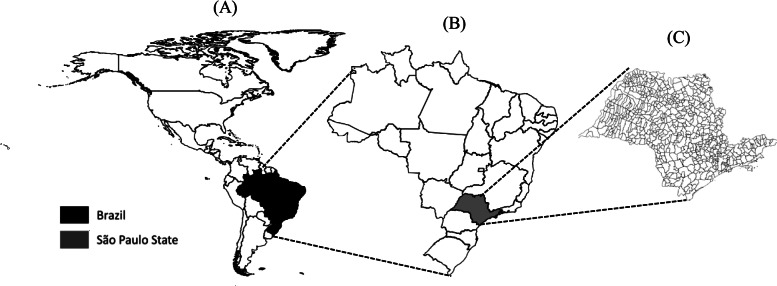
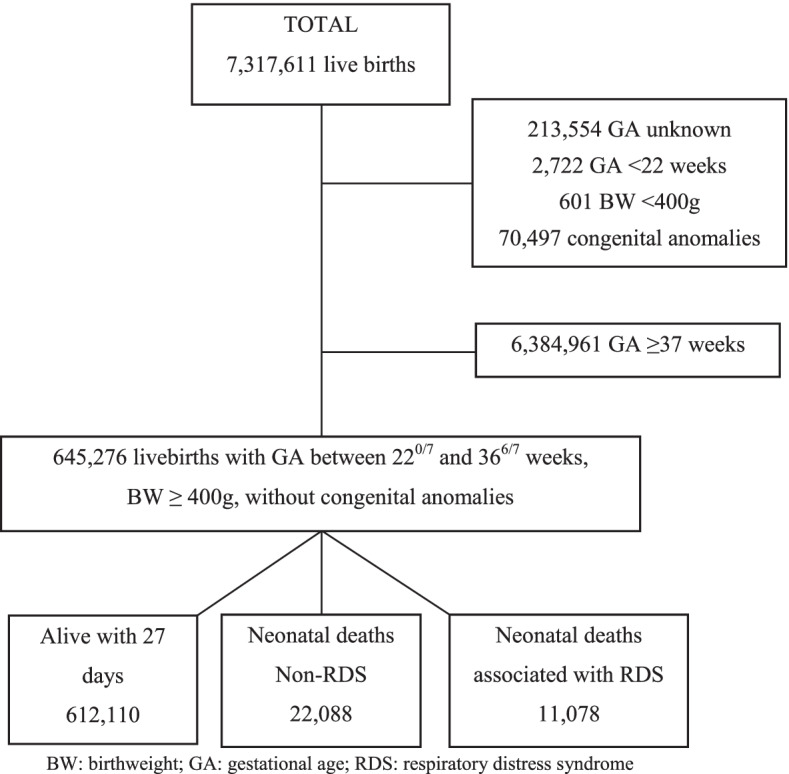
Prematurity and respiratory distress syndrome (RDS) are strongly associated. RDS continues to be an important contributor to neonatal mortality in low- and middle-income countries. This study aimed to identify clusters of preterm live births and RDS-associated neonatal deaths, and their cooccurrence pattern in São Paulo State, Brazil, between 2004 and 2015. METHODS: Population-based study of all live births with gestational age ≥ 22 weeks, birthweight ≥ 400 g, without congenital anomalies from mothers living in São Paulo State, Brazil, during 2004-2015. RDS-associated neonatal mortality was defined as deaths < 28 days with ICD-10 codes P22.0 or P28.0. RDS-associated neonatal mortality and preterm live births rates per municipality were submitted to first- and second-order spatial analysis before and after smoothing using local Bayes estimates. Spearman test was applied to identify the correlation pattern between both rates.
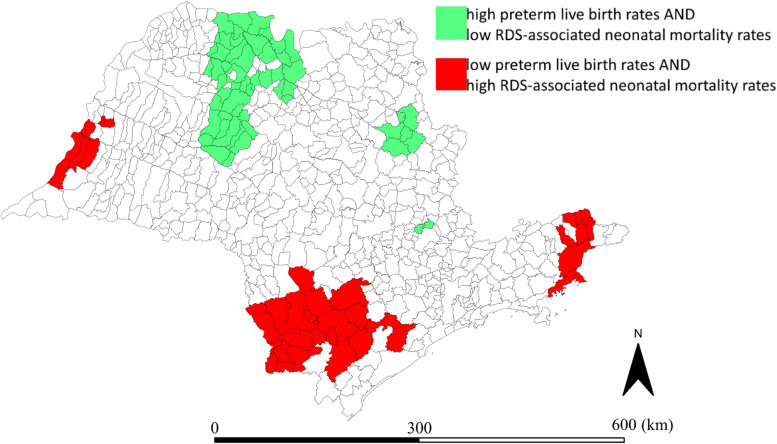
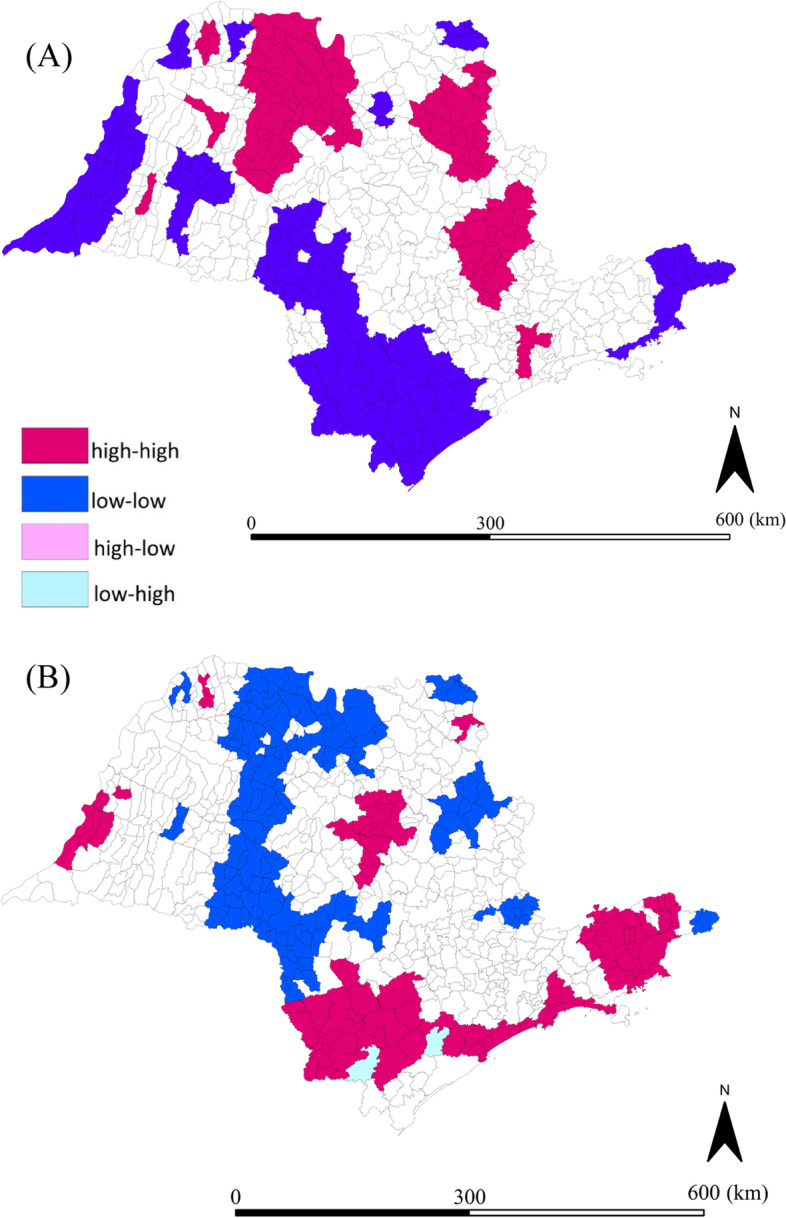
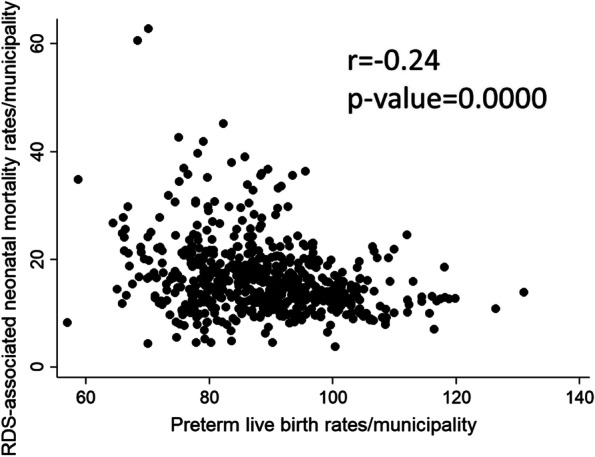
Six hundred forty-five thousand two hundred seventy-six preterm live births and 11,078 RDS-associated neonatal deaths in São Paulo State, Brazil, during the study period were analyzed. After smoothing, a non-random spatial distribution of preterm live births rate (I = 0.78; p = 0.001) and RDS-associated neonatal mortality rate (I = 0.73; p = 0.001) was identified. LISA maps confirmed clusters for both, with a negative correlation (r = -0.24; p = 0.0000). Clusters of high RDS-associated neonatal mortality rates overlapping with clusters of low preterm live births rates were detected.
Asymmetric cluster distribution of preterm live births and RDS-associated neonatal deaths may be helpful to indicate areas for perinatal healthcare improvement.
早产和呼吸窘迫综合征(RDS)密切相关。RDS 仍然是低收入和中等收入国家新生儿死亡的重要原因。本研究旨在确定巴西圣保罗州 2004 年至 2015 年间早产活产儿和与 RDS 相关的新生儿死亡的聚类及其共同发生模式。
这是一项基于人群的研究,研究对象为巴西圣保罗州 2004 年至 2015 年间所有胎龄≥22 周、出生体重≥400 克、无先天性畸形且母亲居住在该州的活产儿。与 RDS 相关的新生儿死亡率定义为 ICD-10 编码为 P22.0 或 P28.0 的 28 天内死亡。对每个市的 RDS 相关新生儿死亡率和早产活产儿率进行一阶和二阶空间分析,然后使用局部贝叶斯估计进行平滑处理。应用斯皮尔曼检验来确定这两个比率之间的相关模式。
在研究期间,巴西圣保罗州有 645276 例早产活产儿和 11078 例与 RDS 相关的新生儿死亡。平滑后,早产活产儿率(I=0.78;p=0.001)和与 RDS 相关的新生儿死亡率(I=0.73;p=0.001)的空间分布是非随机的。LISA 地图证实了这两种情况的聚类存在,且存在负相关(r=-0.24;p=0.0000)。检测到高与 RDS 相关的新生儿死亡率的聚类与低早产活产儿率的聚类重叠。
早产活产儿和与 RDS 相关的新生儿死亡的不对称聚类分布可能有助于指出围产保健改进的领域。