Pandey Saumya, Gupta Sangeeta, Rath Ramashankar, Gupta Gaurav
Department of Physiology, All India Institute of Medical Sciences, Gorakhpur, Uttar Pradesh, India.
Department of Community Medicine and Family Medicine, All India Institute of Medical Sciences, Gorakhpur, Uttar Pradesh, India.
Int J Appl Basic Med Res. 2025 Jan-Mar;15(1):49-59. doi: 10.4103/ijabmr.ijabmr_344_24. Epub 2025 Jan 9.
Cervical vestibular-evoked myogenic potentials (c-VEMPs) is a noninvasive procedure that captures the electrical activity of sternocleidomastoid (SCM) muscles in response to auditory stimuli. The clinical value of VEMP, however, is affected by the use of appropriate stimuli and correct testing techniques. This study investigates the effects of different stimuli and recording conditions on c-VEMP recordings.
Sixty healthy participants, aged 18-60 years, underwent c-VEMP recordings. Air-conducted sound stimuli (tone bursts and clicks) in sitting, supine neck torsion, and supine head lift and neck torsion positions along with the variation in the active electrode positions were employed to obtain the c-VEMP records. The c-VEMP parameters were compared by paired -test, Wilcoxon signed-rank test and one-way ANOVA. < 0.05 was considered statistically significant.
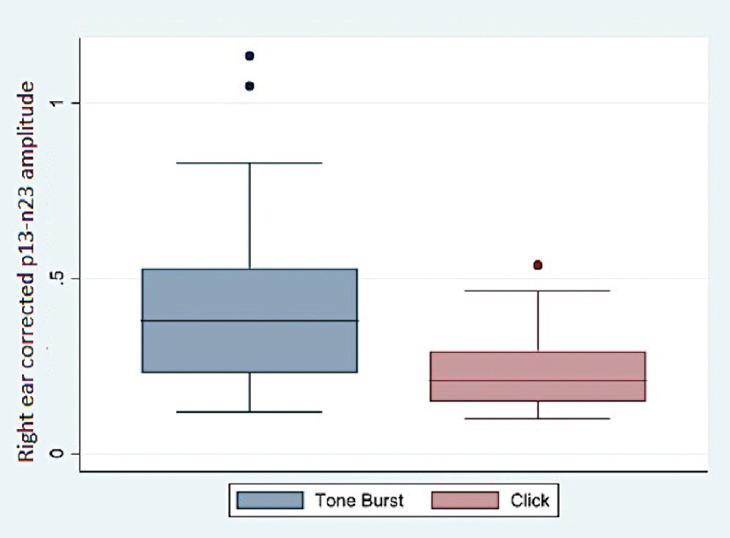
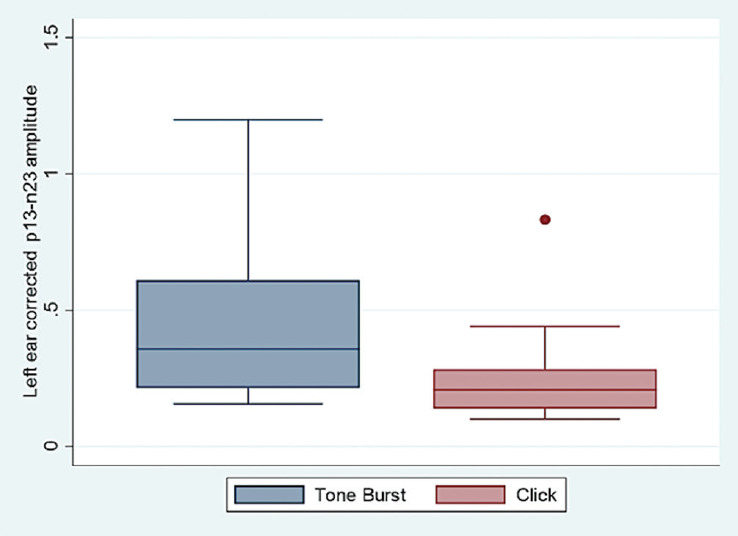
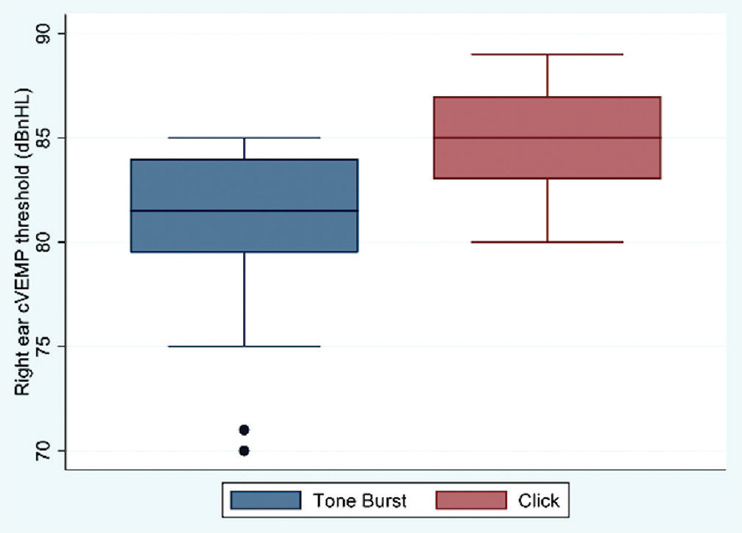
Tone burst and click-evoked c-VEMP varied with statistically significant differences in terms of amplitudes, corrected amplitudes, and thresholds ( = 0.0000). Tone burst stimuli produced larger amplitudes and lower thresholds in both ears. No significant difference was found in c-VEMP parameters tested for differences in active electrode placement except for threshold asymmetry ( = 0.0123) (Wilcoxon signed-rank test). c-VEMP recordings in the sitting position produced significantly larger corrected amplitudes compared to the supine head lift and neck torsion positions, for both sides (one-way ANOVA).
The results of the current study revealed a greater response rates and larger amplitudes for tone burst-evoked c-VEMP responses as compared to those with click stimuli. A seated, head-turned position with the active electrode placed in the middle of the SCM muscle yielded larger tone burst-evoked c-VEMP responses. The variation in the VEMP data obtained owing to different stimuli and recording conditions should be considered when evaluating patients in clinical practice to optimize the clinical applicability of the VEMP examination.
颈前庭诱发肌源性电位(c-VEMP)是一种非侵入性检查方法,可记录胸锁乳突肌(SCM)对听觉刺激的电活动。然而,VEMP的临床价值受适当刺激和正确测试技术的影响。本研究探讨不同刺激和记录条件对c-VEMP记录的影响。
60名年龄在18至60岁的健康参与者接受了c-VEMP记录。采用坐位、仰卧位颈部扭转、仰卧位抬头及颈部扭转位的气导声音刺激(短纯音和短声),同时改变活动电极位置以获取c-VEMP记录。采用配对t检验、Wilcoxon符号秩检验和单因素方差分析比较c-VEMP参数。P<0.05被认为具有统计学意义。
短纯音和短声诱发的c-VEMP在振幅、校正振幅和阈值方面存在统计学显著差异(P=0.0000)。短纯音刺激在双耳均产生较大振幅和较低阈值。除阈值不对称外(P=0.0123)(Wilcoxon符号秩检验),在测试活动电极位置差异时,c-VEMP参数未发现显著差异。坐位的c-VEMP记录在两侧均产生比仰卧位抬头及颈部扭转位显著更大的校正振幅(单因素方差分析)。
本研究结果显示,与短声刺激相比,短纯音诱发的c-VEMP反应具有更高的反应率和更大的振幅。活动电极置于SCM肌肉中部的坐位、头部转动位产生更大的短纯音诱发c-VEMP反应。在临床实践中评估患者时,应考虑因不同刺激和记录条件而获得的VEMP数据差异,以优化VEMP检查的临床适用性。