Yao Qiwei, Zheng Hongying, Huang Shuyun, Lin Mingqiang, Yang Jun, Li Jiancheng
Department of Radiation Oncology Clinical Oncology School of Fujian Medical University Fujian Cancer Hospital Fuzhou China.
Precis Radiat Oncol. 2023 Apr 19;7(2):101-110. doi: 10.1002/pro6.1192. eCollection 2023 Jun.
This study aimed to investigate the effect of different postoperative radiotherapy doses on the prognosis of patients with esophageal squamous cell carcinoma (ESCC).
A total of 199 patients (aged 18-75 years) with locally advanced ESCC who underwent esophagectomy and postoperative radiotherapy/chemoradiotherapy at the Fujian Cancer Hospital between July 2008 and January 2018 were included. Based on the postoperative radiotherapy dose, the patients were divided into a low-dose group (50-50.4 Gy; median dose 50 Gy) and a high-dose group (>50.4 Gy; median dose 60 Gy). Neoadjuvant and adjuvant chemotherapy regimens included PF (fluorouracil and cisplatin) and TP (paclitaxel and cisplatin) regimens. Patients were followed-up every 3 months in the first 2 years after surgery, every 6 months for the next 3 years, and then subsequently once a year. The primary endpoints were overall survival (OS) and progression-free survival (PFS) rates. The propensity-score matching (PSM) method was applied to identify a 1:1, well-balanced matched cohort with 33 patients in each group for survival comparison.
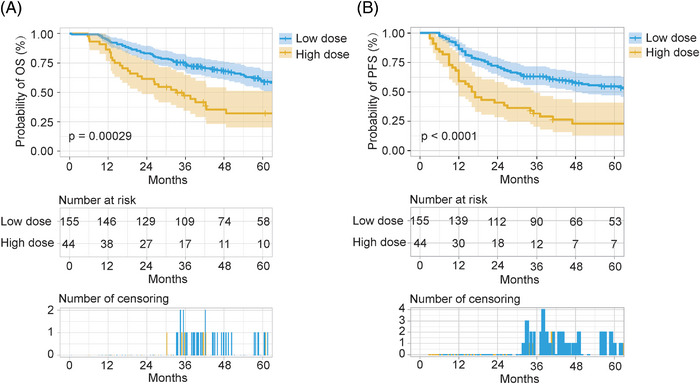
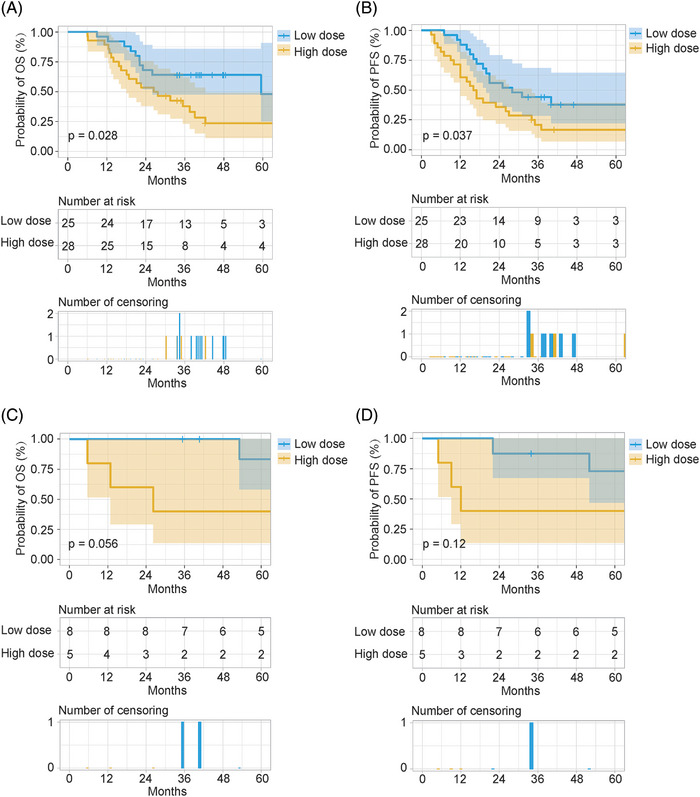
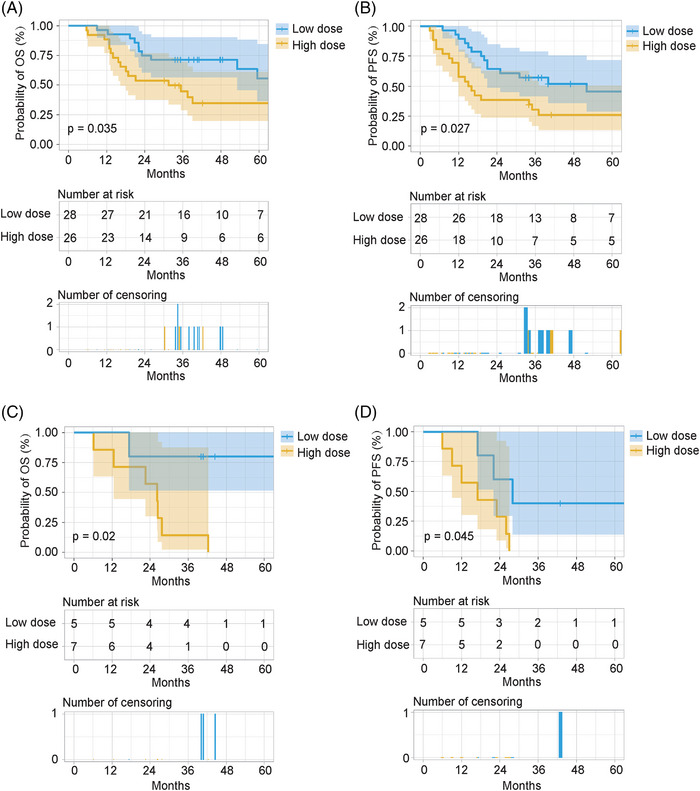
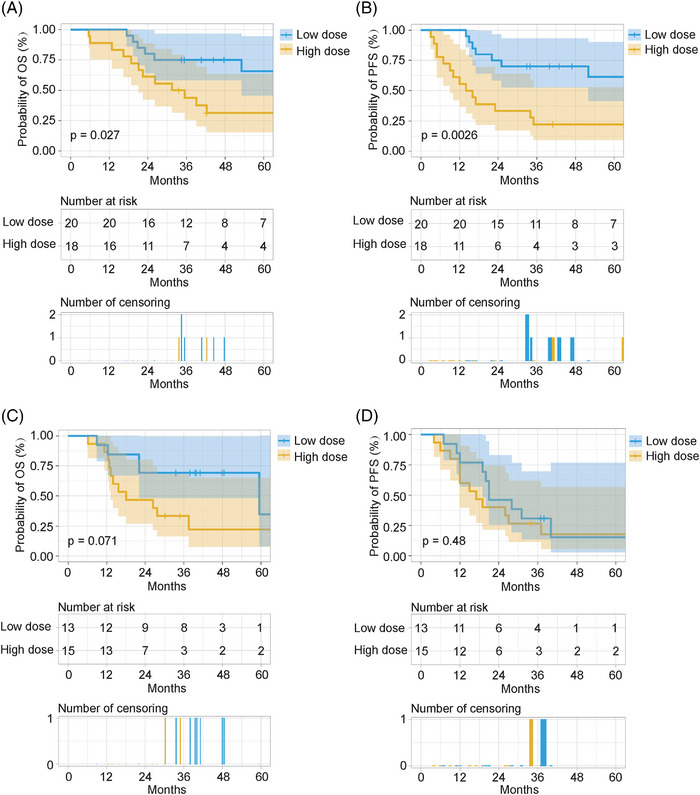
Among the 199 patients enrolled in this study, 144 and 55 were in the low-dose and high-dose groups, respectively. Univariate and multivariate analyses showed that pathological N classification, vascular tumor emboli, and postoperative radiotherapy dose were independent prognostic factors for both OS and PFS, all < 0.05. Before PSM, the OS and the PFS of the low-dose group were significantly longer than those of the high-dose group, both < 0.05. After PSM, better OS and PFS rates were observed in the low-dose group, both < 0.05. The results showed that patients with pathological stages N0-2 or N3, negative surgical margins, and no vascular tumor emboli could obtain a significant benefit in both OS and PFS after treatment with a low dose of postoperative radiotherapy (50-50.4 Gy). In the subgroup with positive surgical margins, treatment with a low dose of postoperative radiotherapy offered a non-significant survival benefit compared to treatment with a high dose of postoperative radiotherapy.
Our study revealed that for patients with ESCC, the low-dose group (50-50.4 Gy) had a significantly higher OS and PFS than the high-dose group (>50.4 Gy). It was suggested that 50-50.4 Gy might be the recommended postoperative radiotherapy dose for ESCC patients.
本研究旨在探讨不同术后放疗剂量对食管鳞状细胞癌(ESCC)患者预后的影响。
纳入2008年7月至2018年1月间在福建省肿瘤医院接受食管切除术及术后放疗/放化疗的199例年龄在18 - 75岁的局部晚期ESCC患者。根据术后放疗剂量,将患者分为低剂量组(50 - 50.4 Gy;中位剂量50 Gy)和高剂量组(>50.4 Gy;中位剂量60 Gy)。新辅助和辅助化疗方案包括PF(氟尿嘧啶和顺铂)方案和TP(紫杉醇和顺铂)方案。术后前2年每3个月对患者进行随访,接下来3年每6个月随访一次,之后每年随访一次。主要终点为总生存期(OS)和无进展生存期(PFS)率。采用倾向评分匹配(PSM)方法确定1:1、均衡匹配的队列,每组33例患者进行生存比较。
本研究纳入的199例患者中,低剂量组和高剂量组分别有144例和55例。单因素和多因素分析显示,病理N分级、血管肿瘤栓子和术后放疗剂量是OS和PFS的独立预后因素,均<0.05。在PSM之前,低剂量组的OS和PFS显著长于高剂量组,均<0.05。PSM后,低剂量组观察到更好的OS和PFS率,均<0.05。结果表明,病理分期为N0 - 2或N3、手术切缘阴性且无血管肿瘤栓子的患者,术后低剂量放疗(50 - 50.4 Gy)治疗后OS和PFS均能获得显著益处。在手术切缘阳性的亚组中,与术后高剂量放疗相比,术后低剂量放疗的生存获益不显著。
我们的研究表明,对于ESCC患者,低剂量组(50 - 50.4 Gy)的OS和PFS显著高于高剂量组(>50.4 Gy)。建议50 - 50.4 Gy可能是ESCC患者术后放疗的推荐剂量。