• 文献检索
  • 文档翻译
  • 深度研究
  • 学术资讯
  • Suppr Zotero 插件Zotero 插件
  • 邀请有礼
  • 套餐&价格
  • 历史记录
应用&插件
Suppr Zotero 插件Zotero 插件浏览器插件Mac 客户端Windows 客户端微信小程序
定价
高级版会员购买积分包购买API积分包
服务
文献检索文档翻译深度研究API 文档MCP 服务
关于我们
关于 Suppr公司介绍联系我们用户协议隐私条款
关注我们

Suppr 超能文献

核心技术专利:CN118964589B侵权必究
粤ICP备2023148730 号-1Suppr @ 2026

文献检索

告别复杂PubMed语法,用中文像聊天一样搜索,搜遍4000万医学文献。AI智能推荐,让科研检索更轻松。

立即免费搜索

文件翻译

保留排版,准确专业,支持PDF/Word/PPT等文件格式,支持 12+语言互译。

免费翻译文档

深度研究

AI帮你快速写综述,25分钟生成高质量综述,智能提取关键信息,辅助科研写作。

立即免费体验

人工智能在骨转移中的应用:对92项研究指南依从性的系统评价

Artificial Intelligence in bone Metastases: A systematic review in guideline adherence of 92 studies.

作者信息

van der Linden Lotte R, Vavliakis Ioannis, de Groot Tom M, Jutte Paul C, Doornberg Job N, Lozano-Calderon Santiago A, Groot Olivier Q

机构信息

Department of Orthopaedic Surgery, University Medical Center Groningen, Groningen, the Netherlands.

Department of Orthopaedic Surgery, Massachusetts General Hospital, Boston, MA, USA.

出版信息

J Bone Oncol. 2025 Apr 24;52:100682. doi: 10.1016/j.jbo.2025.100682. eCollection 2025 Jun.

DOI:10.1016/j.jbo.2025.100682
PMID:40337637
原文链接:https://pmc.ncbi.nlm.nih.gov/articles/PMC12056386/
Abstract

BACKGROUND

The last decade has witnessed a surge in artificial intelligence (AI). With bone metastases becoming more prevalent, there is an increasing call for personalized treatment options, a domain where AI can greatly contribute. However, integrating AI into clinical settings has proven to be difficult. Therefore, we aimed to provide an overview of AI modalities for treating bone metastases and recommend implementation-worthy models based on TRIPOD, CLAIM, and UPM scores.

METHODS

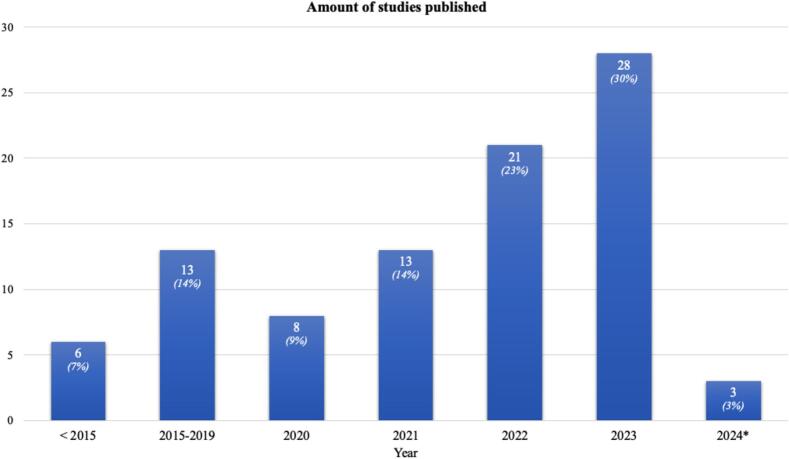
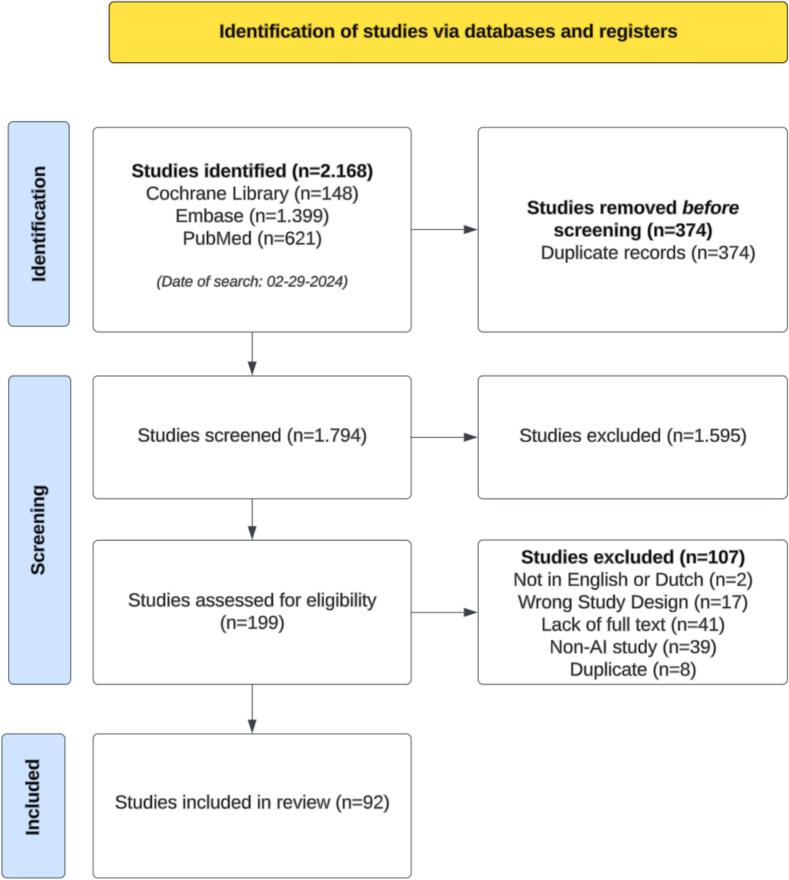
This systematic review included 92 studies on AI models in bone metastases between 2008 and 2024. Using three assessment tools we provided a reliable foundation for recommending AI modalities fit for clinical use (TRIPOD or CLAIM ≥ 70 % and UPM score ≥ 10).

RESULTS

Most models focused on survival prediction (44/92;48%), followed by imaging studies (37/92;40%). Median TRIPOD completeness was 70% (IQR 64-81%), CLAIM completeness was 57% (IQR 48-67%), and UPM score was 7 (IQR 5-9). In total, 10% (9/92) AI modalities were deemed fit for clinical use.

CONCLUSION

Transparent reporting, utilizing the aforementioned three evaluation tools, is essential for effectively integrating AI models into clinical practice, as currently, only 10% of AI models for bone metastases are deemed fit for clinical use. Such transparency ensures that both patients and clinicians can benefit from clinically useful AI models, potentially enhancing AI-driven personalized cancer treatment.

摘要

背景

在过去十年中,人工智能(AI)发展迅速。随着骨转移变得越来越普遍,对个性化治疗方案的需求日益增加,而人工智能在这一领域可以做出巨大贡献。然而,将人工智能整合到临床环境中已被证明是困难的。因此,我们旨在概述用于治疗骨转移的人工智能模式,并根据TRIPOD、CLAIM和UPM评分推荐值得实施的模型。

方法

本系统评价纳入了2008年至2024年间关于骨转移人工智能模型的92项研究。我们使用三种评估工具为推荐适合临床使用的人工智能模式提供了可靠的基础(TRIPOD或CLAIM≥70%且UPM评分≥10)。

结果

大多数模型专注于生存预测(44/92;48%),其次是影像学研究(37/92;40%)。TRIPOD完整性中位数为70%(IQR 64-81%),CLAIM完整性为57%(IQR 48-67%),UPM评分为7(IQR 5-9)。总共有10%(9/92)的人工智能模式被认为适合临床使用。

结论

利用上述三种评估工具进行透明报告对于将人工智能模型有效整合到临床实践中至关重要,因为目前,只有10%的骨转移人工智能模型被认为适合临床使用。这种透明度确保患者和临床医生都能从临床有用的人工智能模型中受益,有可能加强人工智能驱动的个性化癌症治疗。
https://cdn.ncbi.nlm.nih.gov/pmc/blobs/2306/12056386/23694df7c34b/gr3.jpg
https://cdn.ncbi.nlm.nih.gov/pmc/blobs/2306/12056386/0a71284332f0/gr1.jpg
https://cdn.ncbi.nlm.nih.gov/pmc/blobs/2306/12056386/c6ebfe01635c/gr2.jpg
https://cdn.ncbi.nlm.nih.gov/pmc/blobs/2306/12056386/23694df7c34b/gr3.jpg
https://cdn.ncbi.nlm.nih.gov/pmc/blobs/2306/12056386/0a71284332f0/gr1.jpg
https://cdn.ncbi.nlm.nih.gov/pmc/blobs/2306/12056386/c6ebfe01635c/gr2.jpg
https://cdn.ncbi.nlm.nih.gov/pmc/blobs/2306/12056386/23694df7c34b/gr3.jpg

相似文献

1
Artificial Intelligence in bone Metastases: A systematic review in guideline adherence of 92 studies.人工智能在骨转移中的应用:对92项研究指南依从性的系统评价
J Bone Oncol. 2025 Apr 24;52:100682. doi: 10.1016/j.jbo.2025.100682. eCollection 2025 Jun.
2
Protocol for development of a reporting guideline (TRIPOD-AI) and risk of bias tool (PROBAST-AI) for diagnostic and prognostic prediction model studies based on artificial intelligence.基于人工智能的诊断和预后预测模型研究报告指南(TRIPOD-AI)和偏倚风险工具(PROBAST-AI)制定方案。
BMJ Open. 2021 Jul 9;11(7):e048008. doi: 10.1136/bmjopen-2020-048008.
3
Development and reporting of artificial intelligence in osteoporosis management.人工智能在骨质疏松症管理中的发展和报告。
J Bone Miner Res. 2024 Oct 29;39(11):1553-1573. doi: 10.1093/jbmr/zjae131.
4
Adherence to the Checklist for Artificial Intelligence in Medical Imaging (CLAIM): an umbrella review with a comprehensive two-level analysis.遵循医学影像人工智能清单(CLAIM):一项进行全面两级分析的汇总综述。
Diagn Interv Radiol. 2025 Feb 10. doi: 10.4274/dir.2025.243182.
5
Artificial intelligence for breast cancer detection and its health technology assessment: A scoping review.用于乳腺癌检测的人工智能及其健康技术评估:一项范围综述。
Comput Biol Med. 2025 Jan;184:109391. doi: 10.1016/j.compbiomed.2024.109391. Epub 2024 Nov 22.
6
Artificial Intelligence and Machine Learning in Cancer Related Pain: A Systematic Review.人工智能与机器学习在癌症相关疼痛中的应用:一项系统综述
medRxiv. 2023 Dec 8:2023.12.06.23299610. doi: 10.1101/2023.12.06.23299610.
7
Artificial Intelligence-Driven Radiomics in Head and Neck Cancer: Current Status and Future Prospects.人工智能驱动的头颈部癌症放射组学:现状与未来展望。
Int J Med Inform. 2024 Aug;188:105464. doi: 10.1016/j.ijmedinf.2024.105464. Epub 2024 Apr 23.
8
Are current clinical studies on artificial intelligence-based medical devices comprehensive enough to support a full health technology assessment? A systematic review.基于人工智能的医疗器械的当前临床研究是否足够全面,足以支持全面的健康技术评估?系统评价。
Artif Intell Med. 2023 Jun;140:102547. doi: 10.1016/j.artmed.2023.102547. Epub 2023 Apr 23.
9
Implementation of Artificial Intelligence in Personalized Prognostic Assessment of Lung Cancer: A Narrative Review.人工智能在肺癌个性化预后评估中的应用:一项叙述性综述
Cancers (Basel). 2024 May 10;16(10):1832. doi: 10.3390/cancers16101832.
10
Artificial Intelligence and Machine Learning in Cancer Pain: A Systematic Review.人工智能和机器学习在癌症疼痛中的应用:系统评价。
J Pain Symptom Manage. 2024 Dec;68(6):e462-e490. doi: 10.1016/j.jpainsymman.2024.07.025. Epub 2024 Aug 3.

本文引用的文献

1
Narrative review of the epidemiology, economic burden, and societal impact of metastatic bone disease.转移性骨病的流行病学、经济负担及社会影响的叙述性综述
Ann Jt. 2022 Jul 15;7:28. doi: 10.21037/aoj-20-97. eCollection 2022.
2
Comparison of survival prediction models for bone metastases of the extremities following surgery.肢体骨转移瘤术后生存预测模型的比较
Bone Joint J. 2024 Feb 1;106-B(2):203-211. doi: 10.1302/0301-620X.106B2.BJJ-2023-0751.
3
Automated Diagnosis of Bone Metastasis by Classifying Bone Scintigrams Using a Self-defined Deep Learning Model.
使用自定义深度学习模型对骨闪烁图进行分类以实现骨转移的自动诊断
Curr Med Imaging. 2024 Jan 19. doi: 10.2174/0115734056281578231212104108.
4
Systematic review of machine-learning models in orthopaedic trauma.骨科创伤中机器学习模型的系统评价
Bone Jt Open. 2024 Jan 16;5(1):9-19. doi: 10.1302/2633-1462.51.BJO-2023-0095.R1.
5
A New Deep Learning Algorithm for Detecting Spinal Metastases on Computed Tomography Images.一种用于在 CT 图像上检测脊柱转移瘤的新型深度学习算法。
Spine (Phila Pa 1976). 2024 Mar 15;49(6):390-397. doi: 10.1097/BRS.0000000000004889. Epub 2023 Dec 12.
6
ChatGPT-assisted deep learning for diagnosing bone metastasis in bone scans: Bridging the AI Gap for Clinicians.ChatGPT辅助的深度学习在骨扫描中诊断骨转移:弥合临床医生的人工智能差距
Heliyon. 2023 Nov 20;9(12):e22409. doi: 10.1016/j.heliyon.2023.e22409. eCollection 2023 Dec.
7
Development of Machine-Learning Models to Predict Ambulation Outcomes Following Spinal Metastasis Surgery.用于预测脊柱转移瘤手术后步行结果的机器学习模型的开发。
Asian Spine J. 2023 Dec;17(6):1013-1023. doi: 10.31616/asj.2023.0051. Epub 2023 Dec 5.
8
Subcutaneous fat predicts bone metastasis in breast cancer: A novel multimodality-based deep learning model.皮下脂肪预测乳腺癌骨转移:一种新的基于多模态的深度学习模型。
Cancer Biomark. 2024;39(3):171-185. doi: 10.3233/CBM-230219.
9
Prediction and related genes of cancer distant metastasis based on deep learning.基于深度学习的癌症远处转移预测及相关基因。
Comput Biol Med. 2024 Jan;168:107664. doi: 10.1016/j.compbiomed.2023.107664. Epub 2023 Nov 16.
10
Machine learning based on SPECT/CT to differentiate bone metastasis and benign bone lesions in lung malignancy patients.基于 SPECT/CT 的机器学习对肺癌患者骨转移和良性骨病变的鉴别。
Med Phys. 2024 Apr;51(4):2578-2588. doi: 10.1002/mp.16839. Epub 2023 Nov 15.