Jacobson Ingrid, Rydberg Katie, Swendener Alexis, MacDougall Hannah, Henning-Smith Carrie
Division of Health Policy and Management, University of Minnesota School of Public Health, Minneapolis, Minnesota, USA.
University of Minnesota School of Social Work, St. Paul, Minnesota, USA.
J Rural Health. 2025 Mar;41(2):e70034. doi: 10.1111/jrh.70034.
Social/emotional support can help to buffer the health and financial impacts of health care costs. However, little research examines differences in social/emotional support as it relates to health care affordability, and even less examines these issues by rurality despite rural/urban differences in health and health care access. This study addresses these gaps by examining differences in social/emotional support and health care affordability issues among rural and urban adults.
Using weighted data from the 2020 and 2021 National Health Interview Survey (n = 44,987), we examined differences in three health care affordability issues: worry about medical bills, problems paying medical bills, and inability to pay medical bills. We conducted bivariate and multivariate logistic regression analyses comparing these issues by rurality, social/emotional support, and other sociodemographic and health characteristics, generating adjusted odds ratios and predicted probabilities of these issues.
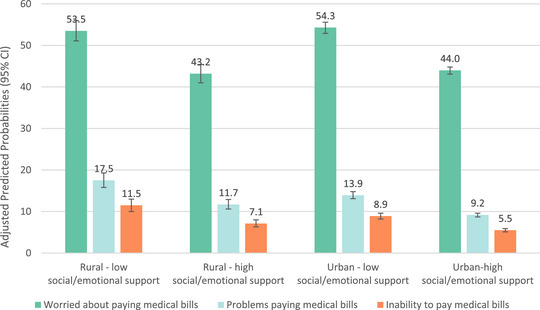
Rural residents were more likely to report problems paying and inability to pay medical bills (13.0% vs. 10.2%, p < 0.001; 8.2% vs 6.2%, p < 0.001). Sociodemographic and health covariates were differentially associated with adjusted odds of health care affordability issues, while low social/emotional support was associated with higher adjusted odds and adjusted predicted probabilities of all three health care affordability issues in both rural and urban areas.
Low social/emotional support is associated with higher odds and predicted probabilities of all health care affordability issues regardless of rurality. Future policy aimed at reducing medical debt in rural areas should consider the beneficial impacts of social/emotional support.
社会/情感支持有助于缓冲医疗费用对健康和经济的影响。然而,很少有研究探讨社会/情感支持在医疗保健可负担性方面的差异,而且尽管农村和城市在健康及医疗保健可及性方面存在差异,但很少有研究按农村地区情况来考察这些问题。本研究通过调查农村和城市成年人在社会/情感支持及医疗保健可负担性问题上的差异来填补这些空白。
利用2020年和2021年全国健康访谈调查的加权数据(n = 44,987),我们考察了三个医疗保健可负担性问题上的差异:担心医疗账单、支付医疗账单有困难以及无力支付医疗账单。我们进行了双变量和多变量逻辑回归分析,按农村地区情况、社会/情感支持以及其他社会人口统计学和健康特征对这些问题进行比较,得出这些问题的调整后比值比和预测概率。
农村居民更有可能报告支付医疗账单有困难和无力支付医疗账单的情况(分别为13.0%对10.2%,p < 0.001;8.2%对6.2%,p < 0.001)。社会人口统计学和健康协变量与医疗保健可负担性问题的调整后几率存在不同程度的关联,而低社会/情感支持与农村和城市地区所有三个医疗保健可负担性问题的较高调整后几率及调整后预测概率相关。
无论农村地区情况如何,低社会/情感支持与所有医疗保健可负担性问题的较高几率和预测概率相关。未来旨在减少农村地区医疗债务的政策应考虑社会/情感支持的有益影响。