Zhou Siqi, Yu Shangchen, Bi Yuan, Tian Zhang, Pan Ruochen, Yan Tianqing, Deng Jianbo, Xu Aijun
Department of Anesthesiology, Hubei Key Laboratory of Geriatric Anaesthesiaand , Perioperative Brain Health, and Wuhan Clinical Research Center for Geriatric Anaesthesia, Tongji Hospital, Tongji Medical College, Huazhong University of Science and Technology, Wuhan, China.
BMC Anesthesiol. 2025 May 8;25(1):230. doi: 10.1186/s12871-025-03108-9.
While propofol remains widely used for endoscopic sedation, its cardiovascular depression and injection pain limitations have prompted exploration of novel agents (remimazolam, ciprofol). This study aimed to compare their safety and efficacy profiles systematically.
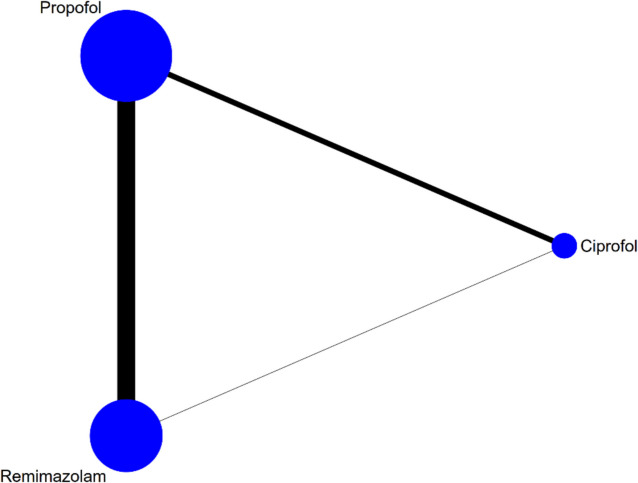
We conducted a network meta-analysis to evaluate remimazolam, ciprofol, and propofol for gastrointestinal endoscopy. Bayesian random-effects models were used to estimate relative risks (RR) and mean differences (MD) with 95% credible intervals(CrI).
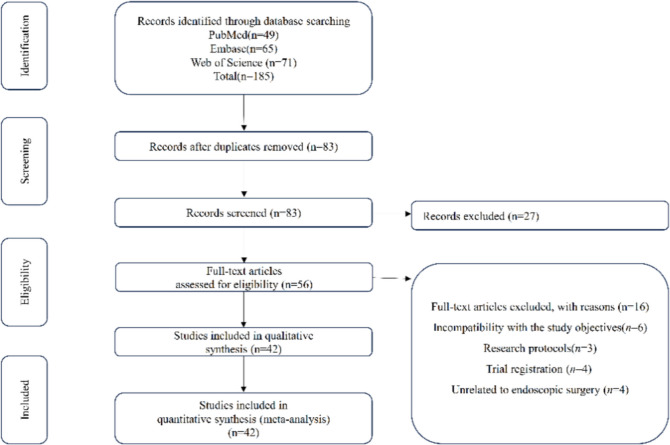
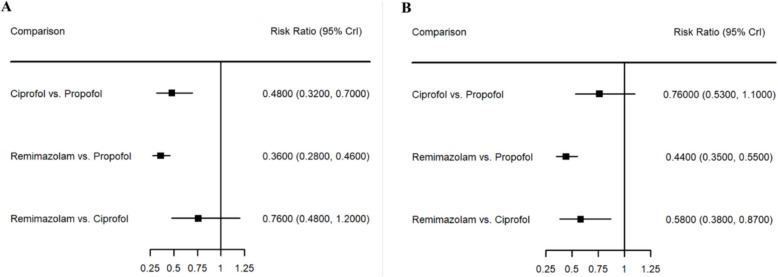
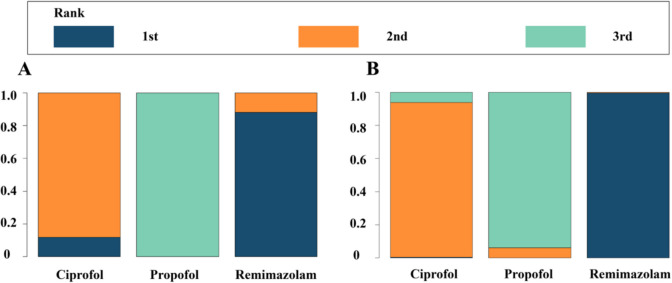
Forty-two randomized controlled trials (N = 10,540 patients) were included. Remimazolam demonstrated superior cardiovascular safety (RR = 0.44, 95%CrI 0.35-0.54 vs propofol) and lowest respiratory depression risk (RR = 0.36, 0.28-0.46). Propofol showed faster recovery (MD -14.22 min, -2.35 to -30.83 vs remimazolam). Both remimazolam (RR = 0.045) and ciprofol (RR = 0.054) significantly reduced injection pain versus propofol.
Remimazolam should be prioritized for high-risk patients (cardiovascular/respiratory comorbidities) despite slightly longer recovery times. Propofol remains suitable for low-risk procedures requiring rapid turnover, while ciprofol offers balanced efficacy for endoscopy.
The study was registered with the UK National Institute for Health Research's PROSPERO platform (CRD42024569405; https://www.crd.york.ac.uk/prospero/ ).
虽然丙泊酚仍广泛用于内镜镇静,但其心血管抑制和注射痛的局限性促使人们探索新型药物(瑞马唑仑、环泊酚)。本研究旨在系统比较它们的安全性和有效性。
我们进行了一项网状Meta分析,以评估瑞马唑仑、环泊酚和丙泊酚用于胃肠内镜检查的情况。采用贝叶斯随机效应模型估计相对风险(RR)和平均差(MD),并给出95%可信区间(CrI)。
纳入了42项随机对照试验(N = 10540例患者)。瑞马唑仑显示出更好的心血管安全性(RR = 0.44,95%CrI 0.35 - 0.54,与丙泊酚相比)和最低的呼吸抑制风险(RR = 0.36,0.28 - 0.46)。丙泊酚的恢复速度更快(MD -14.22分钟,-2.35至-30.83,与瑞马唑仑相比)。与丙泊酚相比,瑞马唑仑(RR = 0.045)和环泊酚(RR = 0.054)均显著减轻了注射痛。
尽管恢复时间稍长,但对于高危患者(心血管/呼吸合并症),应优先选择瑞马唑仑。丙泊酚仍然适用于需要快速周转的低风险手术,而环泊酚在内镜检查中提供了平衡的疗效。
该研究已在英国国家卫生研究院的PROSPERO平台注册(CRD42024569405;https://www.crd.york.ac.uk/prospero/ )。