Ho Peh Joo, Goh Su-Ann, Goh Serene Si Ning, Liu Jenny, Chew Ying Jia, Riza Nur Khaliesah Mohamed, Oh Han Boon, Chin Chi Hui, Kwek Sing Cheer, Zhang Zhi Peng, Ong Desmond Luan Seng, Quek Swee Tian, Wijerathne Sujith, Li Jingmei, Iau Philip Tsau Choong, Hartman Mikael
Saw Swee Hock School of Public Health, National University of Singapore and National University Health System, Singapore, 117549, Singapore.
Agency for Science, Technology and Research (A*STAR), Genome Institute of Singapore (GIS), 60 Biopolis Street, Singapore, 138672, Singapore.
J Transl Med. 2025 May 8;23(1):517. doi: 10.1186/s12967-025-06515-1.
Biennial mammography screening is well-established for women aged 50 and above, but guidelines for younger women are less clear. Risk-based screening may provide women with key information to make informed decisions about their breast cancer risk and screening. This study examines how predicted breast cancer (BC) risk shapes women's perception and confidence in risk prediction.
Women aged 35 to 59 years were recruited for a prospective multi-centre cohort and stratified into above-average, average, or below-average BC risk categories based on genetic and non-genetic risk factors. Perceived risk was assessed at enrolment and after participants were informed of their predicted risk. We used ordinal models to identify predictors of perceived risk and logistic regression to examine the relationship between changes in perceived risk and confidence in the risk prediction.
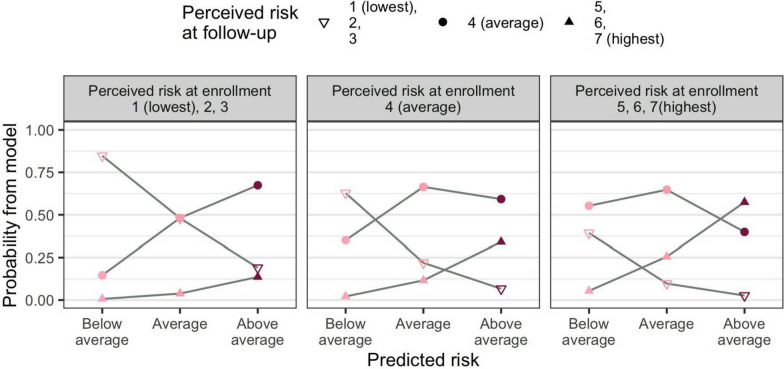
At enrolment, 43% and 47% of 4112 participants perceived their BC risk pre-result as low or average, respectively. Thirty-five percent adjusted their perceived risk to align more closely with their predicted risk. Predictors of perceived risk post-result: perceived risk pre-result, predicted risk, ethnicity and having regular menstruation. Participants who underestimated their BC risk were nearly eight times more likely to have low confidence in the accuracy of their predicted risk (OR for underestimation vs. accurate perception: 7.94 [95% CI 5.60-11.28]). Predictors of perceived risk post-result: perceived risk pre-result, predicted risk, ethnicity and having regular menstruation. Confidence in risk prediction was lowest when women's perceived risk pre-result was lower than their predicted risk (OR [95%CI] 5.06 [3.67 to 6.97]).
Many women underestimated their BC risk, and their initial perceptions were influenced by the knowledge of their predicted risk. Women who underestimated their risk had less confidence in their predicted risk scores.
对于50岁及以上的女性,每两年进行一次乳房X光筛查已得到广泛认可,但针对年轻女性的筛查指南尚不够明确。基于风险的筛查可为女性提供关键信息,以便她们就自身乳腺癌风险和筛查做出明智决策。本研究探讨预测的乳腺癌(BC)风险如何影响女性对风险预测的认知和信心。
招募35至59岁的女性参与一项前瞻性多中心队列研究,并根据遗传和非遗传风险因素将她们分为乳腺癌风险高于平均水平、平均水平或低于平均水平三类。在入组时以及参与者得知其预测风险后,评估她们感知到的风险。我们使用有序模型来确定感知风险的预测因素,并使用逻辑回归来检验感知风险变化与风险预测信心之间的关系。
在入组时,4112名参与者中分别有43%和47%认为她们在得知结果前的乳腺癌风险较低或为平均水平。35%的人调整了她们感知到的风险,使其更接近预测风险。得知结果后感知风险的预测因素:得知结果前的感知风险、预测风险、种族和月经规律。低估自身乳腺癌风险的参与者对其预测风险准确性缺乏信心的可能性几乎高出八倍(低估与准确认知的比值比:7.94[95%置信区间5.60 - 11.28])。得知结果后感知风险的预测因素:得知结果前的感知风险、预测风险、种族和月经规律。当女性得知结果前的感知风险低于其预测风险时,对风险预测的信心最低(比值比[95%置信区间]5.06[3.67至6.97])。
许多女性低估了她们的乳腺癌风险,并且她们最初的认知受到其预测风险知识的影响。低估自身风险的女性对其预测风险评分的信心较低。