Marmarà Danika, Marmarà Vincent, Hubbard Gill
Faculty of Health Sciences, University of Stirling, Room E9, Pathfoot, Stirling, FK9 4LA, Scotland, UK.
Cancer Care Pathways Directorate, Sir Anthony Mamo Oncology Centre, Level -1, Dun Karm Street, Msida, MSD, 2090, Malta.
BMC Public Health. 2017 May 8;17(1):416. doi: 10.1186/s12889-017-4324-6.
Women's beliefs and representations of breast cancer (BC) and breast screening (BS) are salient predictors for BS practices. This study utilized the health belief model (HBM) and common-sense model (CSM) of illness self-regulation to explore factors associated with BS uptake in Malta and subsequently, to identify the most important predictors to first screening uptake.
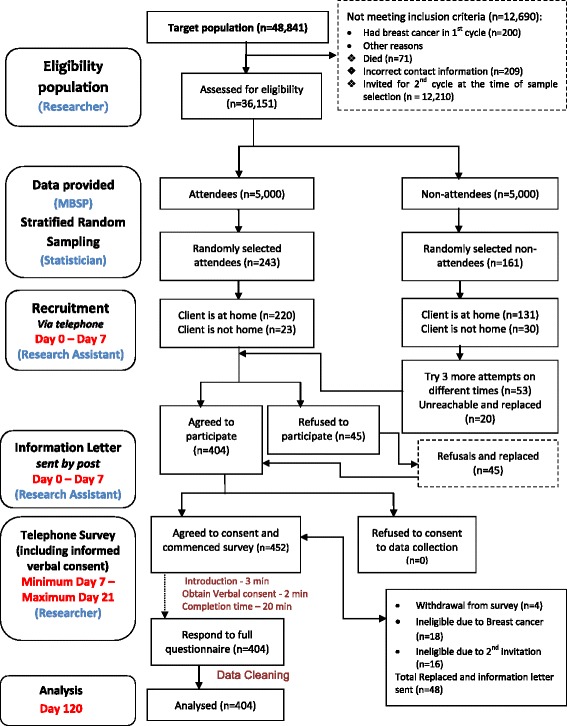
This cross-sectional survey enrolled Maltese women (n = 404) ages 50 to 60 at the time of their first screening invitation, invited to the National Breast Screening Programme by stratified random sampling, with no personal history of BC. Participants responded to a 121-item questionnaire by telephone between June-September 2015. Data were analyzed using descriptive statistics, chi-square tests and logistic regression.
There is high awareness of BC signs and symptoms among Maltese women (>80% agreement for 7 out of 8 signs), but wide variation about causation (e.g., germ or virus: 38.6% 'agree', 30.7% 'disagree'). 'Fear' was the key reason for non-attendance to first invitation (41%, n = 66) and was statistically significant across all subscale items (p < 0.05). Most items within HBM constructs (perceived barriers; cues to action; self-efficacy) were significantly associated with first invitation to the National Breast Screening Programme, such as fear of result (χ2 = 12.0, p = 0.017) and life problems were considered greater than getting mammography (χ2 = 38.8, p = 0.000). Items within CSM constructs of Illness Representation (BC causes; cyclical cancer timeline; consequences) were also significantly associated, such as BC was considered to be life-changing (χ2 = 18.0, p = 0.000) with serious financial consequences (χ2 = 13.3, p = 0.004). There were no significant associations for socio-demographic or health status variables with uptake, except for family income (χ2 = 9.7, p = 0.047). Logistic regression analyses showed that HBM constructs, in particular perceived barriers, were the strongest predictors of non-attendance to first invitation throughout the analyses (p < 0.05). However, the inclusion of illness representation dimensions improved the model accuracy to predict non-attendance when compared to HBM alone (65% vs 38.8%).
Interventions should be based on theory including HBM and CSM constructs, and should target first BS uptake and specific barriers to reduce disparities and increase BS uptake in Malta.
女性对乳腺癌(BC)和乳腺筛查(BS)的认知及观念是乳腺筛查行为的重要预测因素。本研究运用疾病自我调节的健康信念模型(HBM)和常识模型(CSM),探讨马耳他地区与乳腺筛查接受情况相关的因素,并确定首次筛查接受情况的最重要预测因素。
这项横断面调查纳入了404名年龄在50至60岁之间、首次收到筛查邀请时无乳腺癌个人史、通过分层随机抽样被邀请参加国家乳腺筛查计划的马耳他女性。2015年6月至9月期间,参与者通过电话回答了一份包含121个条目的问卷。数据采用描述性统计、卡方检验和逻辑回归进行分析。
马耳他女性对乳腺癌的体征和症状认知度较高(8种体征中有7种的认同率>80%),但在病因方面存在较大差异(例如,细菌或病毒:38.6%“同意”,30.7%“不同意”)。“恐惧”是未接受首次邀请的主要原因(41%,n = 66),并且在所有子量表项目中具有统计学意义(p < 0.05)。HBM模型的大多数构建要素(感知障碍;行动线索;自我效能感)与参加国家乳腺筛查计划的首次邀请显著相关,例如对检查结果的恐惧(χ2 = 12.0,p = 0.017)以及认为生活问题比进行乳房X光检查更重要(χ2 = 38.8,p = 0.000)。CSM模型中疾病表征(乳腺癌病因;癌症周期性时间线;后果)的构建要素也显著相关,例如认为乳腺癌会改变生活(χ2 = 18.0,p = 0.000)且会带来严重经济后果(χ2 = 13.3,p = 0.004)。除家庭收入外(χ2 = 9.7,p = 0.047),社会人口统计学或健康状况变量与接受情况无显著关联。逻辑回归分析表明,在整个分析过程中,HBM模型构建要素,尤其是感知障碍,是未接受首次邀请的最强预测因素(p < 0.05)。然而,与单独使用HBM模型相比,纳入疾病表征维度可提高预测未接受情况的模型准确性(65%对38.8%)。
干预措施应基于包括HBM和CSM模型构建要素在内的理论,并应针对首次乳腺筛查接受情况及特定障碍,以减少差异并提高马耳他地区的乳腺筛查接受率。